
Kubernetes AI Agent: Intelligent Cluster Management Through Multi-Agent Orchestration
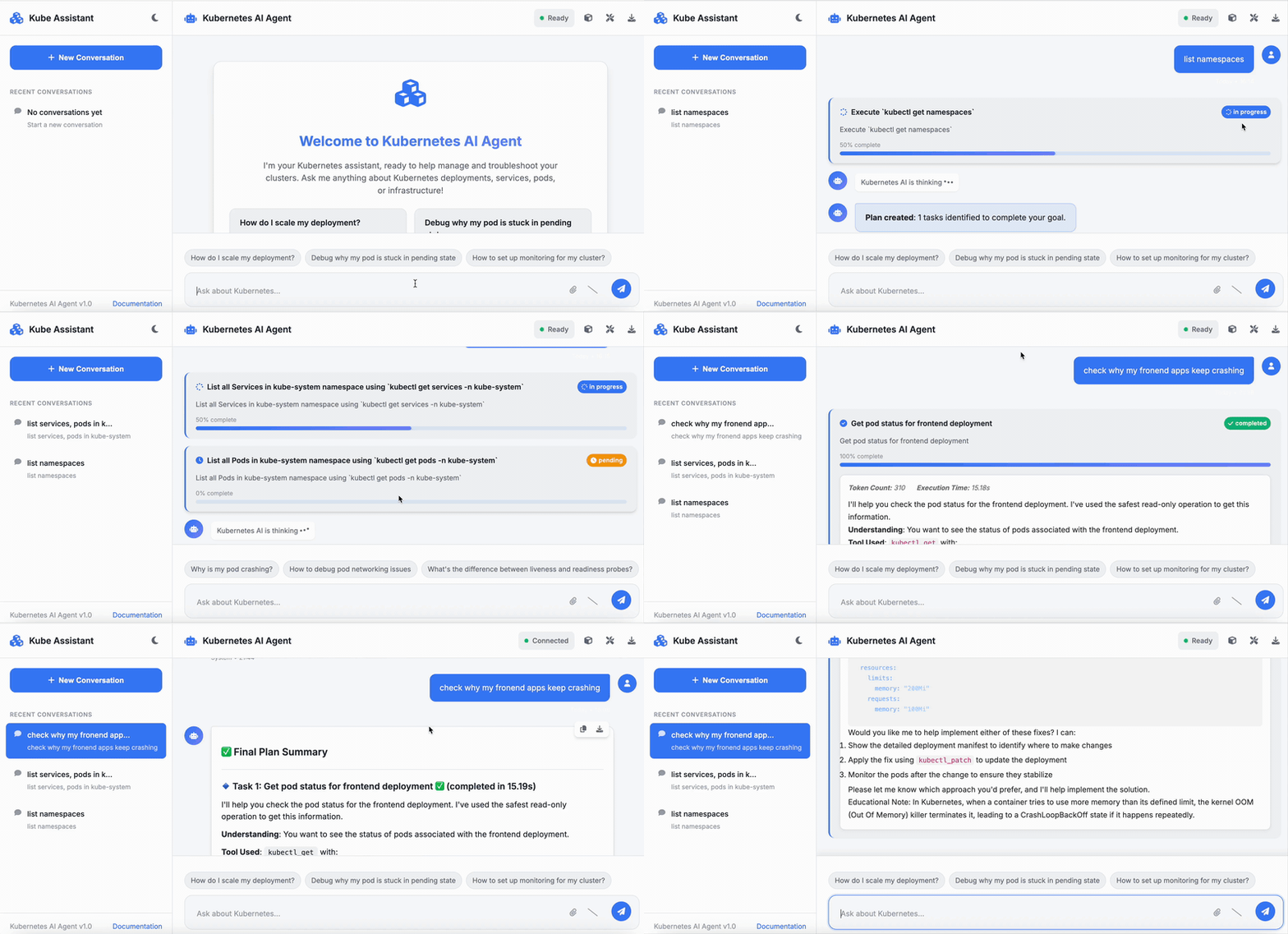
Revolutionizing Kubernetes Operations Through AI-Powered Assistance
graph LR
    A["👤 Human Operators"] --> B["🧠 Kubernetes<br>AI Agent"]
    B --> C["☸️ Kubernetes<br>Clusters"]

    subgraph "❌ Kubernetes Challenges"
    D["🔍 Complex Troubleshooting"]
    E["📊 Resource Optimization"]
    F["🔧 Maintenance Overhead"]
    G["🛡️ Security Management"]
    end

    subgraph "✅ Agent Benefits"
    H["⚡ Rapid Problem Resolution"]
    I["🚀 Automated Operations"]
    J["📈 Optimized Performance"]
    K["🛠️ Proactive Management"]
    end

    A --- D & E & F & G
    B --- H & I & J & K

    style A fill:#ff6b6b,color:#fff,stroke:#333,stroke-width:2px
    style B fill:#4d96ff,color:#fff,stroke:#333,stroke-width:2px
    style C fill:#6bcb77,color:#fff,stroke:#333,stroke-width:2px
The Challenge
In today’s rapidly evolving cloud-native landscape, organizations face significant challenges managing increasingly complex Kubernetes environments:
- Operational Complexity: Troubleshooting requires deep expertise across multiple layers
- Resource Intensive: Manual monitoring and optimization consume valuable engineering time
- Security Concerns: Constantly evolving security threats require vigilant management
- Scaling Difficulties: Managing multiple clusters across environments strains DevOps teams
These challenges create bottlenecks in operational efficiency, slowing down innovation and increasing the risk of costly outages or security incidents.
flowchart TD
A["👤 Kubernetes Operators"] -->|"⏱️ Manual Operations"| B["⌛ Time-Consuming Tasks"]
A -->|"🔧 Limited Automation"| C["🧩 High Complexity"]
A -->|"👨💻 Expertise Gaps"| D["💰 Resource Constraints"]
A -->|"⚠️ Human Error"| E["🐞 Reliability Issues"]
B & C & D & E --> F["🚧 Operational<br>Bottlenecks"]
F --> G["⬇️ Reduced<br>Innovation"]
style A fill:#f8a5c2,color:#333,stroke:#333,stroke-width:2px
style B fill:#f7d794,color:#333,stroke:#333,stroke-width:1px
style C fill:#f7d794,color:#333,stroke:#333,stroke-width:1px
style D fill:#f7d794,color:#333,stroke:#333,stroke-width:1px
style E fill:#f7d794,color:#333,stroke:#333,stroke-width:1px
style F fill:#778beb,color:#fff,stroke:#333,stroke-width:2px
style G fill:#ea8685,color:#fff,stroke:#333,stroke-width:2px
Solution: Kubernetes AI Agent
Our Kubernetes AI Agent represents a paradigm shift in cluster management through an intelligent, multi-agent system that combines specialized AI capabilities with comprehensive Kubernetes integrations.
Core Architecture
The Kubernetes AI Agent is built on a modular architecture with specialized components working in harmony:
graph TD
    A["👤 Human Input"] --> B["🧠 Kubernetes AI Agent"]
    B --> C["☸️ Kubernetes Clusters"]

    subgraph "🤖 AI Agent System"
    D["🔍 Core<br>Agent"] ---|"Orchestrates"| E["🔄 Planning<br>Engine"]
    E ---|"Coordinates"| F["⚙️ Tool<br>Registry"]
    D ---|"Leverages"| G["💾 Memory<br>System"]
    G ---|"Enhances"| D
    end

    D -..->|"Analyzes"| D1["🧠 Conversation<br>Manager"]
    D -..->|"Coordinates"| D2["🛡️ Guardrail<br>System"]

    E -..->|"Manages"| E1["📝 Task<br>Planner"]
    E -..->|"Builds"| E2["🚀 Task<br>Executor"]
    E -..->|"Improves"| E3["🔄 Reflection<br>Engine"]

    F -..->|"Contains"| F1["🧰 Kubectl<br>Tools"]
    F -..->|"Contains"| F2["📦 Pod<br>Tools"]
    F -..->|"Contains"| F3["🚢 Deployment<br>Tools"]

    G -..->|"Stores"| G1["📊 Short-Term<br>Memory"]
    G -..->|"Stores"| G2["📚 Long-Term<br>Memory"]

    style A fill:#f8a5c2,color:#333,stroke:#333,stroke-width:2px
    style B fill:#a3d8f4,color:#333,stroke:#333,stroke-width:2px
    style C fill:#b5ead7,color:#333,stroke:#333,stroke-width:2px

    style D fill:#ffd3b6,color:#333,stroke:#333,stroke-width:1px
    style E fill:#c7ceea,color:#333,stroke:#333,stroke-width:1px
    style F fill:#ff9aa2,color:#333,stroke:#333,stroke-width:1px
    style G fill:#a8e6cf,color:#333,stroke:#333,stroke-width:1px
Key Components
1. Kubernetes Agent Core
The central orchestrator that processes user inputs, plans responses, and manages the overall interaction flow.
Capabilities:
- Natural language understanding for Kubernetes operations
- Context-aware response planning
- Multi-step reasoning for complex Kubernetes scenarios
- Safe operation through guardrail systems
2. Planning Engine
The strategic backbone of the system that breaks down complex cluster management tasks into executable operations.
Components:
- Task Planner: Decomposes goals into atomic Kubernetes operations
- Task Executor: Safely runs operations against cluster resources
- Reflection Engine: Learns from execution results to improve future operations
3. Tool Registry
An extensive collection of specialized Kubernetes tools, each designed for specific cluster operations.
Tool Categories:
- Kubectl Tools: General Kubernetes resource management
- Pod Tools: Pod-specific operations and troubleshooting
- Deployment Tools: Managing application deployments
- Service Tools: Network and service configuration
- Logging Tools: Log analysis and troubleshooting
- Node Tools: Cluster node management
- Namespace Tools: Namespace operations
- Config Tools: ConfigMap and Secret management
- Resource Tools: General resource operations
4. Memory System
A sophisticated data storage and retrieval system that retains contextual information across interactions.
Components:
- Short-Term Memory: Maintains conversation state and recent operations
- Long-Term Memory: Stores persistent knowledge about clusters and operations
- Vectorized Storage: Enables semantic search for relevant past experiences
5. Guardrail System
A comprehensive safety layer that ensures all operations adhere to security policies and best practices.
Core Protections:
- Input Validation: Screens user requests for potentially harmful operations
- Action Validation: Verifies Kubernetes operations against permission matrices
- Output Filtering: Ensures responses don’t contain sensitive information
- Risk Assessment: Evaluates operations for potential impact on cluster stability
Advanced Features
1. Conversation Management
The agent maintains a cohesive conversation flow, allowing users to engage in natural dialogue about their Kubernetes environments.
sequenceDiagram
    participant User
    participant Agent
    participant Planner
    participant Tools
    participant Cluster

    User->>Agent: "Check why my frontend pods keep crashing"
    Agent->>Planner: Create investigation plan
    Planner->>Agent: Return multi-step analysis plan
    Agent->>Tools: Execute pod inspection tools
    Tools->>Cluster: Get pod status and logs
    Cluster->>Tools: Return diagnostic information
    Tools->>Agent: Return analysis results
    Agent->>User: "Your frontend pods are crashing due to memory limits. I found OOM killer events in the logs."
    User->>Agent: "How can I fix this?"
    Agent->>Planner: Create resolution plan
    Planner->>Agent: Return resource adjustment plan
    Agent->>Tools: Prepare deployment modification
    Tools->>Agent: Return update proposal
    Agent->>User: "I recommend increasing memory limits to 512Mi based on usage patterns. Would you like me to make this change?"
2. Multi-Stage Planning
For complex operations, the agent employs a sophisticated planning process to ensure safe and effective execution.
Planning Phases:
- Assessment: Evaluate the current state of the cluster resources
- Planning: Develop a strategy for accomplishing the user’s goal
- Execution: Safely implement the plan with proper validations
- Verification: Confirm that changes achieved the desired outcome
3. Tool Integration Methodology
The agent seamlessly integrates with Kubernetes through a well-defined tool architecture:
flowchart TD
    A["👤 User Request"] --> B["🧠 Agent Processing"]
    B --> C["📝 Task Planning"]
    C --> D["🧰 Tool Selection"]
    D --> E["⚙️ Command Generation"]
    E --> F["🛡️ Guardrail Validation"]
    F --> G["☸️ Kubernetes Execution"]
    G --> H["📊 Result Analysis"]
    H --> I["📋 Response Formatting"]
    I --> J["👤 User Response"]

    style A fill:#f8a5c2,color:#333,stroke:#333,stroke-width:1px
    style B fill:#a3d8f4,color:#333,stroke:#333,stroke-width:1px
    style C fill:#c7ceea,color:#333,stroke:#333,stroke-width:1px
    style D fill:#ff9aa2,color:#333,stroke:#333,stroke-width:1px
    style E fill:#ffb7b2,color:#333,stroke:#333,stroke-width:1px
    style F fill:#ffdac1,color:#333,stroke:#333,stroke-width:1px
    style G fill:#e2f0cb,color:#333,stroke:#333,stroke-width:1px
    style H fill:#b5ead7,color:#333,stroke:#333,stroke-width:1px
    style I fill:#c7ceea,color:#333,stroke:#333,stroke-width:1px
    style J fill:#f8a5c2,color:#333,stroke:#333,stroke-width:1px

    linkStyle default stroke:#999,stroke-width:1px,fill:none;
4. Real-Time Feedback Loop
The system provides real-time updates during long-running operations through WebSocket connections:
WebSocket Events:
- Agent thinking indicators
- Task status updates
- Plan progression notifications
- Error alerts and warnings
- Completion confirmations
5. Learning and Improvement
The Reflection Engine continuously analyzes operation outcomes to enhance future performance:
Reflection Capabilities:
- Identifying successful operation patterns
- Learning from errors and edge cases
- Building a knowledge base of cluster-specific insights
- Adapting approaches based on environmental differences
Safety and Governance
Robust Guardrail System
The Kubernetes AI Agent incorporates a multi-layered guardrail system to ensure safe and controlled cluster operations:
graph TD
    A["🧠 Agent Operations"] --> B["🛡️ Guardrail System"]
    B --> C["☸️ Kubernetes Clusters"]

    subgraph "🛡️ Guardrail Layers"
    D["🔍 Input<br>Validation"] ---|"Filters"| E["⚙️ Action<br>Validation"]
    E ---|"Controls"| F["💬 Output<br>Filtering"]
    end

    D -..->|"Checks"| D1["🚫 Harmful<br>Commands"]
    D -..->|"Prevents"| D2["❌ Injection<br>Attempts"]

    E -..->|"Enforces"| E1["🔑 Permission<br>Levels"]
    E -..->|"Protects"| E2["⚠️ Critical<br>Resources"]
    E -..->|"Analyzes"| E3["⚖️ Operation<br>Risks"]

    F -..->|"Removes"| F1["🔒 Sensitive<br>Information"]
    F -..->|"Sanitizes"| F2["🧹 Credentials<br>& Tokens"]

    style A fill:#a3d8f4,color:#333,stroke:#333,stroke-width:2px
    style B fill:#ff9aa2,color:#333,stroke:#333,stroke-width:2px
    style C fill:#b5ead7,color:#333,stroke:#333,stroke-width:2px

    style D fill:#ffd3b6,color:#333,stroke:#333,stroke-width:1px
    style E fill:#c7ceea,color:#333,stroke:#333,stroke-width:1px
    style F fill:#a8e6cf,color:#333,stroke:#333,stroke-width:1px

    style D1 fill:#ffd3b6,color:#333,stroke:#333,stroke-width:1px,stroke-dasharray: 3 3
    style D2 fill:#ffd3b6,color:#333,stroke:#333,stroke-width:1px,stroke-dasharray: 3 3

    style E1 fill:#c7ceea,color:#333,stroke:#333,stroke-width:1px,stroke-dasharray: 3 3
    style E2 fill:#c7ceea,color:#333,stroke:#333,stroke-width:1px,stroke-dasharray: 3 3
    style E3 fill:#c7ceea,color:#333,stroke:#333,stroke-width:1px,stroke-dasharray: 3 3

    style F1 fill:#a8e6cf,color:#333,stroke:#333,stroke-width:1px,stroke-dasharray: 3 3
    style F2 fill:#a8e6cf,color:#333,stroke:#333,stroke-width:1px,stroke-dasharray: 3 3
Guardrail Layers:
- Input Validation
- Screens user requests for potentially harmful commands
- Blocks command injection attempts
- Prevents access to restricted system areas
- Action Validation
- Enforces role-based access controls
- Protects critical namespace resources (kube-system, etc.)
- Performs risk assessment for operations
- Requires explicit confirmation for high-risk actions
- Output Filtering
- Prevents exposure of sensitive information
- Sanitizes credentials and tokens
- Ensures compliance with data protection policies
Permission Framework:
The agent implements a graduated permission model:
- Viewer: Read-only operations (get, list, describe)
- Editor: Basic modifications (create, update, apply)
- Admin: Full control, including dangerous operations (delete, exec)
Risk Assessment:
Operations are classified by risk level:
- Low: Safe, non-destructive operations
- Medium: Operations with limited potential impact
- High: Operations that could affect stability or security
Technical Architecture
System Components
The Kubernetes AI Agent employs a modern, scalable architecture:
┌─────────────────────────────────────────────────────────────────────┐
│                         User Interface Layer                        │
└───────────────────────────────────┬─────────────────────────────────┘
                                    │
┌───────────────────────────────────┼─────────────────────────────────┐
│                      API Gateway & Websockets                       │
└───────────────────────────────────┬─────────────────────────────────┘
                                    │
┌───────────────────────────────────┼─────────────────────────────────┐
│                      Core Services & Orchestration                  │
│   ┌───────────┐   ┌───────────┐   ┌───────────┐   ┌───────────┐     │
│   │ Agent Core│   │  Planning │   │   Tools   │   │ Guardrails│     │
│   └───────────┘   └───────────┘   └───────────┘   └───────────┘     │
└─────────────────────────────────────────────────────────────────────┘
                                    │
┌───────────────────────────────────┼─────────────────────────────────┐
│                         Memory & Storage                            │
└─────────────────────────────────────────────────────────────────────┘
Service Communication:
- RESTful APIs for synchronous operations
- WebSockets for real-time updates
- Redis for short-term memory
- Qdrant for vector-based long-term memory
Technology Stack:
- FastAPI for high-performance API endpoints
- WebSockets for real-time client communications
- LLM integration for natural language understanding
- Kubernetes client libraries for cluster interaction
- Vector databases for semantic knowledge retrieval
Request Flow (Sample)
sequenceDiagram
    participant Client as MCP Client (LLM/AI Agent)
    participant Server as KAA MCP Server
    participant Validator as MCP Validator
    participant Registry as MCP Tool Registry
    participant Discovery as MCP Tool Discovery
    participant Tools as MCP Server Tools
    participant Store as MCP Message Store
    participant External as External MCP Tool Registry
    participant K8s as Kubernetes API

    Note over Client,K8s: Initial Connection & Tool Discovery Phase

    Client->>+Server: Connect to MCP Server
    Server->>+Discovery: Request available tools
    Discovery->>+Registry: Get registered tool schemas
    Registry-->>-Discovery: Return tool definitions
    Discovery->>+External: Query external tools (optional)
    External-->>-Discovery: Return external tool definitions
    Discovery-->>-Server: Consolidated tool list
    Server-->>-Client: Tool discovery response (available operations)

    Note over Client,K8s: Tool Execution Phase

    Client->>+Server: Send MCP tool execution request
    Server->>+Store: Log incoming request
    Store-->>-Server: Request logged

    Server->>+Validator: Validate MCP request format & permissions
    Validator-->>-Server: Validation result

    alt Invalid Request
        Server-->>Client: Error response
    else Valid Request
        Server->>+Registry: Route request to appropriate tool
        Registry->>+Tools: Execute tool operation

        alt Local K8s Operation
            Tools->>+K8s: Make Kubernetes API call
            K8s-->>-Tools: K8s API response
        else Complex Operation
            Tools->>+External: Call external MCP tool
            External-->>-Tools: External tool response
        end

        Tools-->>-Registry: Operation result
        Registry-->>-Server: Tool execution result

        Server->>+Store: Log execution & response
        Store-->>-Server: Response logged

        Server-->>-Client: MCP formatted response
    end

    Note over Client,K8s: Reflection & Learning Phase

    Client->>+Server: Request execution feedback
    Server->>+Store: Retrieve execution history
    Store-->>-Server: Historical execution data
    Server-->>-Client: Execution feedback

    opt Learning Loop
        Client->>+Server: Send execution feedback
        Server->>+Store: Store feedback for learning
        Store-->>-Server: Feedback stored
        Server->>Server: Update learning models
        Server-->>-Client: Feedback acknowledgement
    end
Use Cases
The Kubernetes AI Agent excels in diverse operational scenarios:
1. Diagnostic Troubleshooting
When pods or services experience issues, the agent can:
- Analyze logs and events across multiple resources
- Identify root causes through pattern recognition
- Suggest targeted remediation steps
- Execute fixes with proper safeguards
2. Resource Optimization
To improve cluster efficiency, the agent can:
- Analyze resource utilization patterns
- Recommend right-sizing for deployments
- Identify underutilized or over-provisioned components
- Implement resource quotas and limits
3. Security Management
For maintaining cluster security, the agent can:
- Audit role-based access controls
- Identify exposed secrets or insecure configurations
- Apply security best practices
- Validate compliance with security standards
4. Operational Assistance
In day-to-day operations, the agent can:
- Draft YAML manifests for new resources
- Explain complex Kubernetes concepts
- Provide step-by-step guidance for operations
- Convert between imperative and declarative approaches
Business Impact
The Kubernetes AI Agent delivers transformative benefits across multiple dimensions:
graph LR
A["🧠 Kubernetes<br>AI Agent"] --> B["⚡ Operational<br>Efficiency"]
A --> C["👨💻 DevOps<br>Productivity"]
A --> D["🛡️ Enhanced<br>Security"]
A --> E["🧠 Knowledge<br>Management"]
A --> F["⏱️ Accelerated<br>Problem Resolution"]
B --> B1["📉 67% Reduction in Manual Tasks"]
C --> C1["📈 3x Engineer Productivity"]
D --> D1["🔒 Consistent Security Enforcement"]
E --> E1["📚 Centralized Cluster Knowledge"]
F --> F1["⚡ 75% Faster Incident Resolution"]
style A fill:#4d96ff,color:#fff,stroke:#333,stroke-width:2px,rx:10px,ry:10px
style B fill:#ff9a8b,color:#333,stroke:#333,stroke-width:1px,rx:5px,ry:5px
style C fill:#ffd3b6,color:#333,stroke:#333,stroke-width:1px,rx:5px,ry:5px
style D fill:#a8e6cf,color:#333,stroke:#333,stroke-width:1px,rx:5px,ry:5px
style E fill:#d3b6ff,color:#333,stroke:#333,stroke-width:1px,rx:5px,ry:5px
style F fill:#ffb6b9,color:#333,stroke:#333,stroke-width:1px,rx:5px,ry:5px
style B1 fill:#ff9a8b,color:#333,stroke:#333,stroke-width:1px,stroke-dasharray: 3 3,rx:5px,ry:5px
style C1 fill:#ffd3b6,color:#333,stroke:#333,stroke-width:1px,stroke-dasharray: 3 3,rx:5px,ry:5px
style D1 fill:#a8e6cf,color:#333,stroke:#333,stroke-width:1px,stroke-dasharray: 3 3,rx:5px,ry:5px
style E1 fill:#d3b6ff,color:#333,stroke:#333,stroke-width:1px,stroke-dasharray: 3 3,rx:5px,ry:5px
style F1 fill:#ffb6b9,color:#333,stroke:#333,stroke-width:1px,stroke-dasharray: 3 3,rx:5px,ry:5px
- Operational Efficiency: Reduce manual Kubernetes management tasks by up to 67%
- Engineer Productivity: Enable engineers to focus on innovation rather than maintenance
- Enhanced Security: Consistent application of security best practices
- Knowledge Management: Centralized Kubernetes expertise accessible to all team members
- Accelerated Problem Resolution: Reduce mean time to resolution by up to 75%
This intelligent assistant doesn’t just automate Kubernetes tasks—it transforms how organizations manage cloud-native infrastructure through a secure, efficient, and knowledgeable AI partner.