
AI SRE: When the Agent Doesn’t Just Suggest the Fix, It Applies It
An alert fires at an hour nobody wants to be awake for. By the time a human on-call engineer has logged in and opened a dashboard, an agent has already correlated the telemetry, formed a root-cause hypothesis, and, in a growing number of production environments, already executed the fix. The interesting engineering question is no longer whether this works. It is what happens the first time the agent is confidently wrong.
From AIOps to AI SRE: What Actually Changed
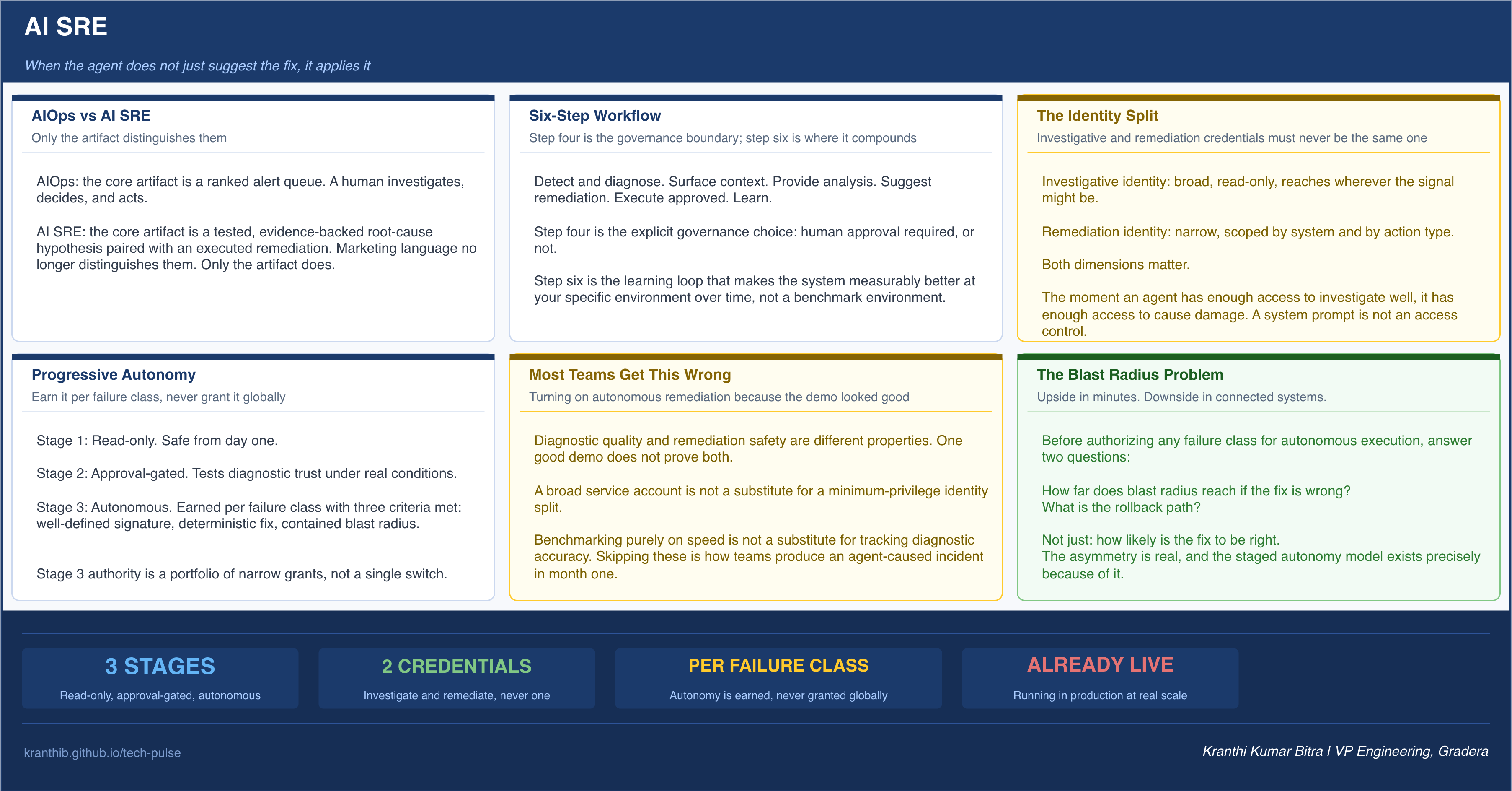
For years, operations teams have used machine learning to reduce alert noise: anomaly detection, alert correlation, automated grouping of related pages into a single incident. This category, generally called AIOps, made the human responder’s job faster without changing who was actually doing the work. The agent surfaced information, ranked it, and occasionally guessed at a cause. A person still investigated, decided, and acted, and the actual judgment involved in resolving the incident remained entirely human from start to finish.
What has changed recently, and changed quickly, is the emergence of a genuinely different category sitting on top of that foundation: agents that do not stop at surfacing information, but actually investigate the incident end to end and, within defined boundaries, execute the remediation themselves. Multiple major observability and cloud platforms have shipped exactly this capability, described consistently across vendors as a shift from advisory dashboards to agents that take actions in the production environment directly, connecting to existing observability tooling, cloud infrastructure, code repositories, and communication platforms to perform root cause analysis in minutes rather than hours.
The distinction matters enough that it is worth stating plainly and early, because the marketing language around both categories has converged even though the underlying capability has not, and a buyer relying on product pages alone will struggle to tell the two apart. If a platform’s core artifact is a cleaner, better-grouped alert queue, that is AIOps with newer branding, however fluent the natural-language interface on top of it looks. If a platform’s core artifact is a tested, evidence-backed root-cause hypothesis paired with an executed or executable remediation action, that is the new category, generally referred to as AI SRE, and it is a meaningfully different engineering commitment to make.
Adoption of the genuine version has moved from pilot to production scale faster than most operations capabilities typically do. One major cloud provider’s SRE agent, built around a Model Context Protocol first architecture connecting to monitoring, ticketing, and version control tools, is now running across more than a thousand internal agent deployments at that same provider, credited with mitigating tens of thousands of incidents and saving a comparable number of engineering hours. A major observability platform’s equivalent agent runs tens of thousands of investigations, with organizations reporting measurable reductions in time to resolution. A large search and cloud company has documented building an agentic orchestration layer specifically for its own incident management process, aimed at the parts of an incident that are least enjoyable for a human to do at speed: correlating communication channels, consolidating context, and forming an initial hypothesis before a human has even finished joining the call.
This is not a future capability being described in a roadmap. It is running in production, in scale, at organizations whose operational discipline is generally trusted, across more than one independently built implementation reaching the same broad conclusions about how the workflow should be shaped. That is precisely why the governance questions underneath it deserve more attention than they are currently getting from most engineering teams outside the small set of companies building these systems first.
The Six-Step Workflow: How an AI SRE Actually Operates
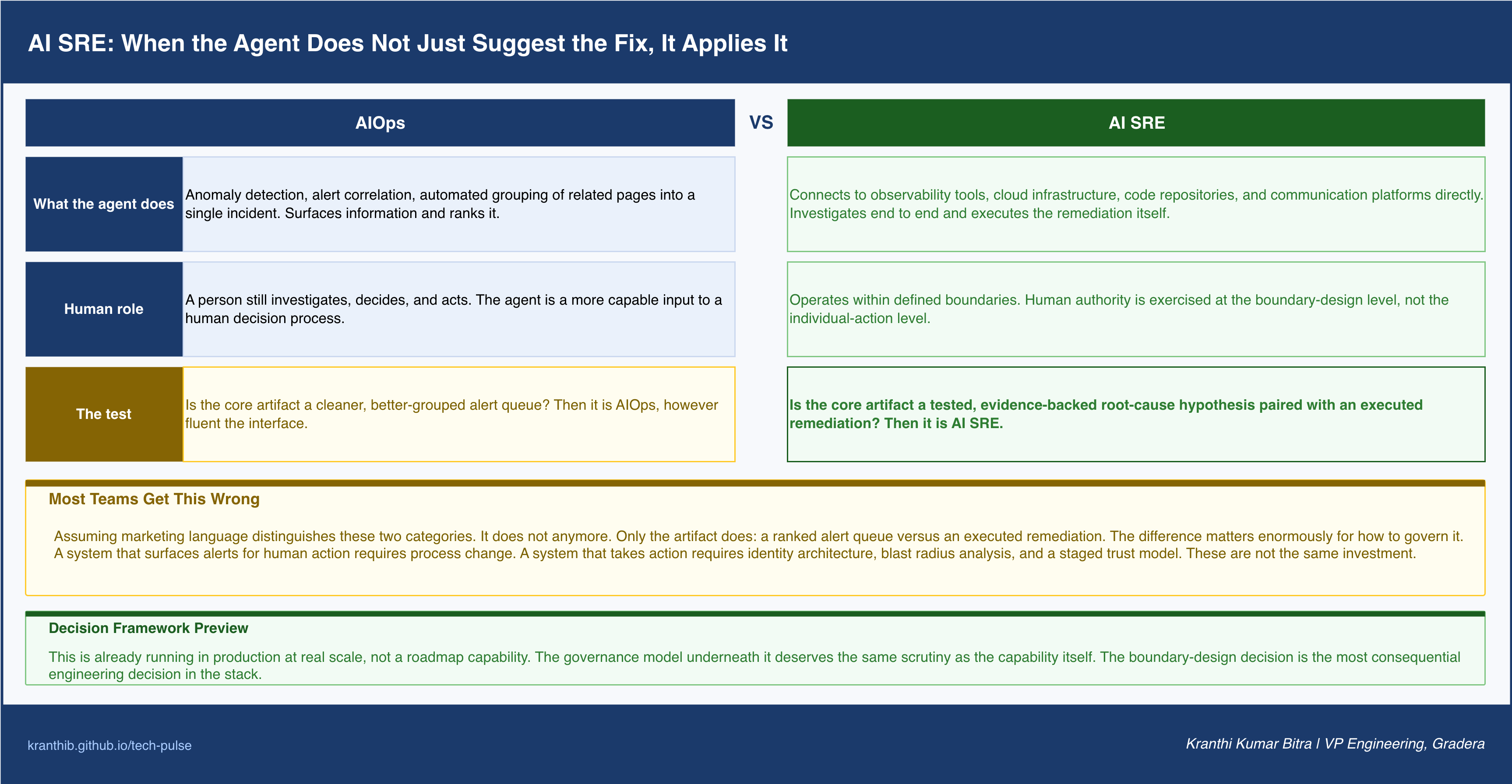
Stripped of vendor-specific branding, the AI SRE workflow that has emerged across the major implementations follows a remarkably consistent shape, and understanding this shape is more useful for engineering planning than comparing any two specific products against each other feature by feature. It is also useful precisely because the consistency across independently built systems suggests this is closer to a natural shape for the problem than a shape any single vendor invented.
Detect and diagnose autonomously. The agent picks up the alert the same way a human on-call engineer would, but begins correlating telemetry, logs, traces, and recent deployment history immediately and in parallel, without the delay of a human first orienting themselves to what changed.
Surface key context. Rather than presenting a wall of raw telemetry, the agent synthesizes what it found into the specific signals that matter: which service degraded, what changed immediately before the degradation, which downstream dependencies are affected, and what similar past incidents looked like.
Provide analysis. The agent forms and states an explicit root-cause hypothesis, not just a correlation. This step is where the genuine version of this category separates most clearly from alert-grouping tooling: a hypothesis is a falsifiable claim about cause, not a cluster of related-looking alerts.
Suggest remediation actions. The agent proposes a specific fix, tied to the specific hypothesis, rather than a generic runbook link. This is also the point where the workflow, in every credible implementation, includes an explicit decision about whether the proposed action requires human approval before proceeding.
Execute approved actions automatically. For remediation classes that have been explicitly approved for autonomous execution, the agent proceeds without waiting for a human. For everything else, it stages the action and waits.
Learn from every incident. The outcome, whether the remediation worked, whether it needed to be rolled back, whether the human approver corrected the hypothesis, feeds back into the system, generating what several implementations describe as reusable playbooks that improve the quality of future response for that specific failure signature.
The operational learning step is the one most likely to be underappreciated by teams evaluating this category for the first time. It is the architectural difference between a system that behaves the same way on its hundredth incident as it did on its first, and one that is measurably better at the specific failure modes your specific production environment actually produces. A generic foundation model with no operational learning loop can still perform steps one through five reasonably well on a first encounter with a novel failure signature, drawing on broad training rather than specific history. What it cannot do without the learning loop is get measurably better at your environment’s particular recurring failure patterns over time, the same way a human engineer who has been on your team for two years is better at diagnosing your specific systems than an equally talented engineer on their first week, not because of raw skill but because of accumulated, environment-specific pattern recognition.
The Identity Split: Why Investigation and Remediation Need Separate Credentials
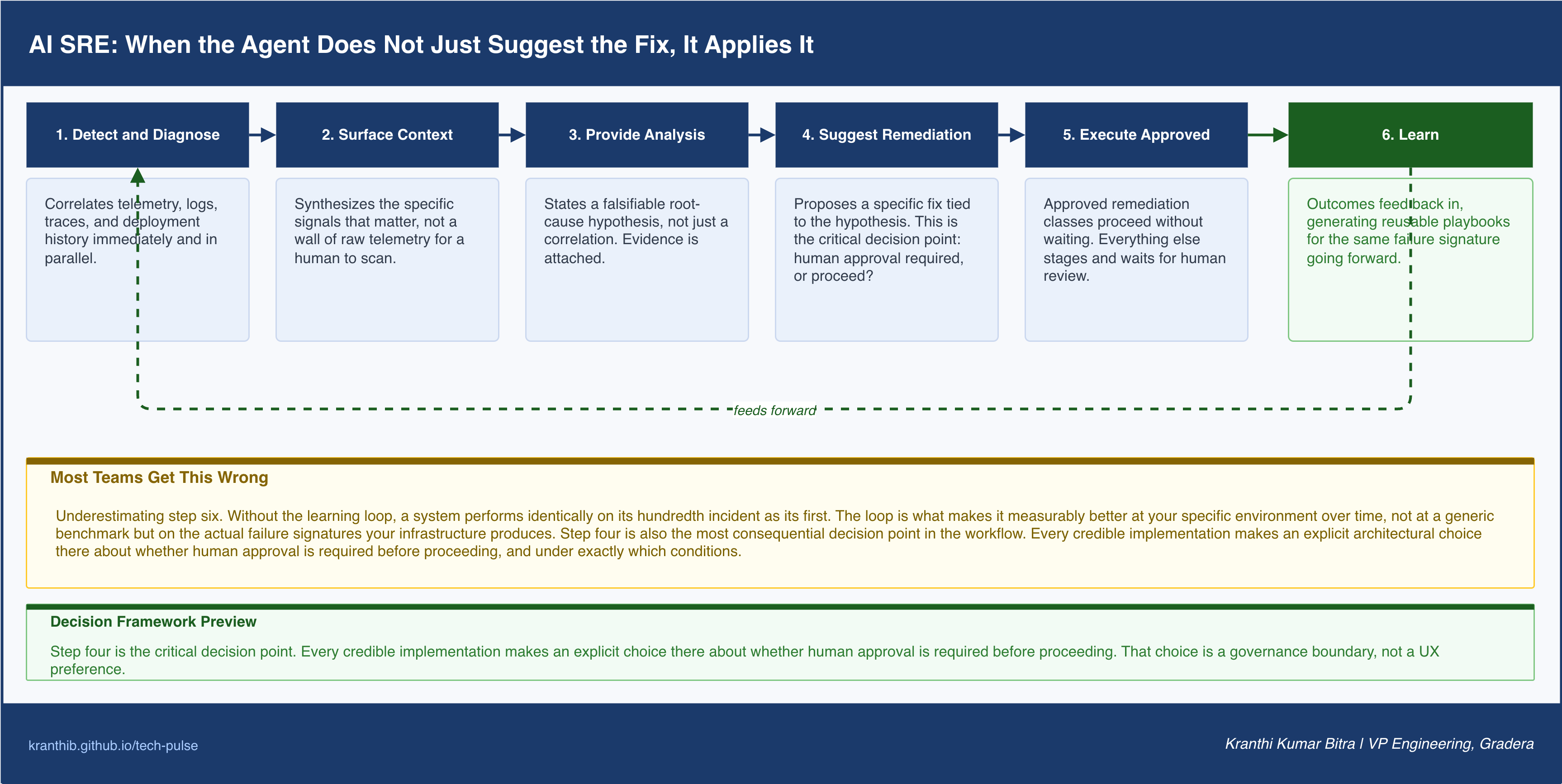
The governance conversation around AI SRE has converged quickly on a single architectural principle, repeated consistently enough across independent sources that it is worth treating as close to settled practice rather than one vendor’s opinion: the credentials an agent uses to investigate an incident should not be the same credentials it uses to act on one.
The reasoning is straightforward once stated, though it is easy to miss when designing the system for the first time. An agent that can read telemetry, logs, and configuration state across your production environment needs broad, low-risk access, the kind that is genuinely useful precisely because it spans many systems. An agent that can restart services, roll back deployments, or modify infrastructure state needs narrow, high-risk access, scoped as tightly as possible to the smallest blast radius that still lets it do its job. Collapsing these into a single credential means that the moment you grant an agent enough access to investigate effectively, you have also, often without deliberately deciding to, granted it enough access to cause damage well beyond the scope any single incident should require.
This is not simply a best practice borrowed from human access control and applied to agents by analogy. It is a response to a specific new failure mode that only exists once an agent can both diagnose and act: the collapse of the boundary between detection and remediation. When a human investigates an incident, there is a natural pause between forming a hypothesis and taking action, a pause where judgment, hesitation, or a second opinion can intervene. When an agent both investigates and remediates within the same execution, that pause can disappear entirely unless it is deliberately engineered back in through the credential boundary itself, not through a prompt instruction asking the agent to pause and think it over.
Practically, this means treating the identity architecture for an AI SRE deployment with the same rigor a security team would apply to any privileged access system: separate service identities for investigative and remediation roles, the smallest useful operational scope for each agent rather than blanket infrastructure access, and an explicit, logged approval boundary at the exact point where the agent’s role shifts from observer to actor.
There is a further nuance worth naming, because it is easy to get the identity split half right. Scoping the remediation identity narrowly by system, restricting it to the specific service or cluster it is allowed to modify, is necessary but not sufficient on its own. The identity also needs to be scoped by action type, distinguishing a credential that can restart a workload from one that can modify network policy from one that can alter a database schema, because these are not equivalent risks even when they happen to target the same service. A remediation identity broad enough to perform any operational action against a narrowly scoped set of systems still concentrates too much capability in a single credential; the failure mode simply shifts from cross-service blast radius to cross-action blast radius within a single service, which is a smaller but still real version of the same underlying problem. The organizations doing this well treat the remediation identity as a matrix of system scope and action type, granting cells in that matrix individually rather than granting broad access along either dimension alone.
This level of granularity has an organizational cost that is worth naming honestly. Building and maintaining a matrix of narrowly scoped remediation identities is more engineering and operational overhead than issuing a single broad service account and trusting the agent’s reasoning to behave conservatively within it. That overhead is the actual price of doing autonomous remediation safely, and teams that skip it are not finding a more efficient path, they are deferring a cost that shows up later, at a moment and a scale of their own choosing.
The Progressive Autonomy Model: Staged Trust Gates
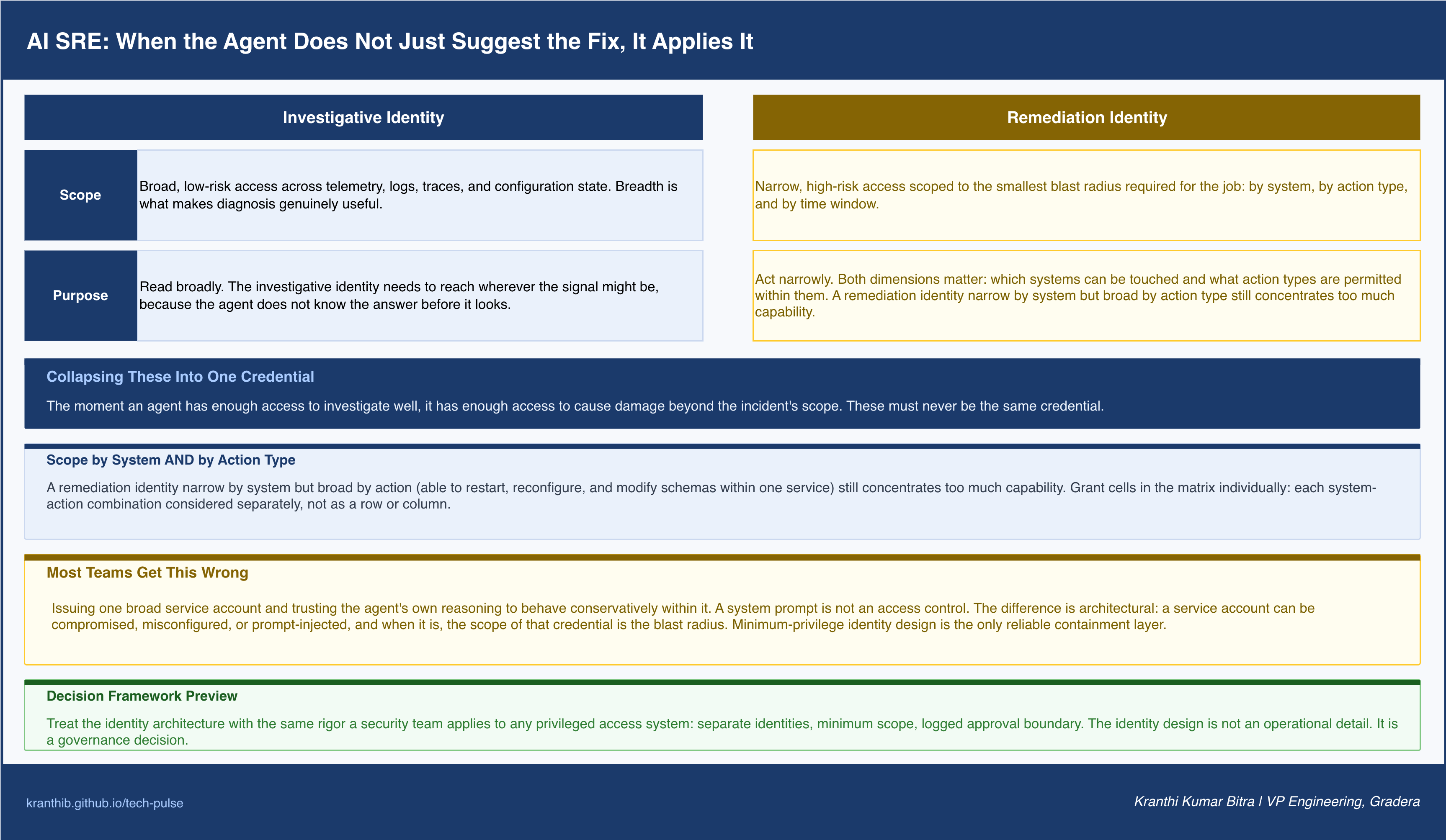
No credible implementation of AI SRE grants full autonomous remediation authority on day one, and the ones that have tried to skip this progression are consistently the source of the cautionary stories circulating in operations communities. The pattern that has emerged instead is a graduated trust model, and it is worth describing as a named framework because the staging itself is the actual safety mechanism, not a formality on the way to full autonomy.
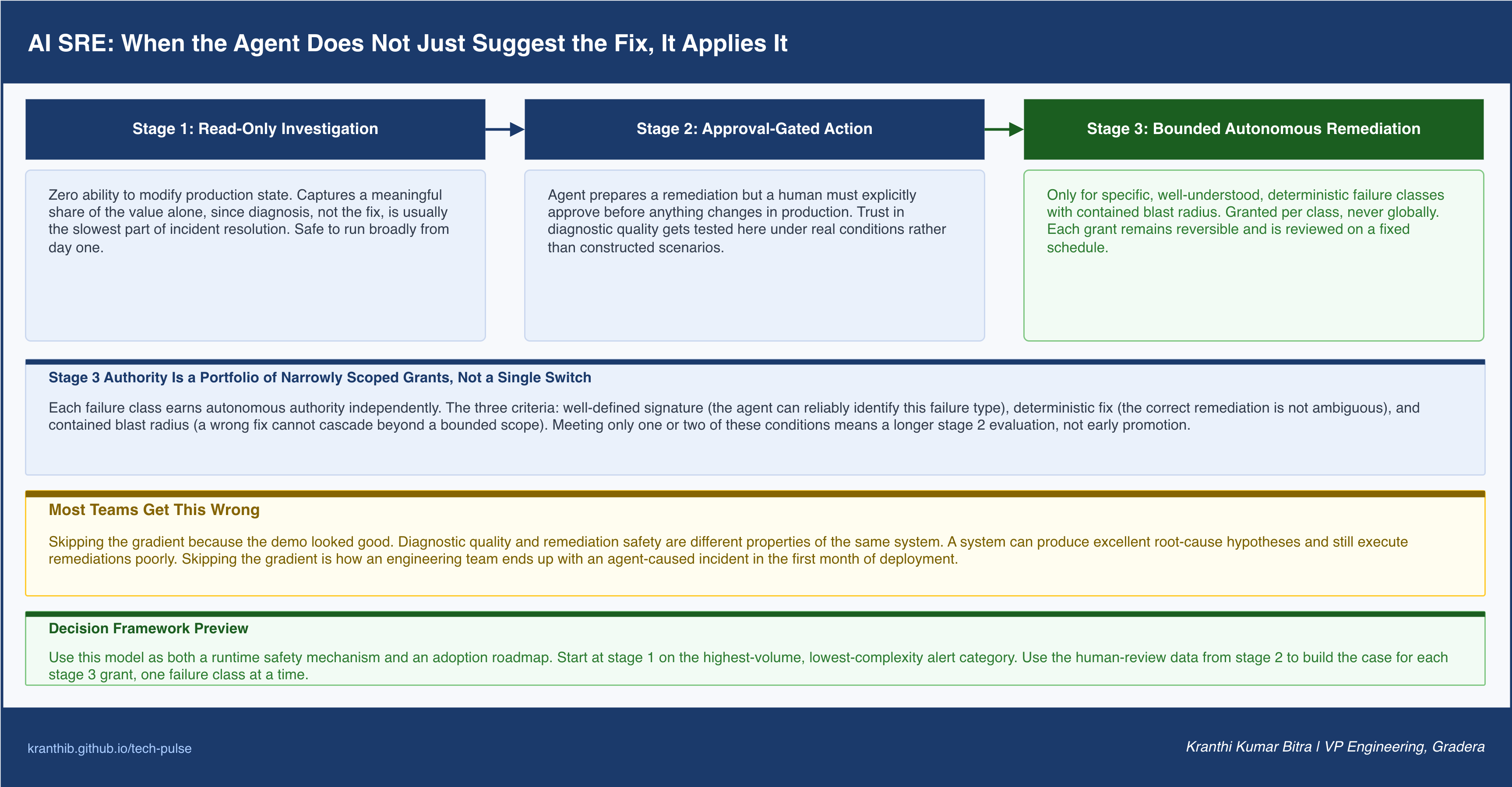
Stage one: read-only investigation. The agent performs root cause analysis and surfaces findings, with zero ability to modify production state. This stage alone captures a meaningful share of the value, since the most time-consuming part of most incidents is diagnosis, not the mechanical act of applying a known fix.
Stage two: staged, approval-gated action. The agent proposes a specific remediation and prepares it for execution, but a human must explicitly approve before anything changes in production. This stage is where trust in the agent’s diagnostic quality is actually tested against real incidents, with a human still holding the final decision.
Stage three: bounded autonomous remediation for well-understood failure classes. Only after a specific failure signature has been observed, correctly diagnosed, and correctly remediated enough times under stage two supervision does an organization extend autonomous execution authority for that specific class of failure, restarting an unhealthy workload or executing a pre-approved rollback being the canonical examples. Authority is granted per failure class, not globally, and remains reversible.
The organizations further along this path are explicit that stage three authority is not a single switch flipped once. It is closer to a portfolio of narrowly scoped grants, each earned independently by evidence that the specific failure class in question is well-defined, the fix is deterministic, and the blast radius of getting it wrong is contained and well understood by the team granting the authority. A failure class that meets none of those three conditions should not receive autonomous authority regardless of how well the agent has performed elsewhere, and a failure class that meets only one or two of them deserves a longer stage-two evaluation period before graduating, not an early promotion on the strength of enthusiasm alone.
The Blast Radius Problem
The single most consequential difference between an AI SRE agent making a mistake and a human on-call engineer making one is speed of propagation, and it deserves to be understood as the central risk of the category rather than a peripheral concern.
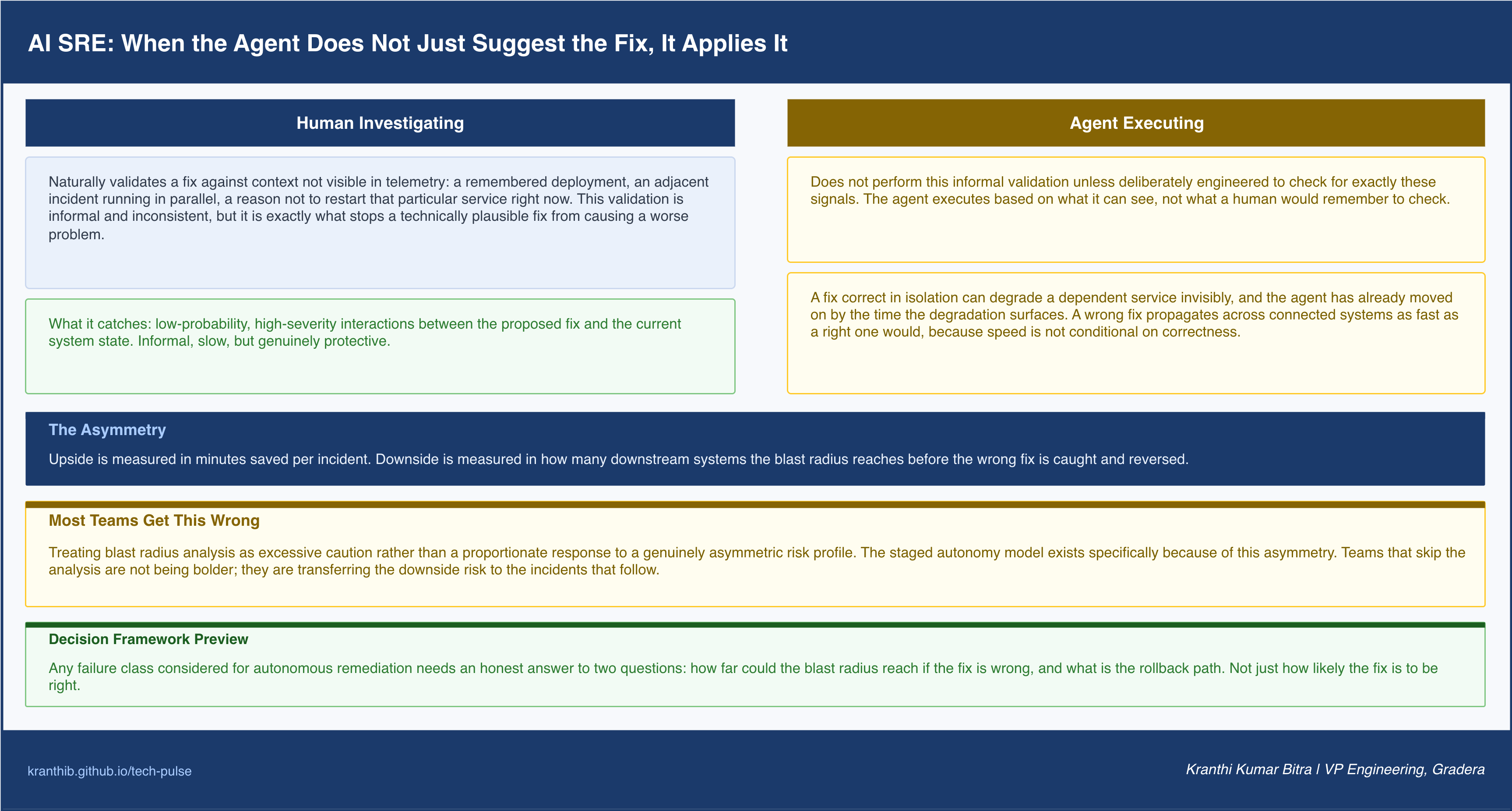
A human engineer investigating an incident naturally validates a proposed fix against context that may not be visible in the telemetry itself: recent deployments they happen to remember, an ongoing unrelated incident in an adjacent team, a planned maintenance window, a business reason a particular service should not be restarted right now. This validation is informal, inconsistent, and frequently exactly what prevents a technically plausible fix from causing a worse problem than the one it was meant to solve. An agent capable of modifying production state across hundreds of interconnected services does not perform this informal validation unless it has been deliberately engineered to check for exactly these signals, and even then, only for the specific categories of adjacent context someone thought to include.
The result is a genuine asymmetry: the same autonomous execution capability that can reduce incident response time dramatically can, with equal speed, propagate an incorrect remediation across every system connected to the one it started on, well before a human notices anything is wrong. A remediation that is correct in isolation for the service it targets can still degrade a dependent service in a way that was never visible to the agent’s investigation, and by the time that secondary effect surfaces as its own alert, the original agent has already moved on, its job, from its own perspective, successfully completed.
This is precisely why the progressive autonomy model above is not excessive caution. It is the direct, proportionate response to an asymmetric risk: the upside of autonomous remediation is measured in minutes saved per incident, while the downside of an unconstrained autonomous remediation gone wrong is measured in the number of downstream systems the blast radius happens to reach, a number that has nothing to do with how well-intentioned or generally accurate the agent’s reasoning was.
A Worked Example: Extending Autonomy for a Memory-Leak Failure Class
The abstract version of the progressive autonomy model is easier to agree with in principle than to actually implement with discipline. Walking through a concrete failure class makes the staging, and the temptation to skip it, more tangible.
Consider a platform engineering team whose services occasionally exhibit a slow memory leak under sustained load, eventually triggering an out-of-memory restart that briefly degrades the affected service before the orchestrator replaces the pod. This is a common, well-understood failure signature in most production environments, and it is a reasonable candidate for eventual autonomous remediation, which is exactly why it is a useful example: it is neither the trivial case nor the genuinely hard one.
At stage one, the team deploys the AI SRE agent in read-only mode against this alert category specifically. For several weeks, the agent investigates every occurrence, correlating the memory growth curve, the specific service and version experiencing it, and recent deployment history, and produces a hypothesis each time without taking any action. During this period, the team is not evaluating whether the fix works. They are evaluating whether the agent’s diagnosis is consistently correct, specifically whether it can reliably distinguish this particular memory-leak signature from superficially similar but mechanically different failure modes, such as a genuine traffic-driven capacity shortfall that happens to look similar on a memory graph but requires a completely different response.
At stage two, once the diagnostic accuracy for this specific failure class has been validated against enough real occurrences, the team extends the agent to propose a specific remediation, a rolling restart of the affected service, for human approval. This stage surfaces a detail that read-only investigation alone would not: the proposed fix needs to account for whether a rolling restart is safe given current traffic levels and whether any other maintenance or deployment activity is in progress on the same service, context that has to be explicitly engineered into the agent’s proposal logic rather than assumed. Several of the approvals during this stage are rejected specifically because the timing was wrong, not because the diagnosis was wrong, which is itself valuable signal the team would not have gotten by jumping straight to autonomous execution.
Only once the team has enough approval-gated history to be confident both in the diagnosis and in the timing logic does this specific failure class, and only this specific failure class, receive autonomous execution authority. The credential enabling that execution is scoped narrowly to restarting workloads matching this service’s deployment pattern, using the identity split described earlier, distinct from whatever broader investigative access the agent uses for its diagnostic work across the rest of the environment. A different failure class discovered next month starts the same three-stage process from the beginning. Nothing about validating one failure class shortcuts the validation required for the next.
This is, deliberately, a slower path to full autonomy than simply granting broad execution rights once the agent demonstrates general competence. It is also the difference between an incident response capability an organization can trust under pressure and one that works well until the day it does not.
What Most Teams Get Wrong
The most common mistake, and the one every serious voice in this space warns against consistently, is turning on autonomous remediation immediately because the diagnostic capability performed impressively during evaluation. Diagnostic quality and remediation safety are different properties, tested differently, and a system that produces excellent root-cause hypotheses in a proof of concept has told you nothing definitive about how safely it will behave the first time it is wrong about a fix it is authorized to apply without asking first.
The second mistake is treating this as a tooling purchase decision rather than an identity and access architecture decision. The vendor comparison questions engineering teams tend to ask first, which platform has the best integrations, which has the most polished interface, are real considerations, but they are secondary to a harder question almost nobody asks upfront: does this platform’s credential model actually separate investigative access from remediation authority, or does it hand the agent one broad service account and rely on the agent’s own judgment, expressed through natural language reasoning, to behave conservatively. A system prompt telling an agent to be cautious is not an access control, in exactly the same way a system prompt telling an agent to respect a budget is not a spend limit.
The third mistake is confusing a platform’s ecosystem fit with its actual capability. The most mature AI SRE implementations right now tend to be deeply integrated with a single cloud or observability ecosystem, extending their reach through additional tool connections at the edges. This is a legitimate and often correct architectural choice for the vendor to make, but it means an organization with a genuinely multi-cloud or multi-vendor telemetry footprint needs to map that footprint honestly before shortlisting, rather than assuming the most capable-looking demo will generalize cleanly to an environment the platform was not primarily built around.
The fourth mistake is measuring the pilot phase against the wrong outcome. Teams frequently frame the evaluation question as does this reduce mean time to resolution, which is intuitive but incomplete, because a system that resolves incidents faster on average while occasionally applying a badly wrong fix can produce a worse aggregate outcome than a slower, more conservative one, depending entirely on how costly the rare bad fix turns out to be. A more complete evaluation tracks at least three numbers together: average time to resolution, the rate at which the agent’s diagnosis is confirmed correct on human review, and, critically, the severity distribution of the cases where it was wrong. A platform that is occasionally wrong in low-stakes, easily reversible ways is a very different proposition from one that is occasionally wrong in ways that are rare but expensive, even if their average performance numbers look identical on a dashboard.
A Maturity Path for Adoption
For engineering leaders evaluating where to start, the progressive autonomy model doubles usefully as an adoption roadmap, not just a runtime safety mechanism.
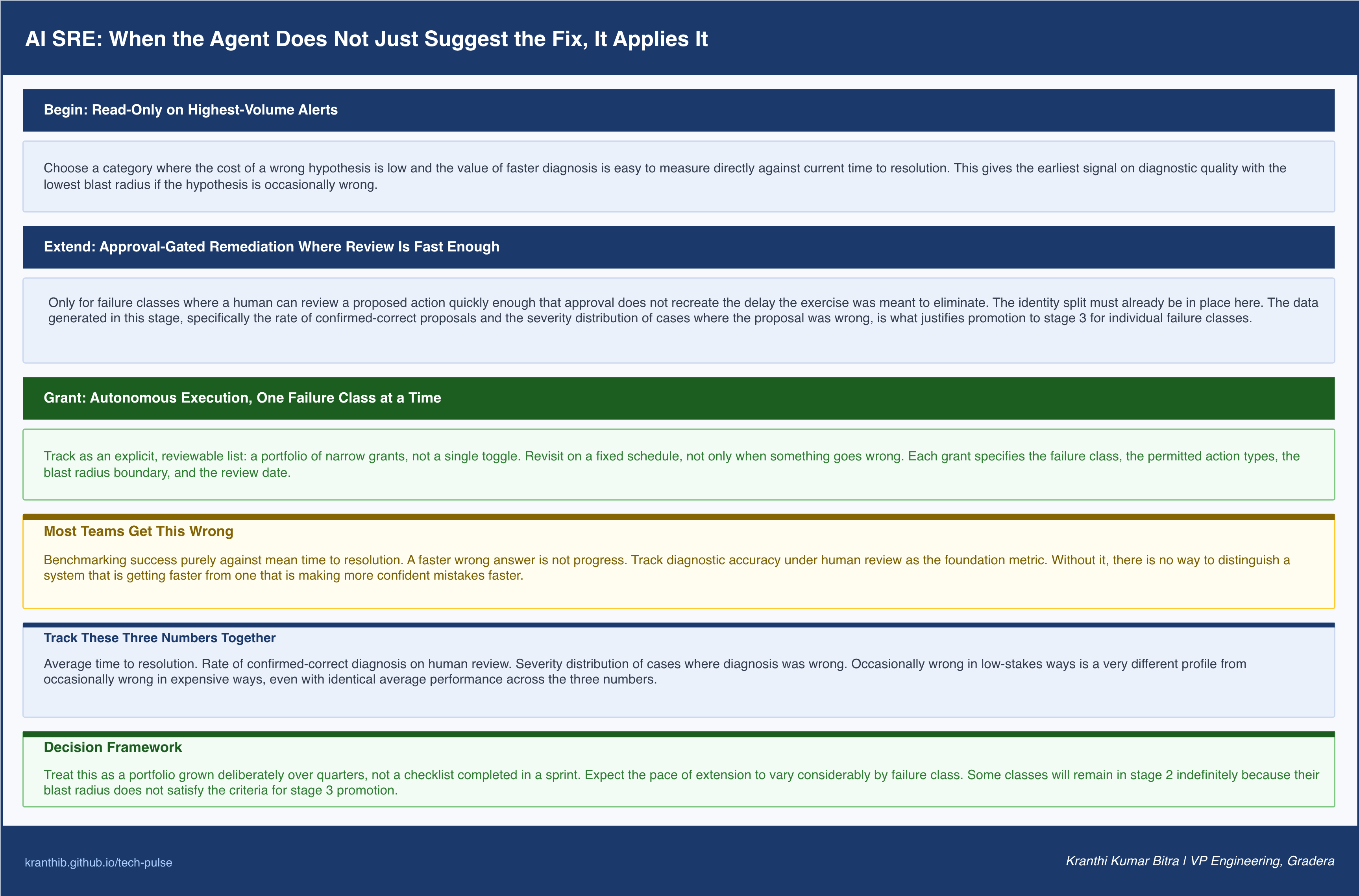
Begin at read-only investigation across your highest-volume, lowest-complexity alert category, somewhere the cost of a wrong hypothesis is low and the value of faster diagnosis is easy to measure directly against current mean time to resolution. Use this stage deliberately as an evaluation period for the platform’s diagnostic quality specifically, independent of any remediation question at all.
Move to approval-gated remediation only for failure classes where a human can review a proposed action quickly enough that the approval step does not simply recreate the delay the whole exercise was meant to eliminate. This stage is where the identity split discussed earlier needs to already be in place, not added retroactively once the first approval-gated action goes live.
Extend autonomous execution authority per failure class, not globally, and only once a specific class has accumulated enough approval-gated history to justify the extension. Track this as an explicit, reviewable list, a portfolio of narrow grants rather than a single toggle, and revisit the list on a fixed schedule rather than only when something goes wrong.
Throughout all three stages, resist the temptation to benchmark success purely against mean time to resolution. A faster wrong answer is not progress, and the more meaningful metric in the early stages of adoption is the accuracy and stability of the agent’s diagnostic hypotheses under human review, since that accuracy is the foundation everything built on top of it, including every future autonomy extension, ultimately depends on. Treat the maturity path as a portfolio to be grown deliberately over quarters, not a checklist to be completed in a single sprint, and expect the pace of extension to vary considerably by failure class, since some categories will accumulate trustworthy evidence quickly while others may never justify autonomous execution at all.
Where This Is Heading
The trajectory here points toward autonomous remediation authority expanding, not contracting, as more organizations accumulate the evidence needed to justify each additional stage-three grant. The economic pressure behind this is straightforward: development velocity keeps increasing, incident volume tends to scale with it, and the operations discipline required to hold response quality steady under that growth increasingly cannot be met by headcount growth alone. Several organizations building at the frontier of this category have described the underlying goal explicitly as holding operational cost steady while absorbing a multiple increase in development velocity, which is not achievable through better dashboards alone.
At the same time, the governance model maturing alongside the capability, separated identities, staged trust gates, per-failure-class authority grants, is likely to become the expected baseline rather than a differentiator, in much the same way access control and audit logging went from advanced practice to table stakes for any system touching production data. Organizations adopting AI SRE capability without this governance model built in from the start are not moving faster than organizations that build it properly. They are borrowing speed now against a blast-radius incident they have not yet had, and the bill for that loan does not arrive on a predictable schedule.
A second trend worth watching closely is the shift from single-agent to multi-agent incident response, where several specialized agents, one focused on infrastructure telemetry, one on application-level tracing, one on recent deployment history, collaborate on a single incident rather than one generalist agent attempting the entire investigation alone. Early implementations of this pattern report faster and more accurate root-cause identification than a single agent working the same incident end to end, for reasons that mirror why human incident response teams already specialize rather than relying on one generalist responder for every incident type. This raises the identity and blast-radius questions discussed above to a second level: not only does each agent’s remediation authority need to be scoped narrowly, but the coordination layer between multiple agents investigating and potentially acting on the same incident needs its own governance, since a disagreement between two agents about the correct remediation, surfaced too late or resolved incorrectly, is a new failure mode that a single-agent architecture does not have to contend with.
A third trend is the gradual formalization of what several organizations are calling a production world model: a continuously maintained, agent-readable map of services, infrastructure, dependencies, and their relationships, distinct from any single incident’s telemetry. This is a meaningful investment in its own right, closer to a living architecture diagram than a traditional monitoring artifact, and organizations further along in AI SRE adoption increasingly treat maintaining it as foundational infrastructure rather than a byproduct of any single agent deployment. An agent’s diagnostic quality is bounded by the quality of its understanding of the system it is diagnosing, and a stale or incomplete map of that system quietly caps how good any AI SRE implementation, regardless of how sophisticated its reasoning, can ultimately become.
The engineering leaders who treat the identity architecture and the staged autonomy model as core requirements from the first deployment, not as hardening work to retrofit after the diagnostic capability proves itself, will be the ones who can keep extending autonomous authority as the evidence justifies it. The ones who skip the gradient because the demo looked good will eventually generate the cautionary story the rest of the industry uses to justify the gradient to their own leadership.