
Cell-Based Architecture
A Modern Framework for Cloud Native Applications
Introduction
In today’s rapidly evolving digital landscape, organizations need architecture approaches that foster agility, resilience, and innovation. Cell-Based Architecture (CBA) offers a decentralized reference architecture specifically designed for modern cloud native applications, providing a structured yet flexible framework for building complex systems.
Unlike traditional monolithic approaches, Cell-Based Architecture embraces modern principles of modularity, composability, and autonomous operations. It enables organizations to respond more effectively to changing business requirements, technological advancements, and competitive pressures.
The key to enterprise agility lies in four fundamental properties:
- Scalability: The ability to handle changing workloads by effectively utilizing available resources while maintaining performance
- Modularity: Creating components with clear boundaries and well-defined interfaces that hide internal complexity
- Composability: Building a recursive and uniform architecture where new components add to the overall platform seamlessly
- Governance: Implementing managed, monitored, resilient systems while enforcing organizational policies
What is a Cell?
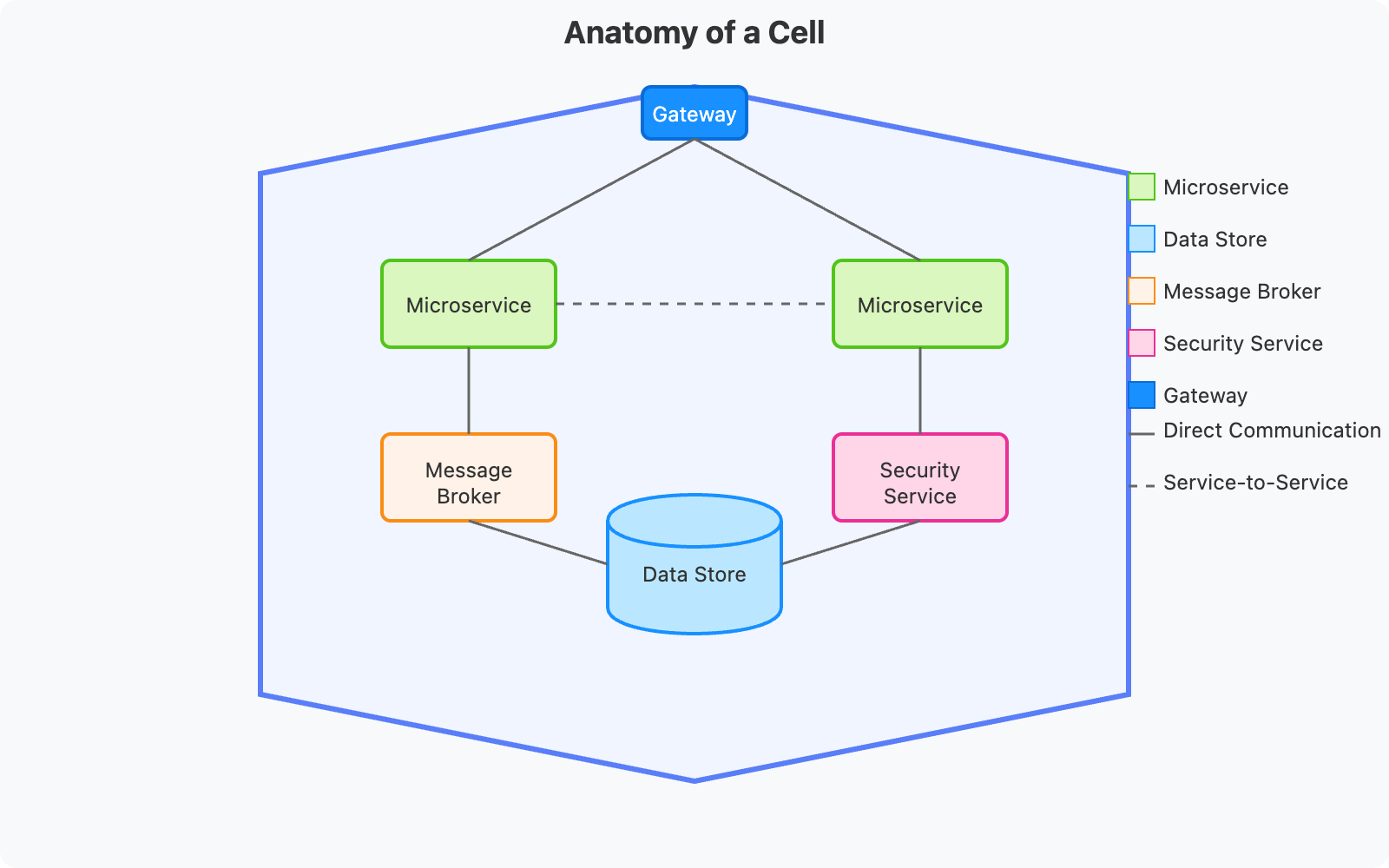
A cell is the core building block of the Cell-Based Architecture. It’s a collection of components, grouped from design and implementation into deployment, that forms a self-contained unit of functionality. Each cell is:
- Independently deployable - Can be deployed without impacting other cells
- Independently manageable - Can be maintained and updated separately
- Independently observable - Has its own monitoring and telemetry
A cell encapsulates a set of related services, APIs, data stores, and other components that together implement a bounded context or business capability. Components inside the cell can communicate directly with each other, but all external communication must happen through the cell’s gateway.
Key characteristics of a cell include:
- Boundary - Clear delineation of what’s inside vs. outside the cell
- Gateway - Acts as the entry point for all external communication
- Components - Microservices, functions, data stores, or other capabilities
- Ownership - Typically owned by a single team
- Versioning - Has a name and version identifier, enabling evolution
- Immutability - Treated as immutable units for deployment
Cell Communication and Interaction
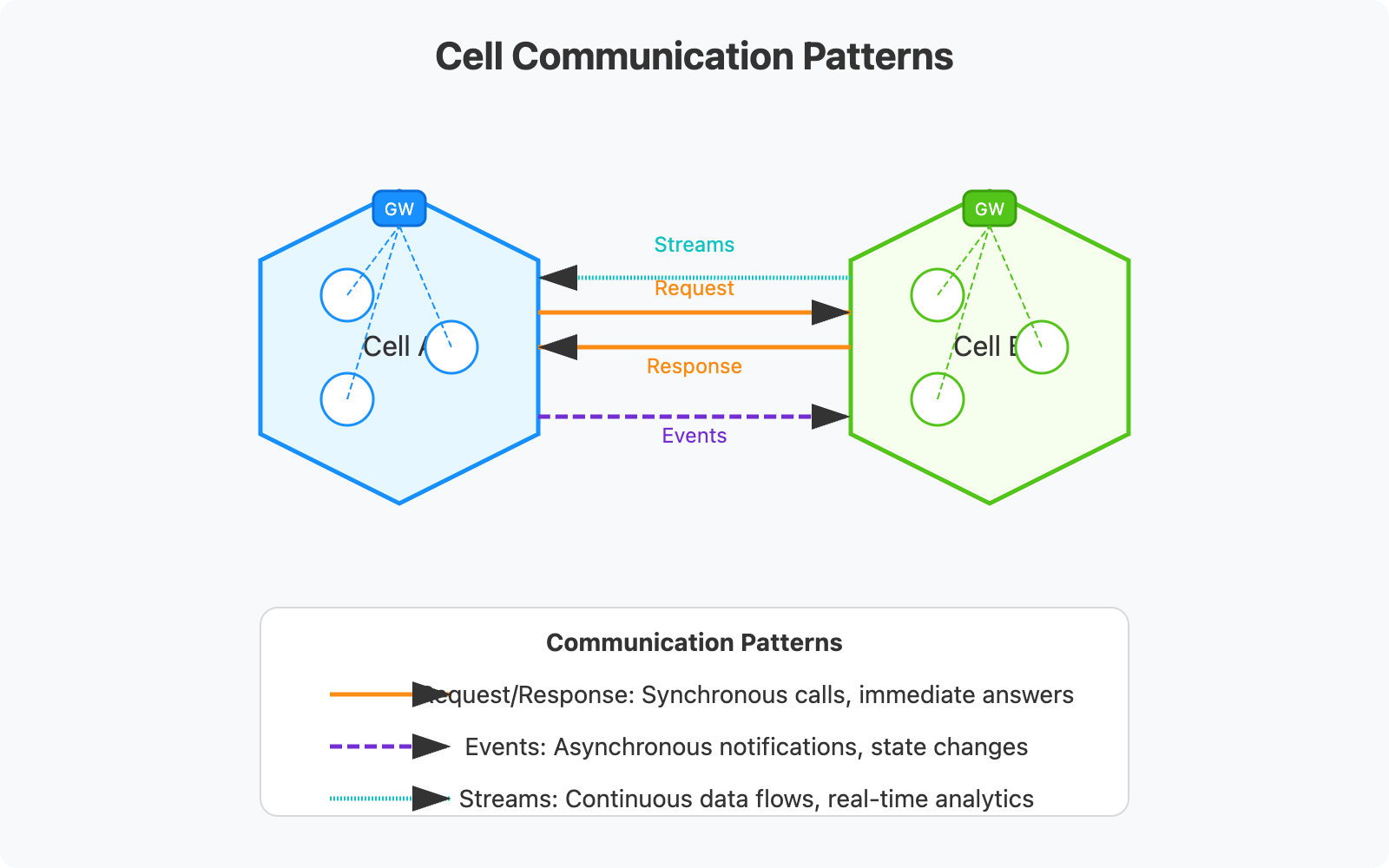
Cells communicate with each other through well-defined API endpoints exposed by their gateways. This approach ensures proper encapsulation of internal implementation details while enabling seamless integration between cells.
Three primary communication patterns facilitate cell-to-cell interaction:
- Request/Response APIs - Synchronous communication for queries and commands
- Used for immediate responses and direct interactions
- Typically implemented using REST or gRPC
- Suitable for user-triggered actions and data retrieval
- Events - Asynchronous notifications about state changes
- Enables loose coupling between cells
- Allows cells to react to changes in other parts of the system
- Follows the publish/subscribe model
- Ideal for tracking important business events (order placed, payment received)
- Streams - Continuous data flows for real-time processing
- Captures evolving states and ongoing activities
- Enables pattern matching and analytics
- Perfect for monitoring, metrics, and trend analysis
This communication framework creates two distinct network planes:
- Local Mesh - Communication within a cell (intra-cell)
- Global Mesh - Communication between cells (inter-cell)
Governance and Security
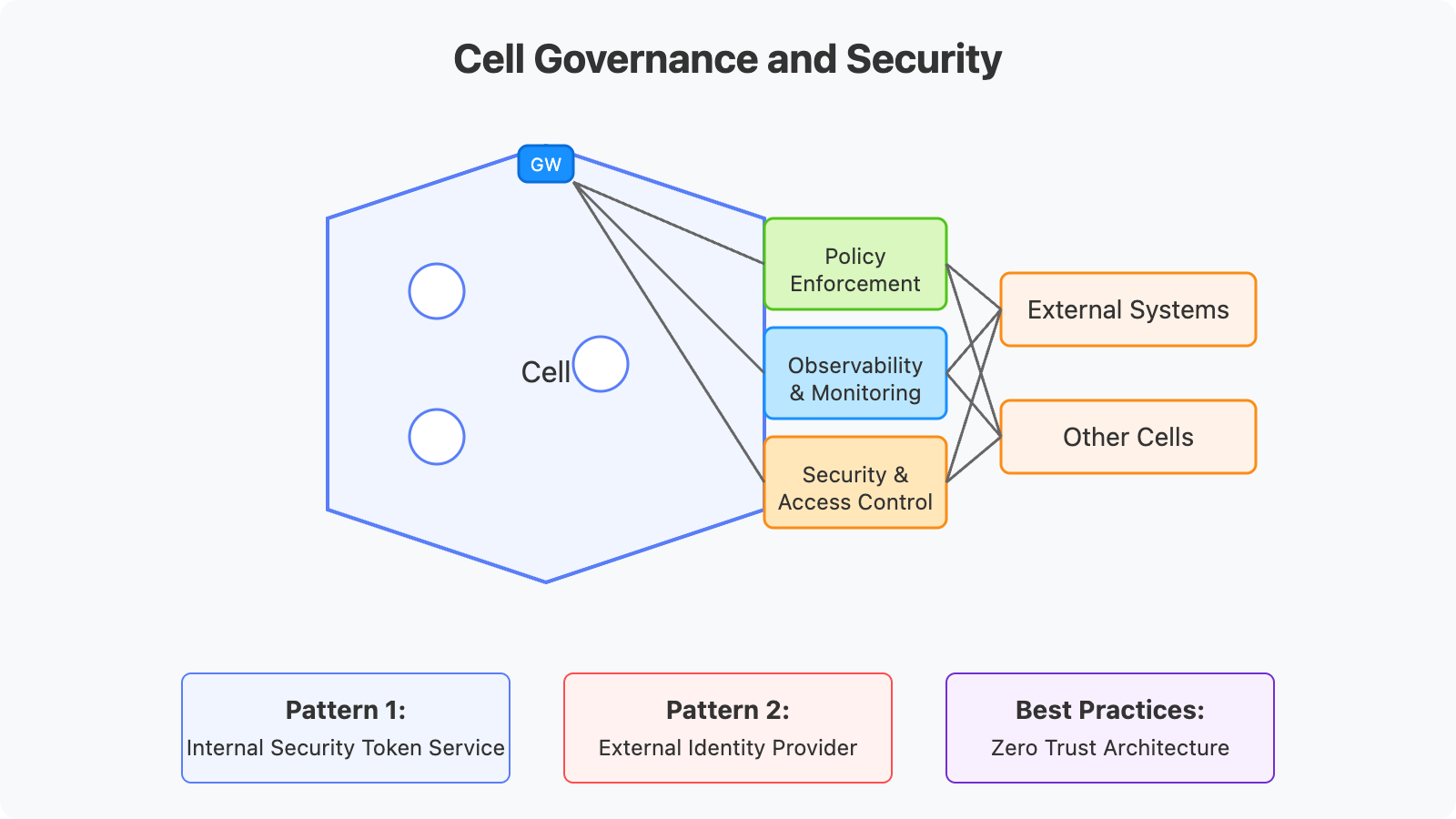
The cell gateway serves as the primary governance point within the cell-based architecture, providing:
- Policy Enforcement - Implementing and enforcing business rules, access control, and throttling
- Observability - Capturing metrics, logs, and traces for monitoring and analysis
- Security - Managing authentication, authorization, and encryption
This gateway pattern creates a clear control point that simplifies policy implementation and enforcement. By mandating that all communication flows through defined gateway clusters, organizations can easily:
- Enforce consistent policies
- Capture comprehensive observability data
- Maintain robust security controls
- Apply changes without modifying internal components
Security Patterns
The security architecture within cells can follow two main patterns:
- Internal Security Token Service (STS) - The cell contains its own security token service that manages authentication and authorization for components within the cell
- Provides greater autonomy and isolation
- Allows for cell-specific security policies
- Suitable for highly regulated domains
- External Identity Provider (IDP) - The cell connects to an external identity service
- Provides consistent identity management across cells
- Simplifies user management
- Enables single sign-on across the enterprise
- Better for user-facing applications
The architecture promotes a zero-trust security model where no component implicitly trusts another, regardless of location. All communications are authenticated and authorized, even within cell boundaries.
Structured Agility
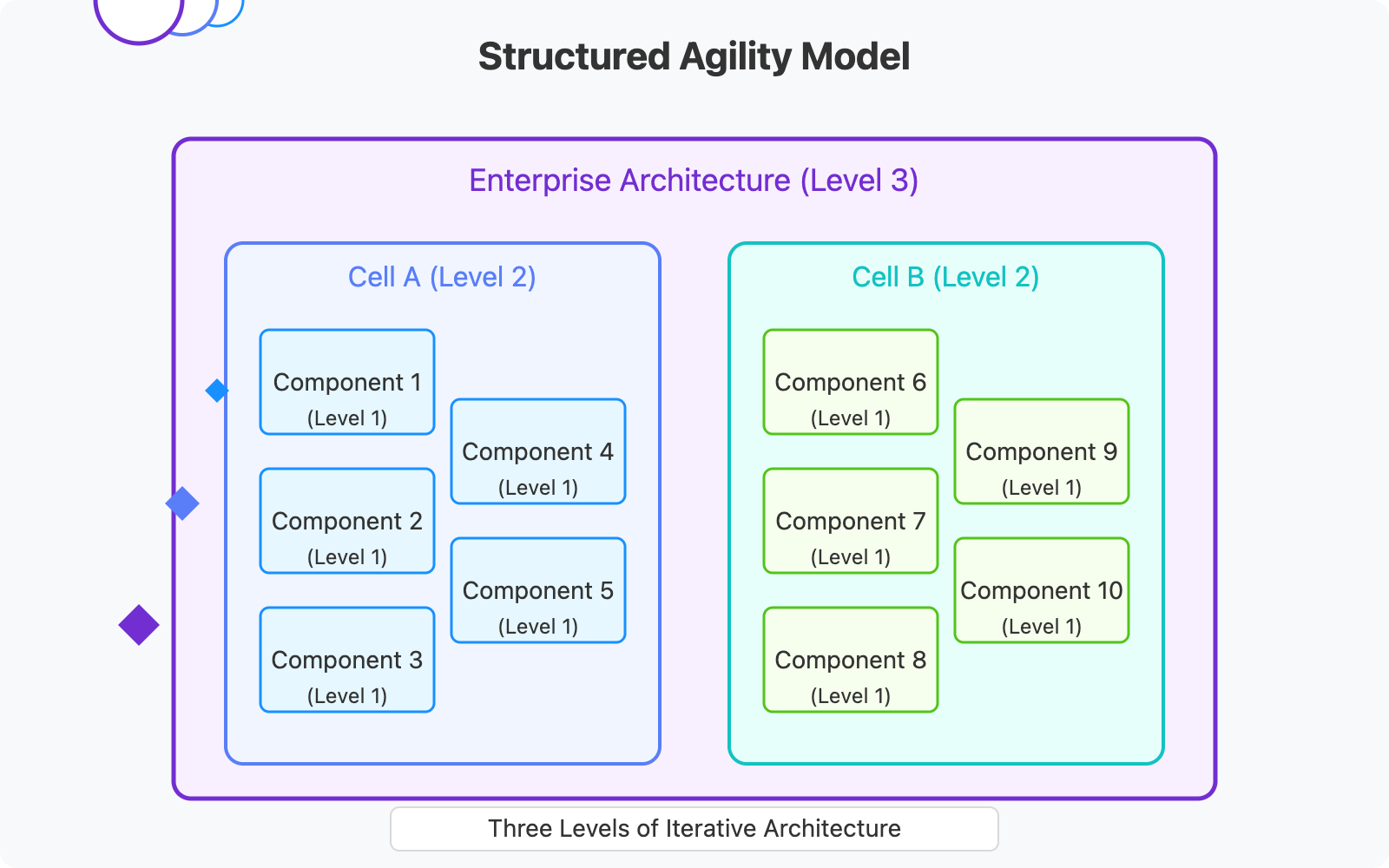
One of the key advantages of the cell-based architecture is its structured approach to agility. By dividing enterprise architecture into cells and components, the architecture enables iterative development at three levels:
- Level 1: Component Iteration - Individual components inside each cell can evolve independently
- Enables rapid feature development
- Allows for technology experimentation
- Facilitates bug fixes without impacting other components
- Level 2: Cell Iteration - Each cell can evolve independently
- Teams can release new versions without coordinating with other teams
- Enables domain-focused innovation
- Supports bounded context evolution
- Maintains clear interfaces with other cells
- Level 3: Enterprise Iteration - The enterprise architecture evolves as a whole
- New cells can be added to address emerging business needs
- Existing cells can be recombined or restructured
- Communication patterns can evolve
This multi-level approach resolves the challenge that large enterprises face in attempting to apply agile methods to complex systems. By dividing architecture into smaller, manageable chunks, cell-based architecture enables teams to move at their own pace while maintaining overall system coherence.
Cell Creation and Team Alignment
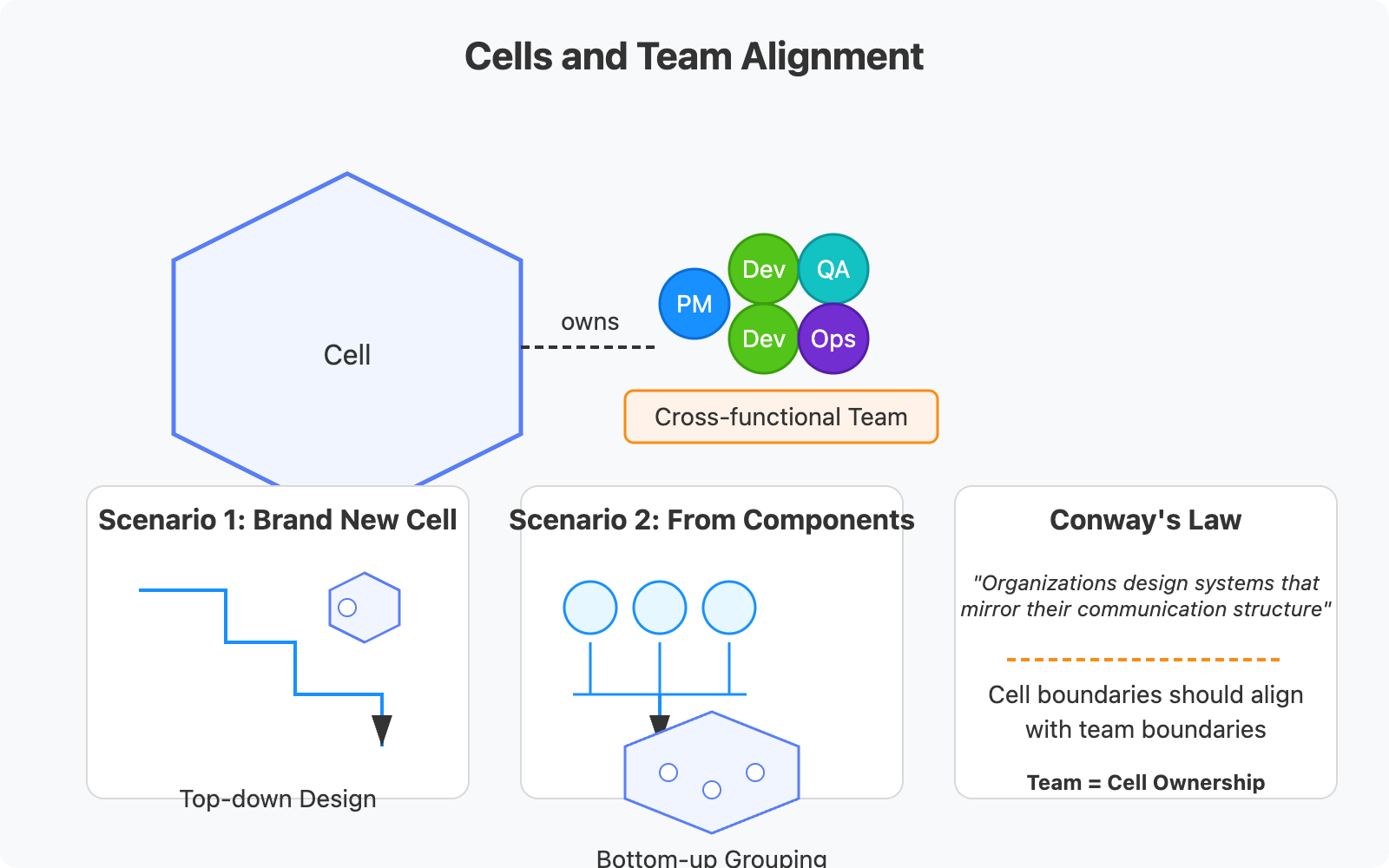
Cell creation aligns closely with organizational team structures, following Conway’s Law, which states that “organizations design systems that mirror their communication structure.” This principle guides how cells are formed and evolve:
Cell Creation Approaches
There are two main approaches to creating cells:
- Top-down Design (Greenfield) - Start with the cell definition first, then develop components
- Define clear cell boundaries based on business domains
- Establish API contracts before implementation
- Add components incrementally
- Ideal for new projects or clear domain boundaries
- Bottom-up Grouping (Brownfield) - Group existing components into cells
- Identify related components
- Define cell boundaries around existing functionality
- Refactor interfaces to match cell gateway patterns
- Suitable for legacy systems or ongoing projects
In both approaches, a key principle is to align cell boundaries with team boundaries. Each cell should be owned by a self-organized, cross-functional team that takes responsibility for the entire lifecycle of the cell, from design to implementation, deployment, and maintenance.
Recommended Team Structure
The recommended team structure for cell ownership includes:
- Product Owner/Manager - Defines cell capabilities and priorities
- Developers - Implement cell components and interfaces
- QA Engineers - Ensure quality through automated testing
- Operations - Support deployment and runtime management
This cross-functional team can work autonomously while adhering to organizational standards and architectural principles. The cell boundary provides a clear scope for the team’s responsibility and authority.
Cell Granularity and Best Practices
Determining the right size and boundaries for cells is crucial for successful implementation. Several factors influence cell granularity:
- Conway’s Law - Design cells that align with your organization’s communication structure
- Component Connectivity - Intra-cell component connections should exceed inter-cell connections
- Domain-Driven Design - Use bounded contexts to identify natural cell boundaries
- Team Size - A cell should match the size and capacity of a single team (often using the “two-pizza team” rule)
- Business Focus - Organize cells around business capabilities rather than technical layers
Best Practices for Cell Design
- A cell encapsulates a set of functionality implemented as a combination of components
- Communication between cells happens via well-defined, versioned APIs
- Each cell implements both logic and data, with the cell owning all data for its domain
- A cell should be deployable as an immutable unit via version-controlled deployment processes
- Cells should scale independently and implement appropriate throttling and SLA policies
- Cells should not contain nested cells (avoid cyclic dependencies)
- Security must be implemented at the cell level with clear policies controlling access
Cell Evolution and Lifecycle
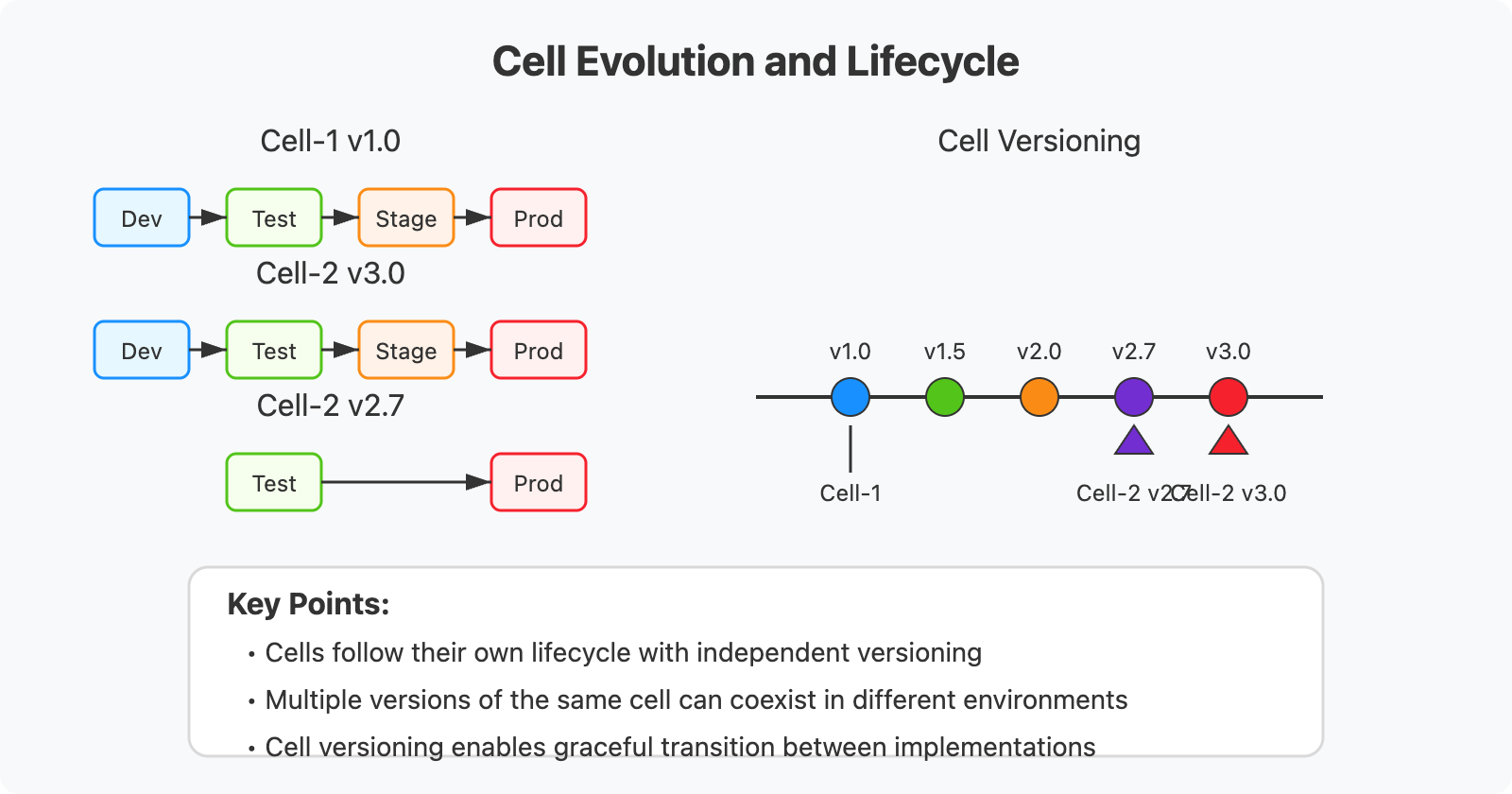
Cells evolve over time as business requirements change and technologies advance. Each cell follows its own lifecycle with independent versioning and deployment processes.
Key aspects of cell evolution include:
- Independent Lifecycle - Each cell has its own lifecycle stages (development, testing, staging, production)
- Versioning - Cells are versioned independently, allowing for evolution at different rates
- Coexistence - Multiple versions of a cell can exist simultaneously to support transition periods
- Immutability - Cells are treated as immutable units during deployment
- Progressive Deployment - New cell versions can be deployed using patterns like blue/green or canary releases
The cell lifecycle management approach enables organizations to:
- Deploy new features incrementally without disrupting the entire system
- Support legacy interfaces while developing new capabilities
- Maintain backward compatibility during transitions
- Test changes in isolation before system-wide integration
- Roll back problematic updates to stable versions
Each version of a cell creates separate pipelines through the various lifecycle stages, enabling teams to manage multiple versions simultaneously when necessary.
Real-World Applications
Organizations across various industries have successfully implemented cell-based architecture to solve complex challenges:
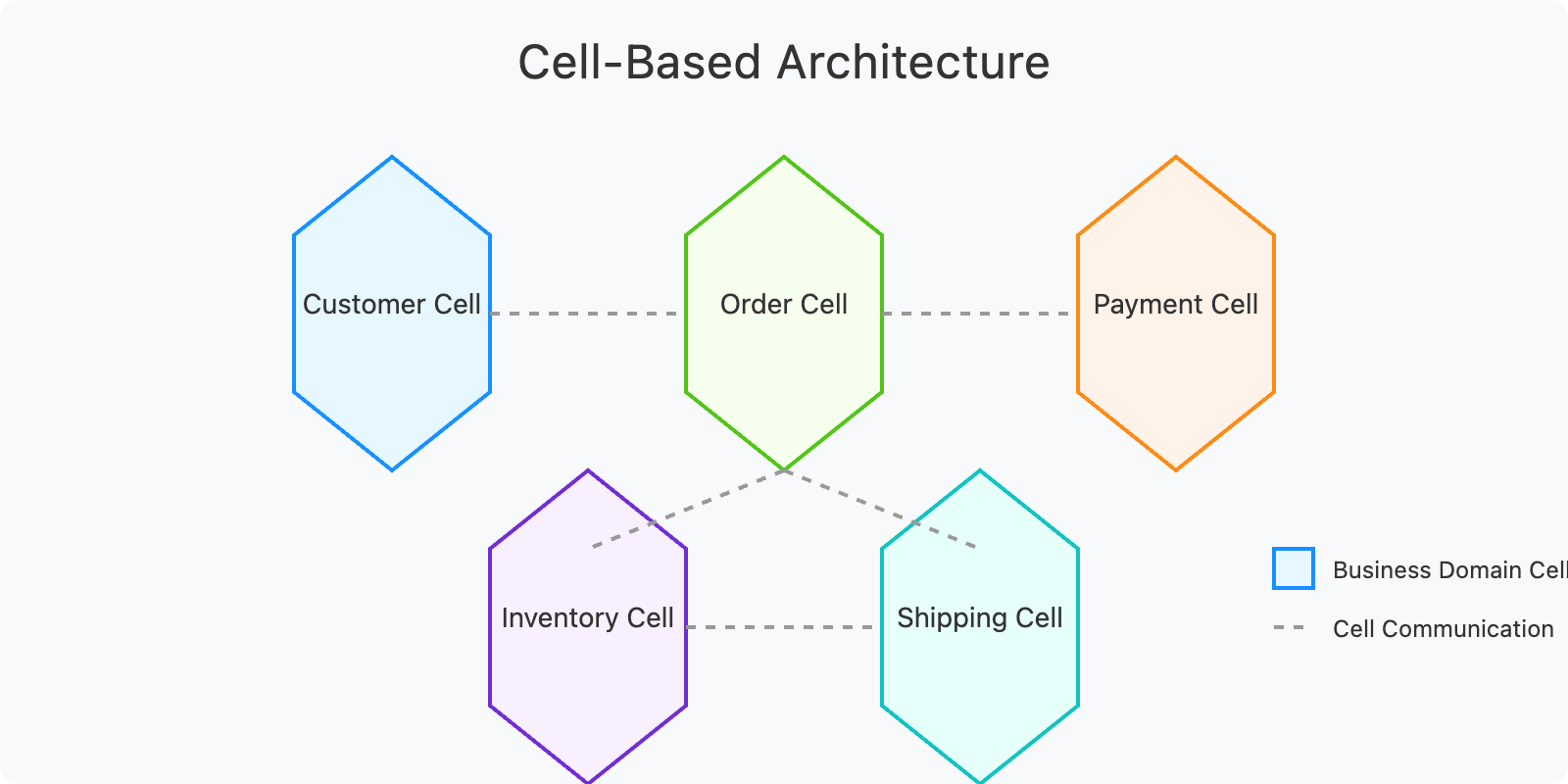
- E-commerce Platforms - Breaking down monolithic shopping applications into customer, order, payment, inventory, and shipping cells
- Financial Services - Creating isolated cells for different banking products while maintaining security and compliance
- Healthcare Systems - Separating patient data, clinical services, and administrative functions into distinct cells
- Telecommunications - Building scalable network management systems with clear domain boundaries
- Transportation and Logistics - Creating modular systems that handle booking, tracking, and billing as separate concerns
The cell-based approach has proven particularly valuable for organizations that:
- Need to evolve different parts of their systems at different rates
- Have complex domain boundaries that benefit from explicit isolation
- Require clear team ownership and accountability
- Need to scale specific functions independently
- Want to maintain system integrity during rapid innovation
Conclusion
Cell-Based Architecture offers a powerful framework for building modern cloud native applications that balance agility with governance. By organizing systems into independently deployable, manageable, and observable cells, organizations can accelerate innovation while maintaining system coherence.
The key benefits of this architectural approach include:
- Enhanced Agility - Multi-level iteration allows teams to evolve at their own pace
- Clear Boundaries - Explicit interfaces between cells create strong encapsulation
- Team Autonomy - Self-contained units align with team structures and responsibilities
- Scalability - Independent cell scaling enables efficient resource utilization
- Resilience - Isolation boundaries prevent cascading failures
- Governance - Cell gateways provide consistent policy enforcement
- Evolution - Independent versioning supports graceful system evolution
As digital transformation accelerates, Cell-Based Architecture provides a structured yet flexible approach to building systems that can adapt to changing business needs while maintaining technical integrity. By focusing on modularity, composability, and clear ownership, cell-based architecture creates a foundation for sustainable innovation in complex enterprise environments.