
Platformless: The Future of Enterprise Software Engineering
The Evolution Toward Simplification
Throughout technology history, we’ve witnessed a pattern of moving toward simplified models where complex infrastructure becomes invisible to users:
- From wired to wireless: Freedom from physical connection constraints
- From client-server to web: Elimination of local software installation
- From data centers to cloud: Abstraction of physical hardware management
- From app servers to serverless: Removal of infrastructure configuration
In each case, the underlying technology didn’t vanish—it was abstracted away with clean boundaries between users and providers. The technologies still exist, but users no longer need detailed knowledge to leverage them.
Now, enterprise software is experiencing its next major evolution: from platforms to platformless.
The Platform Challenge
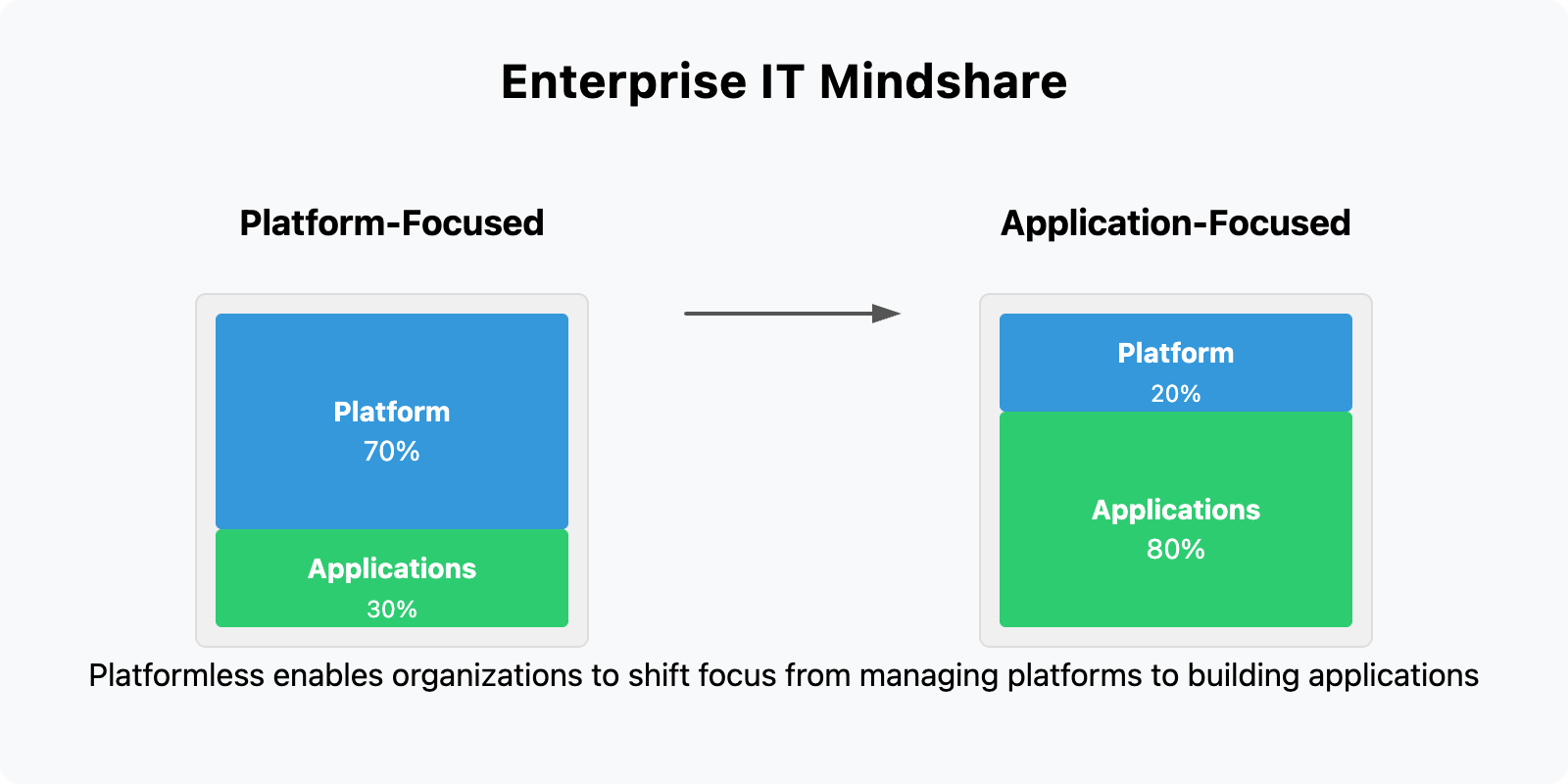
Today’s enterprise software delivery platforms built on technologies like Kubernetes provide tremendous power, enabling continuous deployment and rapid evolution. However, these complex systems have introduced significant challenges:
- Specialized skill requirements: They demand large teams with highly-specialized knowledge
- Resource diversion: Organizations spend more time maintaining platforms than creating value
- Integration complexity: Each platform requires connecting multiple components like CI/CD pipelines, monitoring systems, and network substrates
- Operational overhead: Updates, patches, and security management create ongoing maintenance burden
The result? Organizations shift their focus from building valuable applications to maintaining complex platforms.
Introducing Platformless
Platformless represents a fundamental shift in approach—eliminating platform complexity from developers’ consciousness and allowing them to focus entirely on building applications. It doesn’t eliminate platforms but creates an invisible boundary that hides underlying complexity.
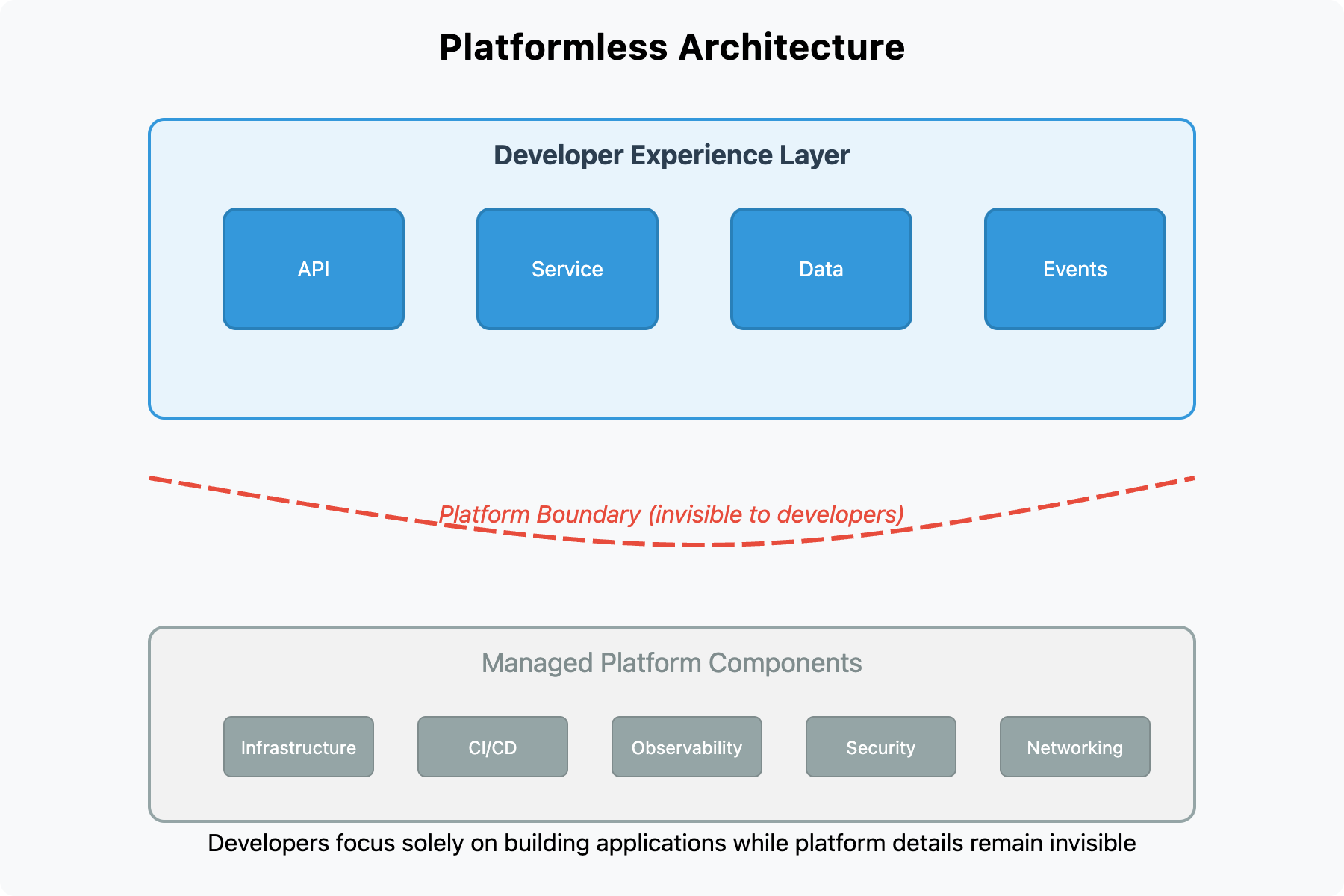
Platformless brings together four essential domains:
1. API-First Architecture
In a platformless environment, everything operates through well-designed APIs that enable seamless integration. API-first means:
- Designing interfaces before implementation
- Standardizing how systems communicate
- Creating self-describing service boundaries
- Building discoverable, reusable components
With API-first design, developers can find, understand, and integrate with existing capabilities without needing to understand underlying implementation details.
2. Cloud Native Middleware
Platformless leverages modern middleware technologies that enable distributed systems through:
- Domain-driven design: Organizing software around business domains
- Modular architecture: Creating independent components that can evolve separately
- Service communication: Managing interactions between distributed components
- Zero-trust security: Verifying every access request regardless of source
This middleware handles complexity invisibly, allowing developers to create applications without worrying about infrastructure.
3. Internal Developer Platforms
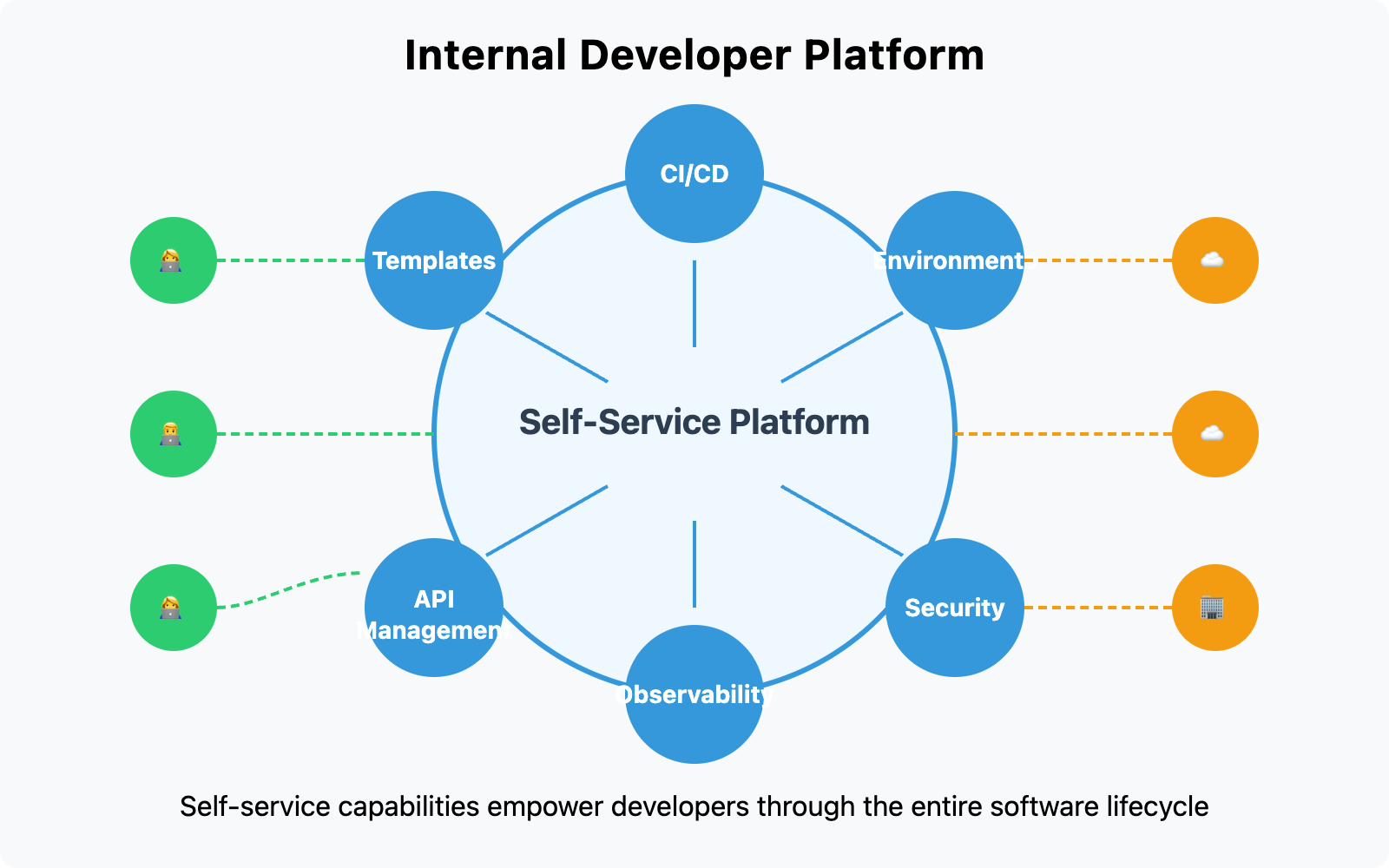
The backbone of platformless is a seamless internal developer platform that provides:
- Self-service capabilities for every development role
- Automated build, test, and deployment workflows
- Environment management with consistent configurations
- Release management with strategies like canary deployments
- Built-in observability and monitoring
These platforms eliminate manual processes and configuration tasks, letting developers focus on creating value.
4. Developer Experience
The fuel that powers platformless is exceptional developer experience (DX), which includes:
- Intuitive interfaces and tools that minimize cognitive load
- Clear, consistent workflows that avoid context switching
- Immediate feedback during development and testing
- Documentation and examples that accelerate learning
- Elimination of unnecessary complexity and procedures
Great developer experience makes developers more productive and creative, leading to better applications.
A Day in the Life: Platformless in Action
Imagine Kranthi, a developer at a financial services company, who needs to build a new customer notification system:
-
Discovery: Kranthi browses an API marketplace to find existing services for customer data, notification preferences, and delivery channels.
-
Development: She creates her application using her preferred language and tools without worrying about infrastructure configurations.
-
Testing: With a single command, she deploys to a test environment that automatically configures connections to all dependent services.
-
Iteration: As she refines her application, automatic CI/CD processes handle testing and deployment, with immediate feedback.
-
Promotion: When ready, she promotes the application to production with a simple approval process—no manual configuration required.
-
Monitoring: Built-in observability tools show performance metrics and user engagement data without additional setup.
Throughout this process, Kranthi focuses solely on creating business value—not managing infrastructure, configuring environments, or setting up monitoring tools.
Benefits of Platformless
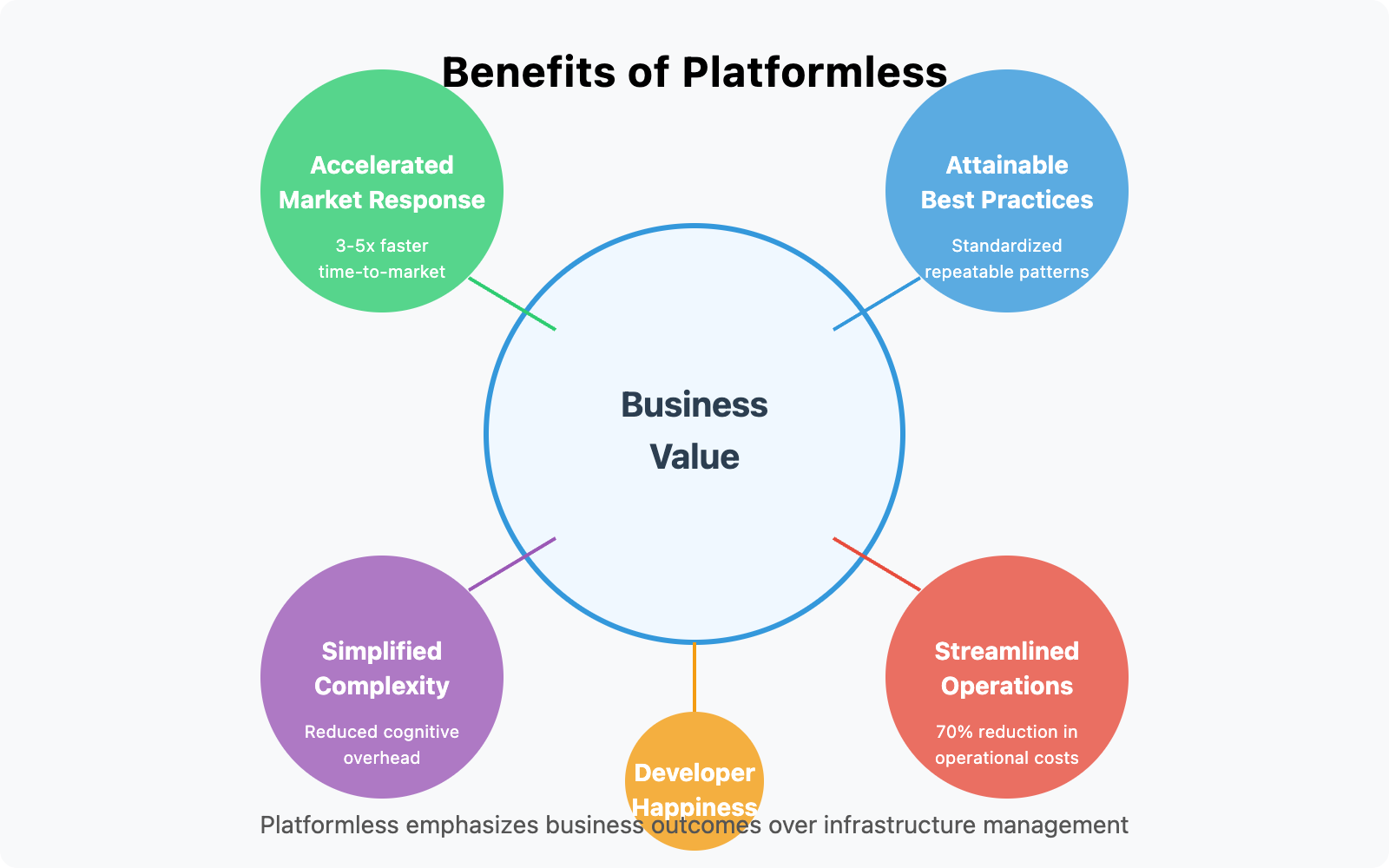
Organizations that adopt a platformless approach experience:
-
Increased development velocity: Teams deliver features 3-5x faster by focusing on business logic rather than infrastructure.
-
Higher quality applications: With standardized patterns and automated testing, applications become more reliable and secure.
-
Reduced operational costs: Organizations need fewer specialized platform engineers and spend less time on maintenance.
-
Improved compliance: Standardized, automated processes ensure consistent application of security and regulatory requirements.
-
Better developer satisfaction: By removing frustrating infrastructure tasks, developers stay engaged and turnover decreases.
Building Your Platformless Future
Transitioning to platformless isn’t an overnight process. Organizations should follow these steps:
-
Assess current state: Identify where teams spend time on platform management versus application development.
-
Define developer workflows: Map ideal developer experiences from ideation to production.
-
Standardize APIs: Create consistent patterns for service interaction and discovery.
-
Automate operations: Implement self-service capabilities for common tasks.
-
Measure outcomes: Track metrics like developer productivity, deployment frequency, and time to market.
The goal isn’t to eliminate all platforms but to make them invisible to developers—allowing teams to focus entirely on creating value for customers.
Conclusion
Platformless represents the next major evolution in enterprise software development. By abstracting away complex infrastructure and providing seamless developer experiences, organizations can focus on what matters most: building exceptional applications that deliver business value.
As the complexity of modern applications continues to grow, platformless approaches will become essential for organizations that want to maintain agility, reduce costs, and attract top development talent.
The future of enterprise software isn’t about better platforms—it’s about making platforms disappear from developers’ consciousness entirely.