
The Agentic Reliability Gap: Why the Demo Always Works and Production Never Does
The demo worked. The pilot worked. The evaluation suite passed. The stakeholder presentation went well enough that budget was approved. Then the agent met production: real data, live systems, proprietary APIs, edge cases that nobody documented. The reliability numbers that looked strong in a controlled environment quietly collapsed. This is not a story about one team or one agent. It is the defining pattern of enterprise agentic AI in the current period, and understanding exactly why it happens is the prerequisite for building systems that survive it.
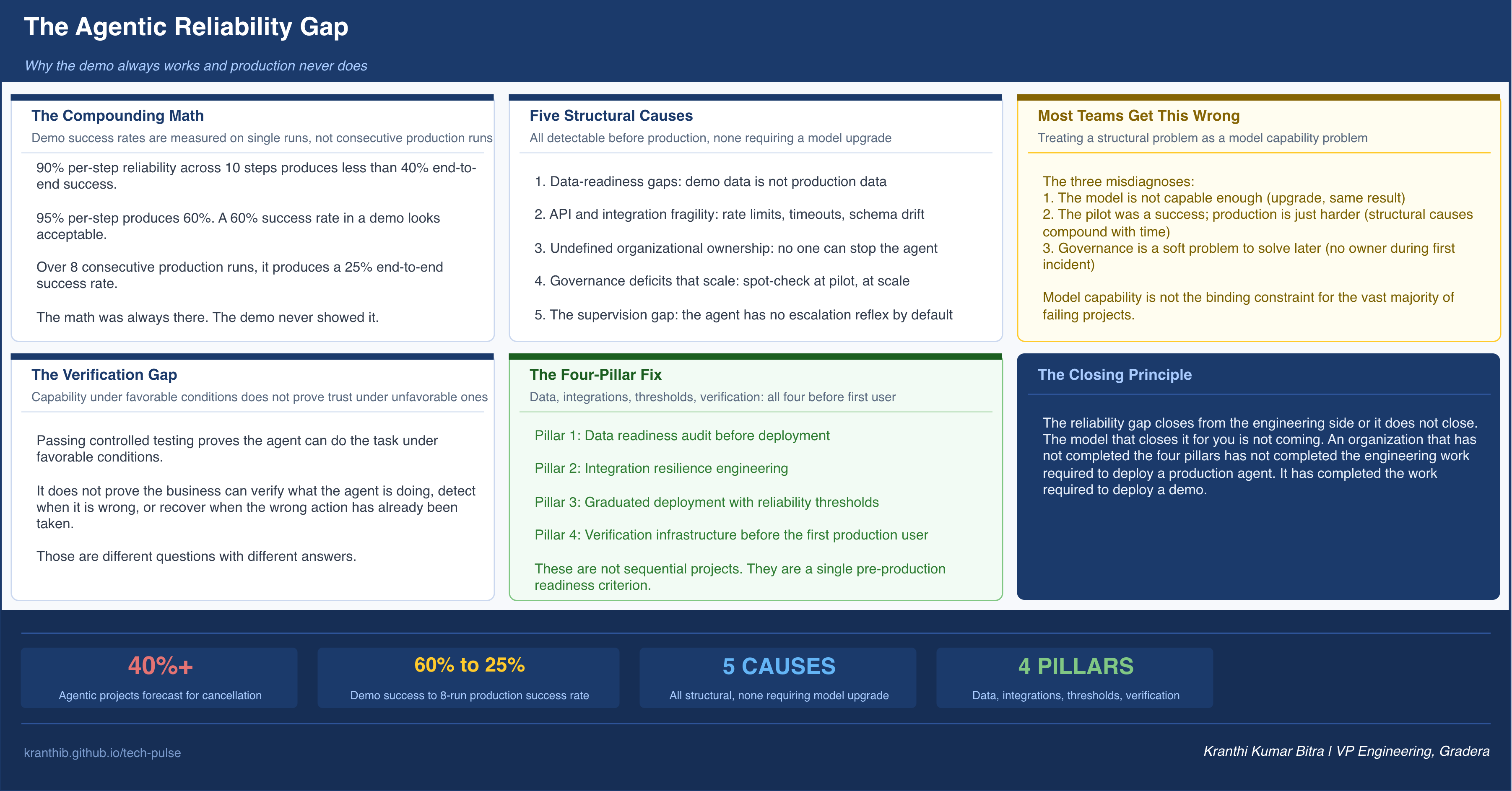
The Numbers Behind the Pattern
Several research organizations have attempted to measure the gap between agentic AI adoption claims and production reality. The findings vary depending on what exactly each study measured, and the differences matter enough that they are worth separating rather than blending into a single aggregate claim.
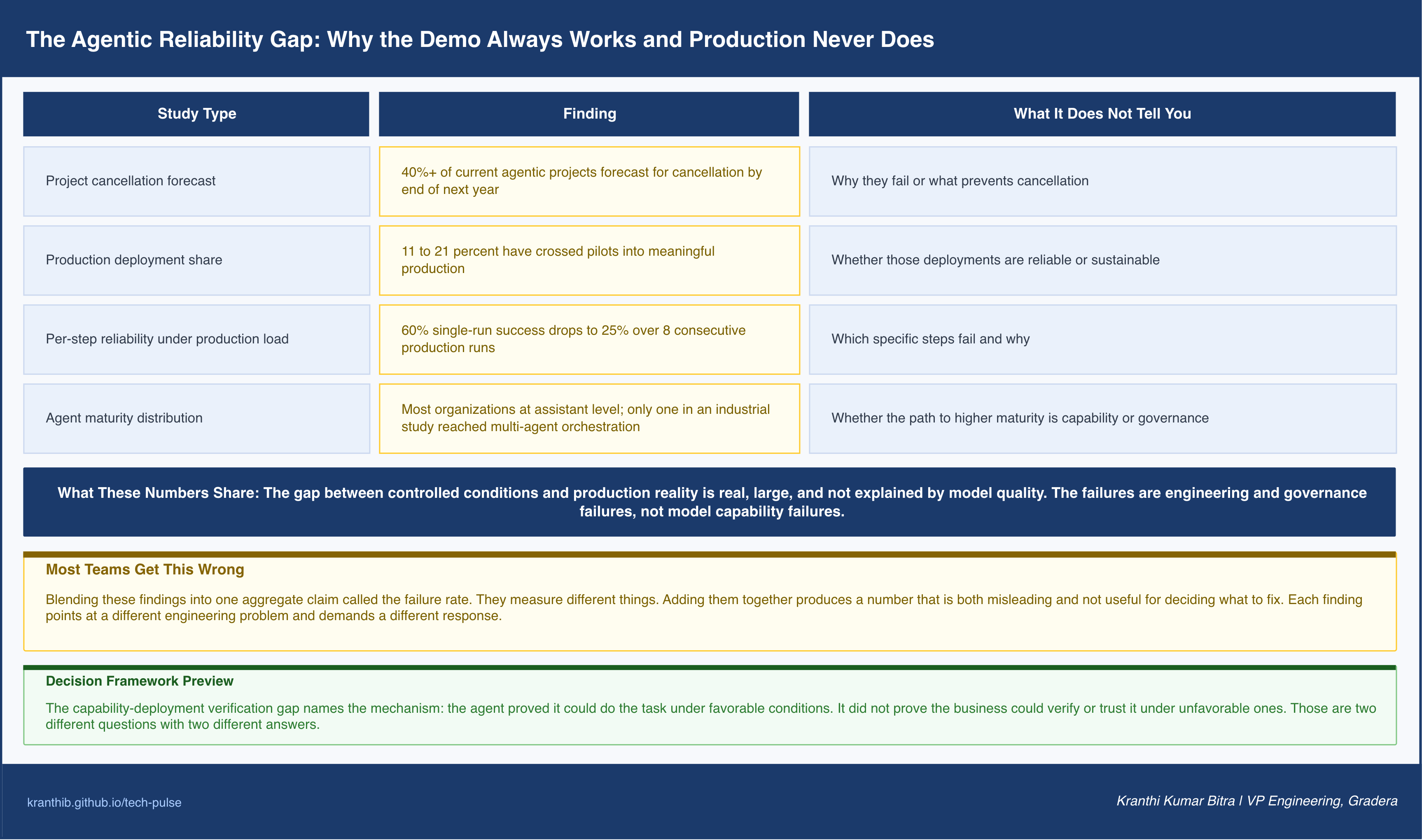
One projection, widely cited, estimates that more than forty percent of agentic AI projects currently in motion will be canceled before they complete, driven by escalating costs, unclear business value, and insufficient operational controls. A separate study found that while a large majority of organizations report running agentic AI pilots, the share that has successfully crossed those pilots into meaningful production sits at a small fraction of that number, with estimates ranging from eleven to twenty-one percent depending on how “production-ready” is defined. A third data point, from research on production reliability specifically, found that agents which succeed in controlled demo environments at a sixty percent success rate on single runs see that rate drop to roughly twenty-five percent when measured over eight consecutive runs at production load. A fourth study, of agentic AI adoption across industrial firms, found that the vast majority of organizations examined sat at the lowest rungs of an agent-maturity scale, functioning essentially as assistants with narrow task scope, with exactly one organization in the study having reached genuine multi-agent orchestration at scale. A fifth finding, from an independent analysis, placed the share of generative AI pilots showing measurable business value in the single digits.
These numbers measure different things and should not be added together as though they are measuring the same failure. The cancellation rate is a forecast about projects not yet complete. The production-readiness percentage is a snapshot of current deployment status. The reliability degradation data is a measurement of a specific technical property under production load. The maturity distribution is an assessment of organizational capability. The business value finding is a measurement of outcome, not process.
What they share is directional consistency: the gap between what agentic AI produces in controlled conditions and what it sustains in production is real, large, and not explained by model quality. The agents that fail to reach production are not failing because the underlying models are incapable of the task. They are failing for reasons that have nothing to do with model capability and everything to do with the engineering, governance, and organizational infrastructure surrounding the model.
A named concept from academic research captures the core mechanism precisely: the capability-deployment verification gap. An agent that passes controlled testing demonstrates that it can perform a task under favorable conditions. It does not demonstrate that the business can verify or trust its behavior when it runs against proprietary systems, live data, undocumented APIs, and the full complexity of a real enterprise environment. That is a verification problem, not a capability problem. And verification problems are solved by engineering discipline, not by model upgrades. The distinction matters because the two problems have different solutions, and teams that diagnose a verification problem as a capability problem will invest in the wrong fix and be disappointed when the upgraded model produces the same production reliability as the one it replaced.
Why Demos Are Structurally Deceptive
The demo environment and the production environment differ in ways that are invisible until the agent is running in the wrong one, and those differences are the direct cause of reliability degradation that cannot be fixed by improving the model.
A demo is designed to make the agent succeed. This is not malicious; it is the natural behavior of teams building toward a decision point. The data used in the demo is clean, well-structured, and chosen because it represents the task the agent was built for. The APIs the agent calls are documented, behave consistently, and return predictable outputs. The workflows the agent navigates have clear start and end states. The user inputs the agent receives during the demo are reasonable, well-formed, and within the distribution the team tested for. None of this is fraud. It is just not production.
Production has the opposite of all of these things simultaneously. The data is fragmented across sources with inconsistent schemas, contains values the agent was never trained to encounter, and is sometimes missing entirely when the upstream system that generates it is unavailable. The APIs the agent calls return rate limit errors, timeout under load, change their response schema after a vendor update, and occasionally return success codes on failed operations. The workflows the agent navigates contain branches that nobody documented because they are edge cases that human operators handle by feel and institutional memory. The inputs the agent receives in production include requests that fall outside its design envelope, expressed in language the agent interprets differently than the human intended.
Each of these differences individually is manageable. The problem is that they interact. A data gap that causes the agent to make a wrong assumption, combined with an API that returns an ambiguous response, combined with a workflow branch that was never documented, produces a failure that no individual mitigation would have prevented because each problem was only visible in combination with the others. This is why production reliability is not simply reduced demo reliability: it is a qualitatively different environment that produces qualitatively different failure modes.
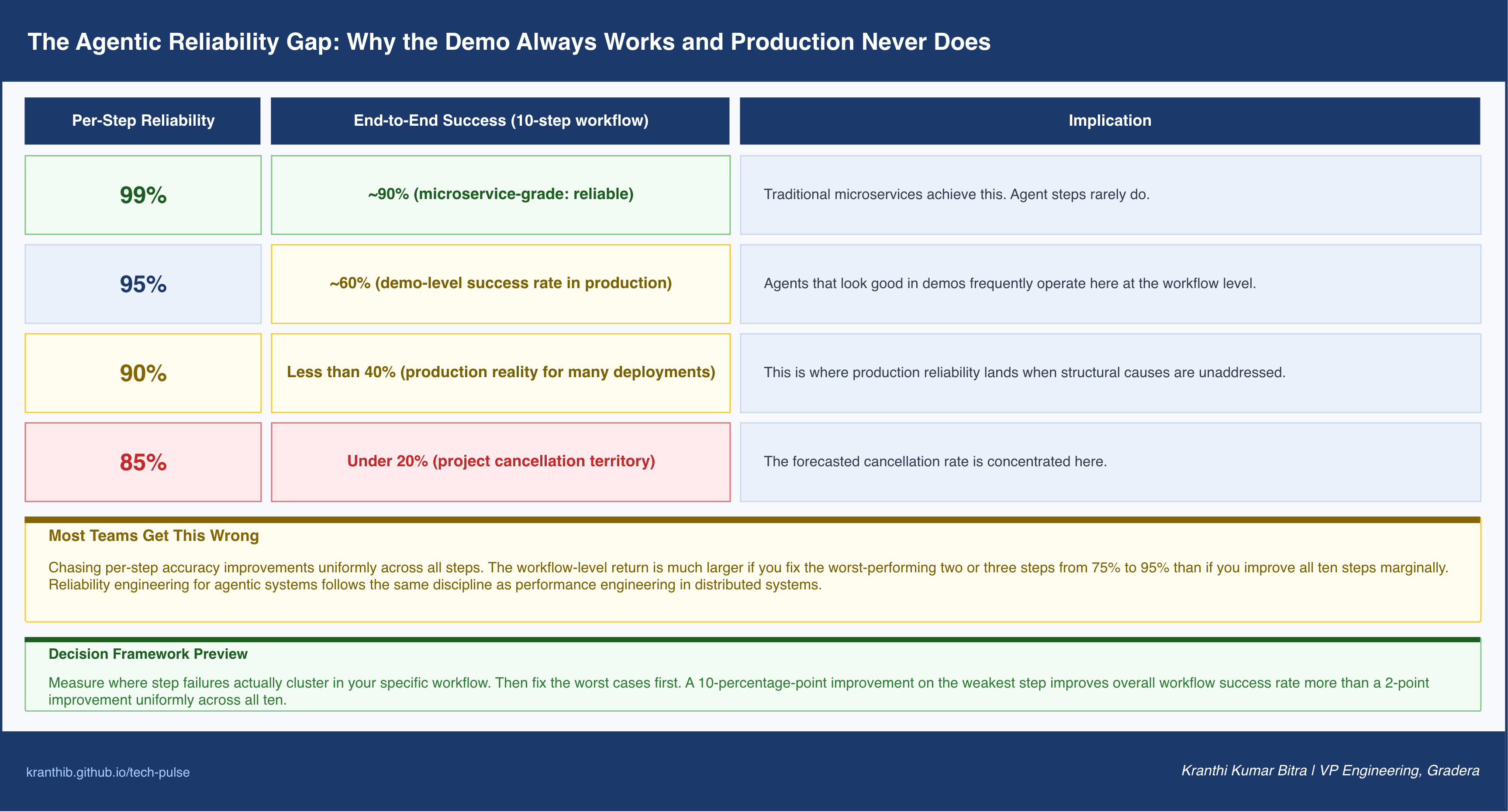
The compounding effect of multi-step execution makes this worse in a specific, quantifiable way. An agent that is ninety-five percent reliable on any individual step in a ten-step workflow has a roughly sixty percent chance of completing the workflow correctly, assuming the steps are independent. If the agent is ninety percent reliable on each step, the probability of a successful completion falls below forty percent. At eighty-five percent per step, it is under twenty percent. This is the same mathematics that governs any cascading system, but it surfaces more dramatically in agentic systems because the steps are longer, more heterogeneous, and less predictable than the components of a typical distributed service.
A traditional microservice that is ninety-nine percent reliable per request is highly reliable even in complex pipelines, because the per-request unit of work is narrow, well-defined, and designed to be composed. An agent step that is ninety percent reliable per operation is not, because agent steps are not narrow, not always well-defined, and not designed with the same level of composability discipline. The per-step success rate that looks impressive in isolation produces unacceptable end-to-end reliability at the workflow level.
This mathematics has a counterintuitive implication for where to invest in reliability improvement. Teams that focus on pushing individual step accuracy from eighty-eight to ninety-two percent are making an investment whose workflow-level return is modest. If the baseline per-step reliability is ninety percent across ten steps, improving to ninety-two percent improves end-to-end workflow reliability from approximately thirty-five percent to roughly forty-three percent: real, but not dramatic. The same engineering effort spent on eliminating one entire category of step failures, improving the two worst-performing steps from seventy-five percent to ninety-five percent rather than improving all ten steps marginally, produces a much larger end-to-end gain. Reliability engineering for agentic systems should follow the same discipline as performance engineering in distributed systems: measure where the failures actually cluster, then fix the worst cases first rather than applying uniform improvement across the board.
Five Structural Causes of the Reliability Gap
The reliability gap is not random. It clusters in predictable categories, and the organizations that close it consistently do so by addressing the same set of structural problems rather than by building smarter agents.
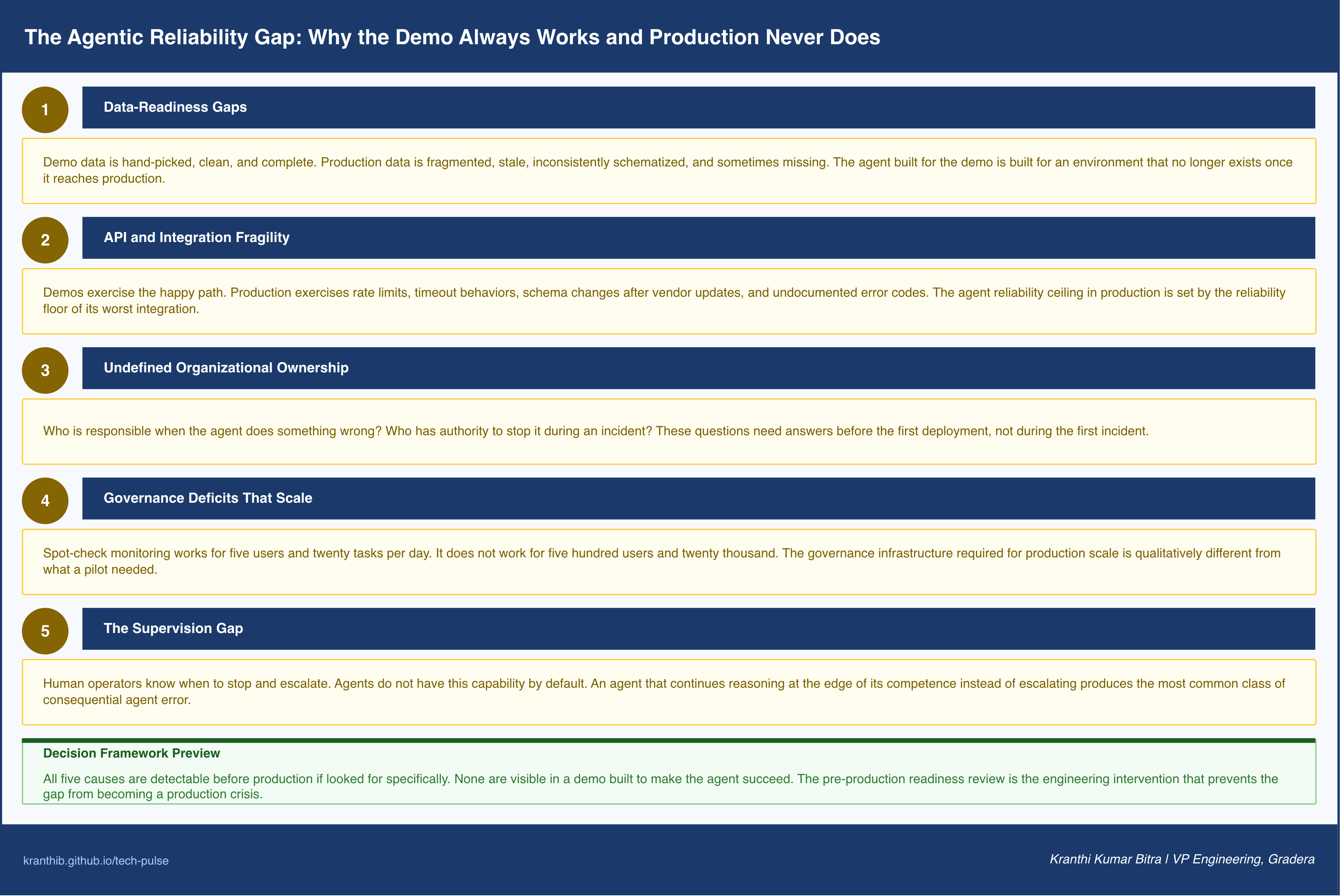
Data-readiness gaps that were invisible in the demo. Agentic systems are only as reliable as the information they can access and reason from. Demo data is hand-picked to be clean, complete, and representative. Production data is none of these things at any reliable frequency. Fragmented data across siloed systems, stale data from upstream processes that run on batch schedules, inconsistent schemas across business units, and missing values in fields the agent’s reasoning depends on are all normal conditions in production enterprise environments, and they are all invisible in a demo that uses a curated dataset. An agent built without an honest assessment of the data it will encounter in production is not a production-ready agent; it is a pilot that has not yet met its environment.
API and integration fragility outside the happy path. A demo typically exercises the happy path of every API the agent calls. Production exercises every path, including paths the API vendor did not document, rate limits that kick in under load, transient failures that require retry logic the agent was not given, and schema changes between vendor API versions that were not communicated ahead of time. An agent built with the assumption that its tool calls will succeed reliably in production will fail exactly as often as its integrations do, and enterprise integration reliability is measurably lower than the demo implied.
Undefined ownership at the boundary between the agent and the organization. The most common non-technical cause of agentic AI project failure is the absence of a clear answer to a simple question: when the agent does something wrong, who is responsible for fixing it, and who has the authority to stop it while the fix is being developed? In most failed pilots, this question was never answered before deployment, and the first time it needed an answer was during an incident. Organizational ownership ambiguity does not surface in a demo because the demo never produces an incident. It surfaces in production the first time something goes wrong.
Governance deficits that become compliance liabilities at scale. A pilot with five users and twenty tasks per day can be monitored informally, with a team member reviewing outputs and catching problems through spot checks. A production deployment with five hundred users and twenty thousand tasks per day cannot be monitored the same way. The governance infrastructure required to ensure the agent is behaving within its authorized scope, producing auditable outputs, and complying with applicable policies is qualitatively different at production scale from what the pilot required.
This is not primarily a compliance problem, although it becomes one quickly in regulated domains. It is an operational integrity problem: without governance infrastructure, the organization has no reliable way to know whether the agent is doing what it was designed to do, and no reliable way to detect when it is not. The most common discovery pathway for agents operating outside their intended scope is a downstream business consequence that gets noticed by a human who was not actively monitoring the agent. That discovery pathway is expensive, delayed, and does not tell the organization the full scope of what happened before the discovery. The governance infrastructure exists to replace it with a proactive, continuous, low-cost detection capability that catches drift before it produces consequences.
The supervision gap: nobody designed what happens when the agent fails. Human operators in the same roles the agent is now performing learned through experience how to recognize when a task was outside their competence and escalate rather than guess. This meta-skill, knowing when to stop and ask rather than when to continue and risk being wrong, is one of the most valuable things experienced operators bring to complex processes, and it is one that agents do not have by default. An agent that reaches the edge of its competence and continues reasoning rather than stopping and escalating is the most common proximate cause of the kind of consequential agent error that triggers a project cancellation.
Designing the failure mode explicitly, before production, requires the engineering team to answer a question that is uncomfortable during a period of enthusiasm and momentum: where are the conditions under which this agent will fail, and what should it do when it gets there? The answer is not usually “try harder.” It is usually “recognize that the situation has exceeded the design envelope and surface it to a human who can handle it.” Building that recognition into the agent requires more than a system prompt instructing it to escalate when uncertain. It requires defining, in advance, the specific signals that indicate the agent has exceeded its design envelope, and building explicit detection and escalation logic around those signals rather than relying on the agent’s general reasoning to make the call correctly under pressure.
The Capability-Deployment Verification Gap
The concept of a capability-deployment verification gap is more precise and more useful than the generic framing of “pilot-to-production failure,” because it names the specific problem rather than just the symptom.
An agent that succeeds in a controlled evaluation demonstrates one thing: that it can perform the task when the conditions are favorable. It does not demonstrate that the organization can run, monitor, and trust the agent when the conditions are unfavorable. These are different capabilities, and the second one is organizational rather than technical.
Verification in this context means something specific: the ability of the organization to determine, in real time or close to it, whether the agent is operating within its designed parameters, whether its outputs are correct, and whether any given action it is taking is one the organization authorized it to take. In a pilot, verification is informal and human-intensive: someone reviews the agent’s outputs and catches problems. In production at scale, that approach fails because there are too many outputs to review and the agent is taking actions faster than any human review process can track.
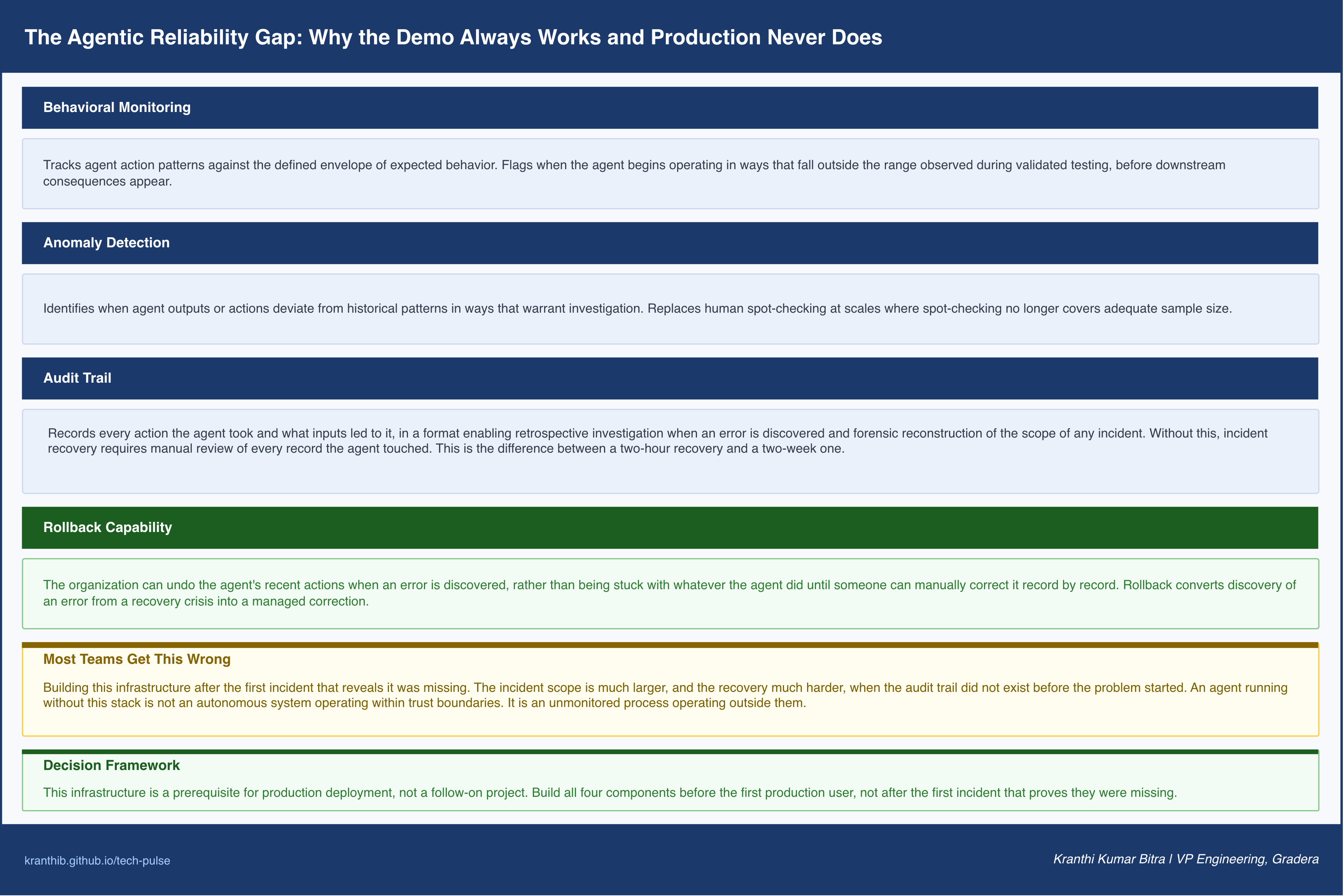
The verification infrastructure required for production agentic deployment includes several components that are each individually straightforward but collectively represent a significant engineering commitment when they have not been planned from the start. Behavioral monitoring tracks the agent’s action patterns against a defined envelope of expected behavior, flagging when the agent begins operating in ways that fall outside the range observed during validated testing. Anomaly detection identifies when the agent’s outputs or actions deviate from its historical pattern in ways that warrant investigation, without requiring a human to review every individual action. An audit trail records every action the agent took and what inputs led to it, in a format that enables retrospective investigation when an error is discovered and forensic reconstruction of the scope of any incident. Rollback capability means the organization can undo the agent’s recent actions when an error is discovered, rather than being stuck with whatever the agent did until someone can manually correct it record by record.
None of this infrastructure is visible in the demo, and all of it is required for the organization to trust the agent in production. The organizations that close the capability-deployment verification gap consistently treat this infrastructure as a first-class engineering deliverable rather than an operational afterthought. An agent running without verification infrastructure is not an autonomous system operating within organizational trust boundaries. It is an unmonitored process operating outside them, and the difference is precisely the distance between a pilot that impressed everyone and a production deployment that the organization can actually stand behind.
What Most Teams Get Wrong
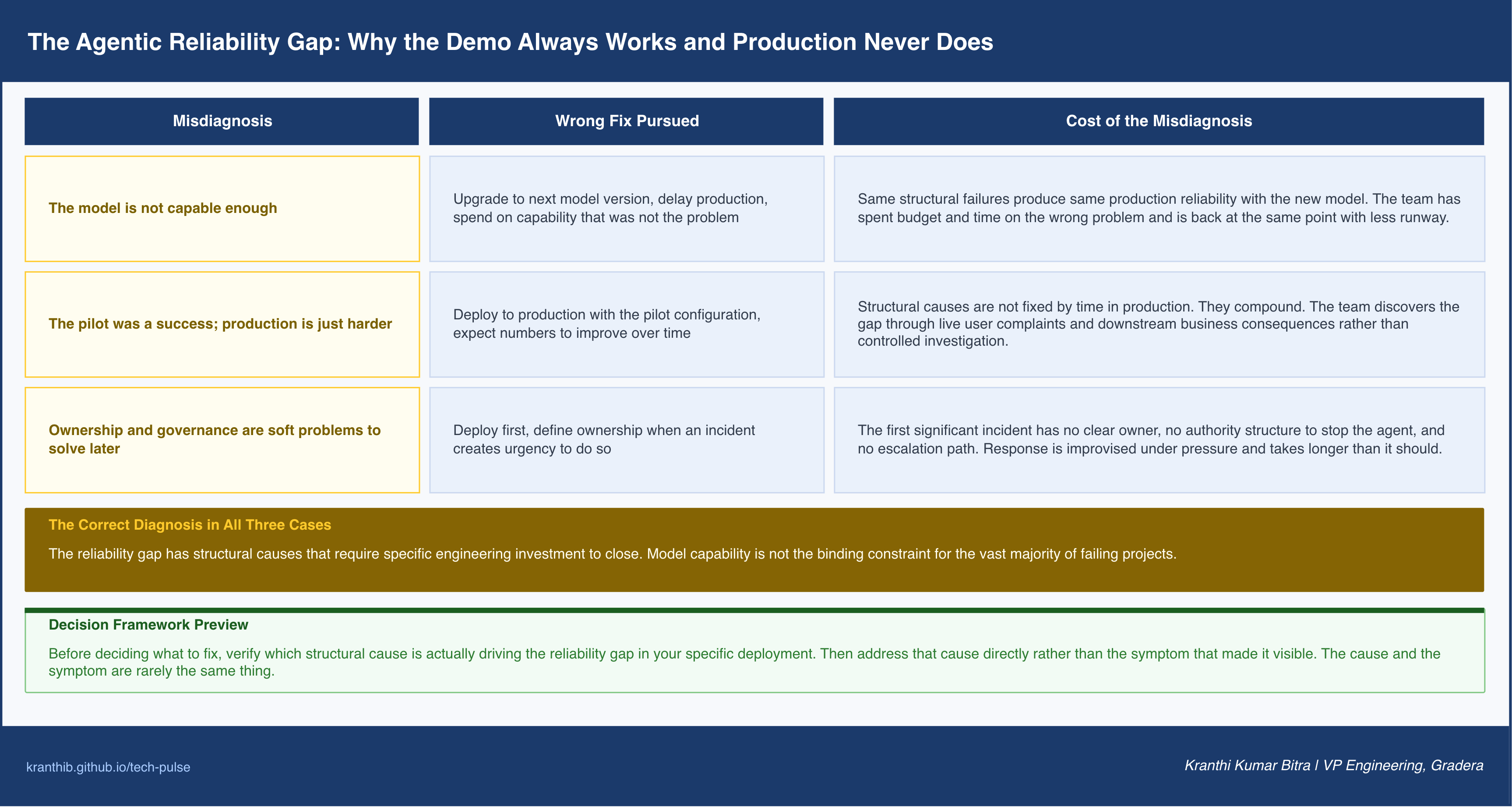
The most common mistake is treating the reliability gap as a model problem and responding by searching for a more capable model. A team that has a thirty percent end-to-end workflow success rate in production and concludes that the agent needs a smarter model is misdiagnosing the failure. The compounding mathematics described earlier mean that even a very significant improvement in individual step accuracy produces only modest improvement in end-to-end reliability if the structural causes of step failures are not addressed. A team that fixes the data-readiness gaps, adds retry logic for the fragile integrations, and defines the failure escalation path will see a larger reliability improvement than one that upgrades to the next model version, and the improvement will be more durable because it addresses root causes rather than symptoms.
The second most common mistake is piloting in a clean environment and calling it a production readiness test. A pilot that succeeded on curated data, exercised only the happy path of every integration, and never encountered an input outside its design envelope has not passed a production readiness test. It has passed a demo readiness test. Production readiness requires exercising the agent against a representative sample of the actual messy reality it will encounter, which means dirty data, unexpected API responses, out-of-distribution inputs, and the edge cases that human operators handle by institutional knowledge the agent does not have. A team that advances from pilot to production without having exercised the agent against this reality is discovering the reliability gap on live users rather than in a controlled environment where they can do something about it.
The third mistake is treating organizational ownership ambiguity as a soft problem to be resolved later. The question of who owns the agent in production, who is accountable for its outputs, who has authority to stop it when something goes wrong, and what the escalation path is for failures, needs a specific answer before the first production deployment, not after the first incident. Incidents do not wait for organizational design to be completed, and the cost of answering these questions under incident pressure is dramatically higher than the cost of answering them in advance.
A Framework for Closing the Gap
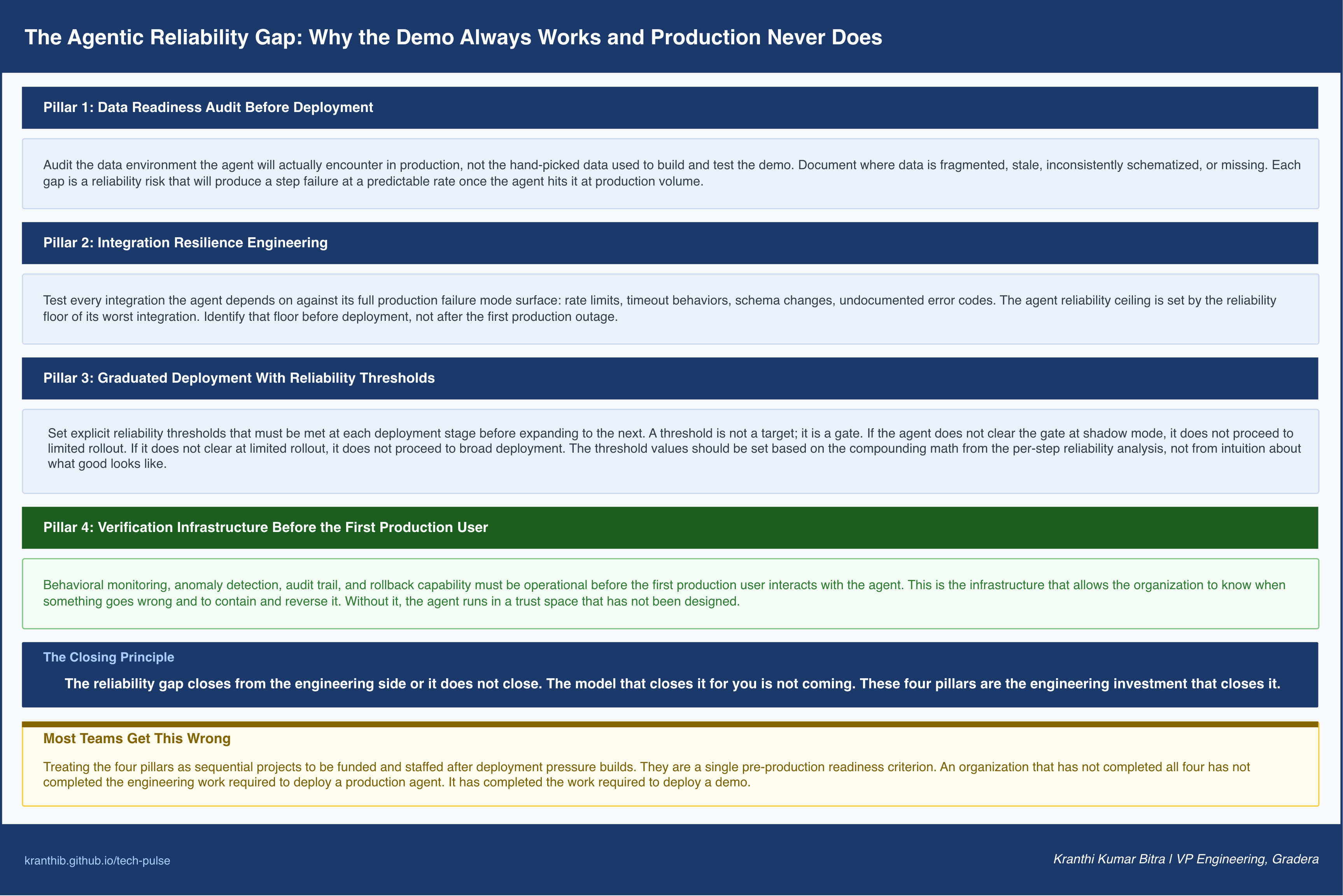
The organizations whose agentic AI projects survive into production share a consistent set of practices that can be grouped into four categories. None of these practices are exotic or technically sophisticated. They are discipline applied before the pressure of a live deployment makes everything harder.
Data readiness before agent deployment. Before any agent is deployed to production, the team should be able to answer with specificity: what data will this agent access in production, what is the quality and consistency of that data, what happens when data is missing or malformed, and has the agent been tested against the actual data it will encounter rather than a clean sample. Organizations that skip this step invariably discover the answer to these questions through production failures rather than through pre-deployment investigation, and the difference in cost between the two discovery pathways is substantial.
Integration resilience as a first-class design requirement. Every tool the agent calls should be treated as a potential failure point, because in production it will be. This means retry logic with appropriate backoff, explicit handling of every documented and undocumented failure mode of each integration, circuit breakers that prevent the agent from continuing when a critical integration is unavailable, and monitoring that tracks integration health independently of the agent’s behavior. The guiding principle is that the agent’s reliability ceiling in production is set by the reliability floor of its worst integration, and that ceiling is lower than most teams assume before they have measured it.
Graduated deployment with explicit reliability thresholds. The transition from pilot to production should be staged, with defined reliability thresholds that must be demonstrated at each stage before the next stage proceeds. A team that defines what acceptable production reliability looks like, and measures actual reliability against that definition at each stage, knows when the gap is closed. A team that deploys to production without defining these thresholds will only know the gap exists after the first significant failure.
Verification infrastructure as a prerequisite, not a follow-on. The behavioral monitoring, anomaly detection, audit trail, and rollback capability described earlier should be in place before the agent handles production traffic, not added after the first incident that reveals they were missing. This sequencing is the single biggest operational difference between the teams whose agentic projects succeed and those whose projects are cancelled.
A Worked Example: What the Gap Looks Like Inside a Real Pipeline
Abstractions make the reliability gap sound like a policy problem. Concrete examples make clear it is an engineering problem with specific, findable failure points.
Consider an agent built to handle supplier invoice processing for a mid-sized manufacturing organization. The pilot runs for six weeks against a clean dataset of five hundred historical invoices, exercises the workflow end to end, and achieves a ninety-two percent success rate that the team correctly recognizes as impressive for a first deployment. Budget is approved and the agent moves to production against a live invoice stream.
Within the first ten days, the production success rate is running at roughly fifty-five percent. The team investigates and finds five distinct failure modes, none of which appeared in the pilot.
The first is a data format issue. One of the organization’s three supplier portals exports invoices in a slightly different date format from the other two, a legacy artifact of a system migration that was never normalized. The pilot dataset was drawn entirely from portals with consistent formatting. The agent handles the inconsistent format incorrectly, mis-categorizing a subset of invoices.
The second is an API rate limit. The accounting system the agent posts approvals to has a rate limit that is never hit during the pilot’s leisurely pace. In production, the full invoice volume regularly exceeds it. The agent was not built to handle this error gracefully, retries immediately, hits the limit again, and eventually times out, leaving invoices in an ambiguous state that requires human resolution.
The third is a missing escalation path. Approximately twelve percent of production invoices contain a line-item discrepancy that requires a human reviewer to check against a purchase order. The curated pilot dataset had no such invoices. The agent in production encounters them, has no defined behavior, marks them as processed rather than escalating, and generates incorrect financial records downstream.
The fourth is an organizational ownership gap. When the team discovers the errors, they need to understand the full scope and correct the affected records. There is no audit trail recording which invoices were processed by the agent versus humans, or what state each invoice was in when the agent touched it. Reconstructing the scope requires manual review of every invoice since go-live.
The fifth is a verification gap. Nobody designed monitoring that would detect the success rate falling from ninety-two percent in the pilot to fifty-five percent in production. The team discovered the problem when a downstream finance report had numbers that did not match expectations, ten days into the damage.
Every one of these failure modes was detectable before production if the team had looked specifically for it. The date format inconsistency would have appeared in a production data sample. The rate limit would have appeared in a load test. The missing escalation path would have appeared in a workflow edge case exercise. The ownership gap would have appeared in a production readiness review that asked who was responsible for what. The verification gap would have appeared if someone had designed a monitoring system alongside the agent rather than after the first incident.
The team spent three weeks in recovery. After addressing the five failure modes, the production success rate moved to eighty-seven percent and continued improving as additional edge cases were discovered and handled systematically. The pilot’s ninety-two percent success rate was real. It was just measuring something different from what production required.
Where This Is Heading
The projected cancellation rate for current agentic AI projects is a forecast about projects that have already started, built by teams who are already invested in the outcomes, which means the organizational incentives are strongly against honest assessment of the reliability gap. Teams that have piloted agents, received budget, and made commitments to stakeholders do not naturally reach for the data that says forty percent of projects like theirs will be cancelled. They reach for the data that says their project is different.
It is different in the ways that matter. What is not different is the underlying physics of the problem: the reliability gap between demo environments and production environments exists for structural reasons that apply regardless of the quality of the team or the capability of the model. The teams that will successfully close the gap are the ones that treat the structural causes as engineering problems to be solved rather than as obstacles to be explained away on the path to the next sprint.
The trajectory of agentic AI as a category is toward more autonomy, more tool access, and more organizational reliance on agent outputs. Each of these trends makes the reliability gap more consequential rather than less. An agent with narrow tool access and human review of every output can fail quietly and be corrected with modest effort. An agent with broad tool access, organizational authority to take actions, and no verification infrastructure fails loudly, expensively, and in ways that generate exactly the kind of incident that prompts the cancellation that was forecast.
A useful reframe for engineering leaders is to treat production readiness not as a binary gate that gets cleared once but as an ongoing property that requires maintenance as the agent’s scope, tools, and usage patterns evolve. An agent that was production-ready at launch with ten tool integrations and a narrow task scope is not automatically production-ready after six months of additions that expand its tool surface and broaden its task envelope, even if each individual addition seemed modest in isolation. Production readiness requires reassessment whenever the agent’s capabilities or context change materially, and the verification infrastructure that supports that reassessment needs to be designed for evolution rather than for a snapshot.
The teams that build the verification infrastructure, address the data readiness gaps, design the failure escalation paths, and define the production reliability thresholds before deployment will not eliminate the reliability gap entirely. They will make it visible, manageable, and narrow enough to operate inside. That is the actual definition of production-ready, and it is achievable through engineering discipline rather than through waiting for the next model that is good enough to make the gap disappear on its own. That model is not coming. The gap closes from the engineering side, or it does not close.