
AI Governance for Engineering Leaders: Why Your Compliance Team Cannot Solve This Problem
The Framework That Saved Us — and the One That Failed
Two years ago, an engineering team I know well shipped an AI-assisted underwriting feature into production. The compliance team had reviewed it. Legal had signed off. The model card existed. The risk assessment was filed. Every box was checked.
Six weeks later, the model was producing recommendations that systematically disadvantaged a subset of applicants based on a proxy variable no one had explicitly included — a neighborhood-level feature that correlated strongly with protected characteristics. No alert fired. No monitoring caught it. No human flagged it during review. The model was performing exactly as optimized, and the governance documentation described a system that no longer reflected what was running in production because the model had been updated twice since the paperwork was completed.
The incident was caught by a downstream analyst who noticed a pattern in rejection rates. By then, thousands of decisions had been made. The remediation cost — regulatory, reputational, and operational — ran into eight figures.
The governance framework failed not because it was poorly designed. It failed because it was designed by the wrong team, using the wrong tools, for a system that moves faster than any static process can follow.
This is the governance problem in 2026. And it is an engineering problem — not a compliance problem.
Why the August 2026 Deadline Changes Everything
The EU AI Act enforcement clock has been running since 2024. In August 2026, the high-risk AI system requirements move from voluntary alignment to enforced compliance. For engineering leaders, the implications are concrete and immediate.
Most multi-agent orchestration deployed in regulated sectors — financial services, healthcare, legal, HR, critical infrastructure — qualifies as high-risk under the Act’s classification criteria. High-risk classification triggers specific engineering obligations: transparency requirements on model behavior, mandatory human oversight mechanisms, detailed logging of consequential decisions, incident reporting within 72 hours, and the ability to produce an audit trail that traces any output back through its data lineage and model version.
These are not policy requirements. They are system requirements. You cannot produce an audit trail that does not exist. You cannot demonstrate human oversight that was not architected into the system. You cannot report an incident within 72 hours if your observability layer does not detect it.
Only 7 to 8 percent of organizations had integrated cross-agent governance as of early 2026. That number has not grown fast enough to prevent what is coming. The teams that have not built engineering-owned governance into their AI systems are now in a race with a fixed deadline — and they are building on the wrong foundation.
The Fundamental Problem with Policy-First Governance
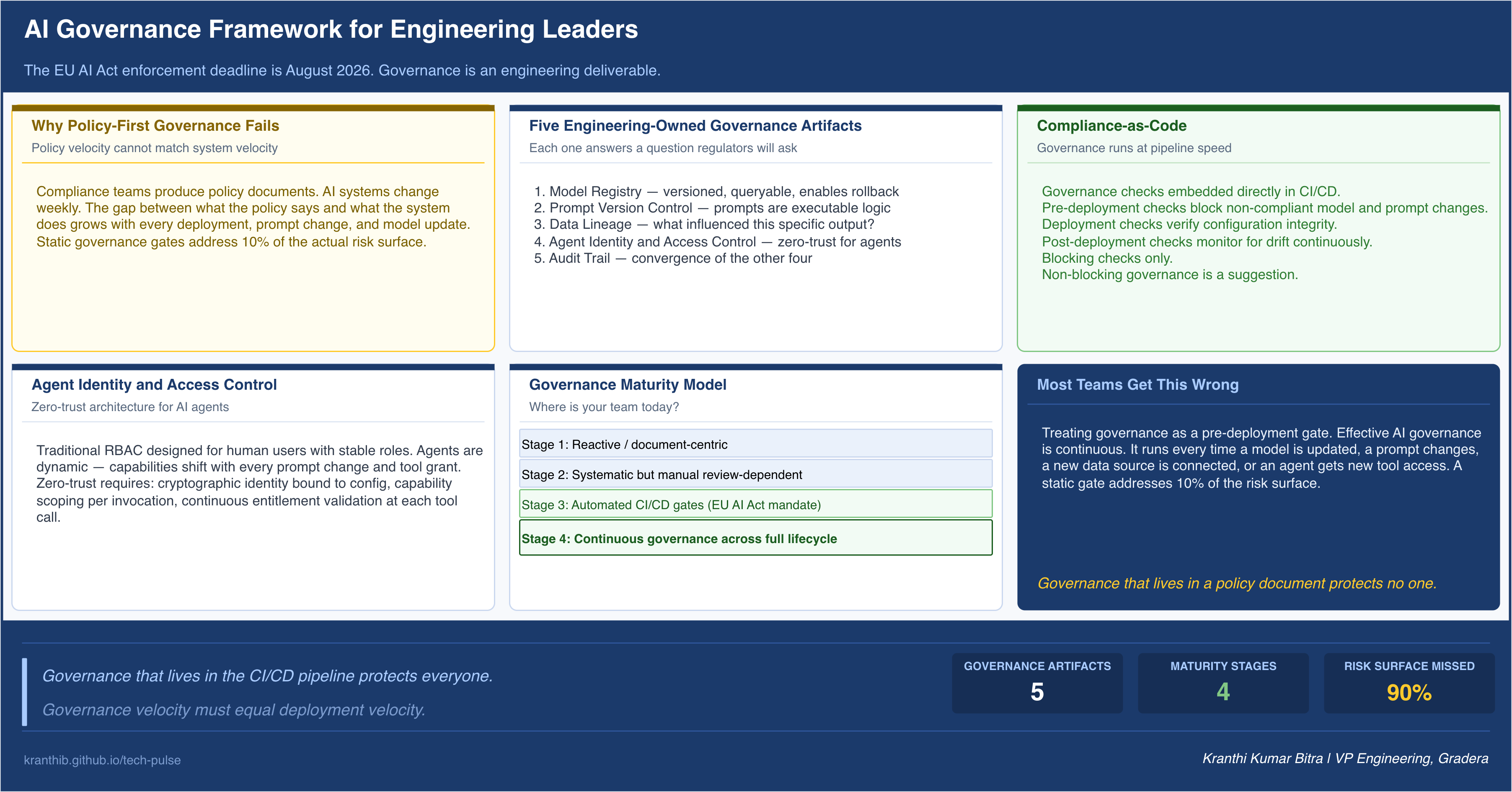
Compliance teams produce policy documents. Policy documents describe how a system should behave. AI systems change weekly. The gap between what the policy says and what the system does grows every time a model is updated, a prompt is modified, a new data source is connected, or an agent is granted new tool access.
This is not a critique of compliance professionals. It is a structural observation about the toolset they have available. A policy document cannot enforce itself. A review committee that meets monthly cannot keep pace with a CI/CD pipeline that deploys multiple times per day. A static risk assessment cannot capture a system whose risk surface is continuously expanding.
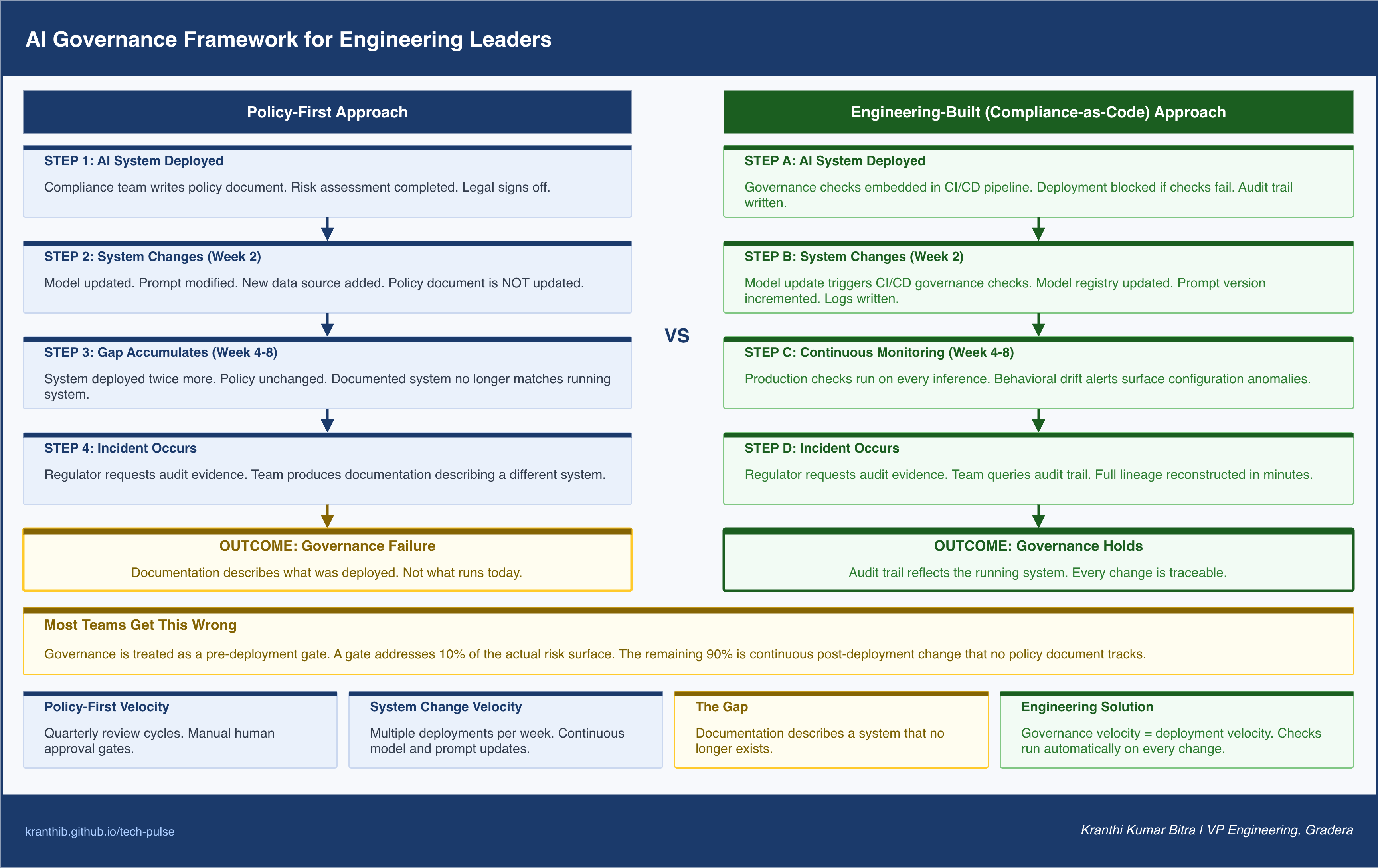
The consequences of this mismatch are predictable. Governance becomes a pre-deployment gate rather than a continuous control. Teams learn to write documentation that satisfies the gate. The actual running system diverges from the documented system. Auditors review the documentation. Nobody reviews the delta.
Engineering-built governance works differently. Instead of describing how the system should behave, it enforces how the system behaves — continuously, automatically, at the speed of the pipeline. The enforcement is in the code, not in the document. When the system changes, the governance changes with it because they are the same artifact.
The shift from compliance-as-documentation to compliance-as-code is not a philosophical preference. It is the only approach that scales to the velocity of modern AI systems.
The Five Engineering-Owned Governance Artifacts
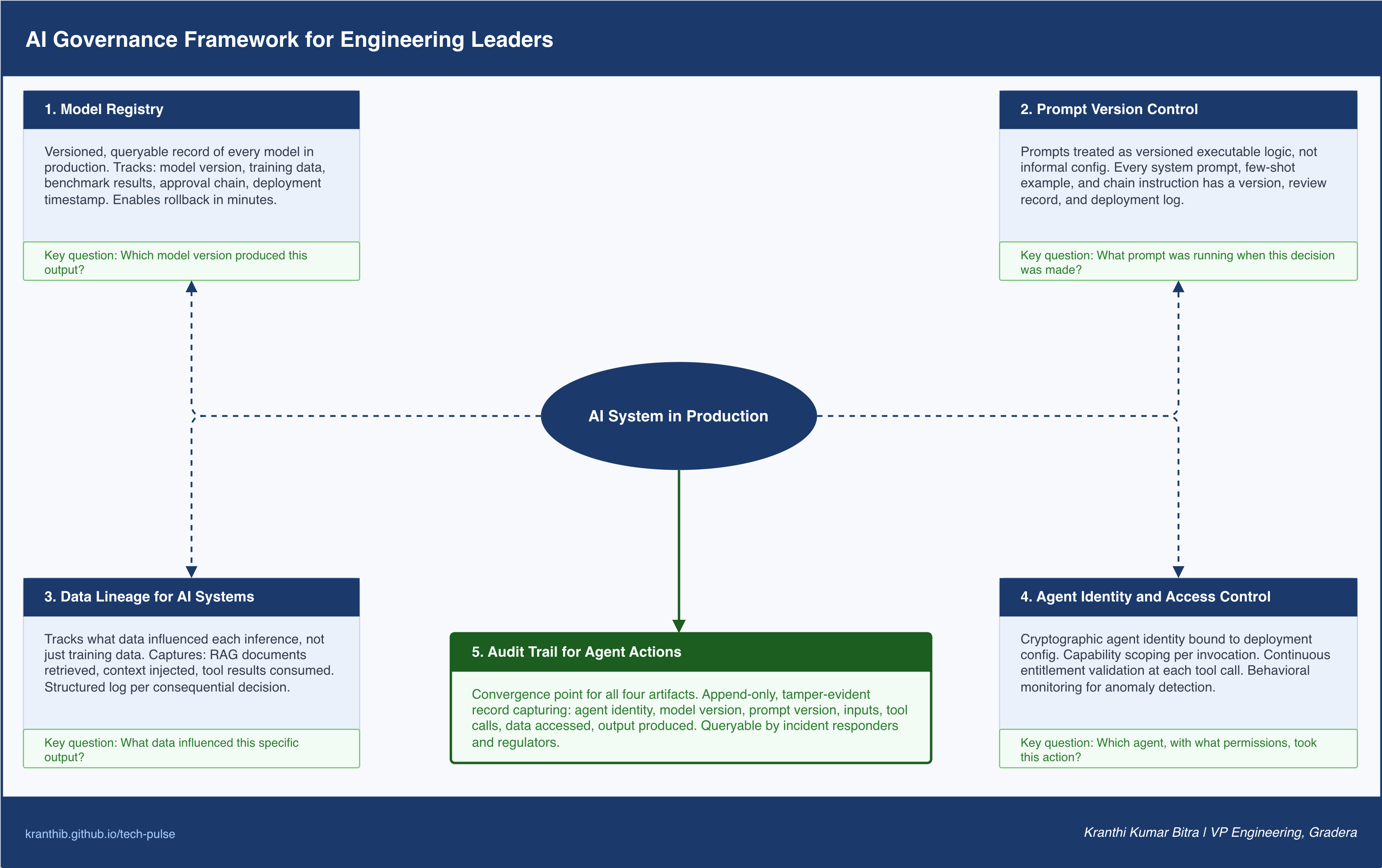
After working through this problem across several production AI systems, I have come to treat governance as five specific engineering artifacts. Each one addresses a distinct governance gap. Together, they cover the full risk surface of a production AI deployment.
1. Model Registry
A model registry is not a spreadsheet. It is a versioned, queryable record of every model in production — including which version is running, what training data was used to produce it, what evaluation benchmarks it was tested against, who approved its deployment, and when. It tracks the full provenance chain from training data through fine-tuning through deployment.
The governance function of the model registry is traceability. When an incident occurs — when a model produces outputs that cause harm, trigger a regulatory inquiry, or simply behave unexpectedly — the first question is always “which version of which model produced this?” Without a model registry, that question cannot be answered quickly. With one, it can be answered in seconds.
A production-grade model registry also enables rollback. If a newly deployed model version degrades quality or introduces bias, the registry provides the reference point for reverting to the last known good state. This is not a convenience feature. It is a safety mechanism.
2. Prompt Version Control
Prompts are not configuration. They are executable logic that determines how a model interprets inputs and generates outputs. Changing a system prompt changes model behavior as reliably as changing code changes application behavior. Yet most teams treat prompts as informal configuration that lives outside their version control system.
The governance implication is severe. If you cannot tell me what prompt was in production at a specific time, you cannot reconstruct what a model was doing when an incident occurred. You cannot audit the behavior. You cannot demonstrate to a regulator that your system behaved consistently with its documentation.
Prompt version control means treating every system prompt, every few-shot example, every chain instruction as a versioned artifact. Prompt changes go through the same review and approval process as code changes. Deployment of a prompt change is logged with the same specificity as a code deployment. The running prompt in production is always identifiable by version.
3. Data Lineage for AI Systems
Traditional data lineage tracks how data flows through a pipeline — which source it came from, which transformations were applied, where it ended up. AI data lineage requires something more: tracking what data influenced a specific output.
This distinction matters enormously for governance. In a traditional system, data lineage tells you what went into the database. In an AI system, you need to know what data influenced the model’s decision at inference time — which RAG chunks were retrieved, which few-shot examples were selected, which context was included in the prompt window. This is different from training data lineage, though both matter.
The architecture for AI data lineage involves instrumenting the inference pipeline to capture the full context that accompanied each consequential decision. For RAG-based systems, this means logging which documents were retrieved and their relevance scores. For agent systems, it means logging which tool calls were made and what data was returned. The output is a retrievable record that shows exactly what information the model had access to when it produced a specific output.
4. Agent Identity and Access Control
Traditional role-based access control was designed for human users. It assumes identities are stable, that access grants are deliberate, and that the principal requesting access is a known entity. Agentic systems violate all three assumptions.
Agents are dynamic. An agent’s capabilities change when its tool access changes, when its system prompt is updated, or when it is given access to a new memory store. The “same” agent in production today may be substantially different from the same agent last week. Traditional RBAC cannot model this dynamism.
The governance requirement for agent access control has three components. First, agent identity must be stable and verifiable — each agent instance has a cryptographically bound identity that is separate from the human or service that deployed it. Second, access grants must be scoped to the minimum capability required for the agent’s current task — not the maximum capability the agent might conceivably need. Third, every action taken by an agent under a specific identity must be logged against that identity with enough context to reconstruct the agent’s reasoning for taking that action.
This is zero-trust applied to non-human identities. It is harder than traditional zero-trust because the principals are not stable. But it is the only access control model that provides meaningful governance for agentic systems.
5. Audit Trail for Agent Actions
The audit trail is where all four previous artifacts converge. It is the record that answers the question every regulator, every auditor, and every incident responder will ask: “Show me exactly what happened, when, and why.”
An effective audit trail for an agentic system captures: the agent identity that initiated the action, the model version and prompt version in effect at the time, the inputs received, the tool calls made and their outcomes, the data accessed, the output produced, and the human or system that consumed that output. It is append-only, tamper-evident, and queryable.
The architectural requirements are demanding but not novel. They map closely to what distributed systems engineers have built for event sourcing and CQRS patterns. The difference is that the events being sourced are agent actions rather than domain events, and the consumers of the audit stream include compliance systems, not just application components.
Model Provenance and Data Lineage: The Technical Architecture
Model provenance and data lineage deserve a dedicated section because they are the least understood of the five governance artifacts — and the most technically demanding to implement correctly.
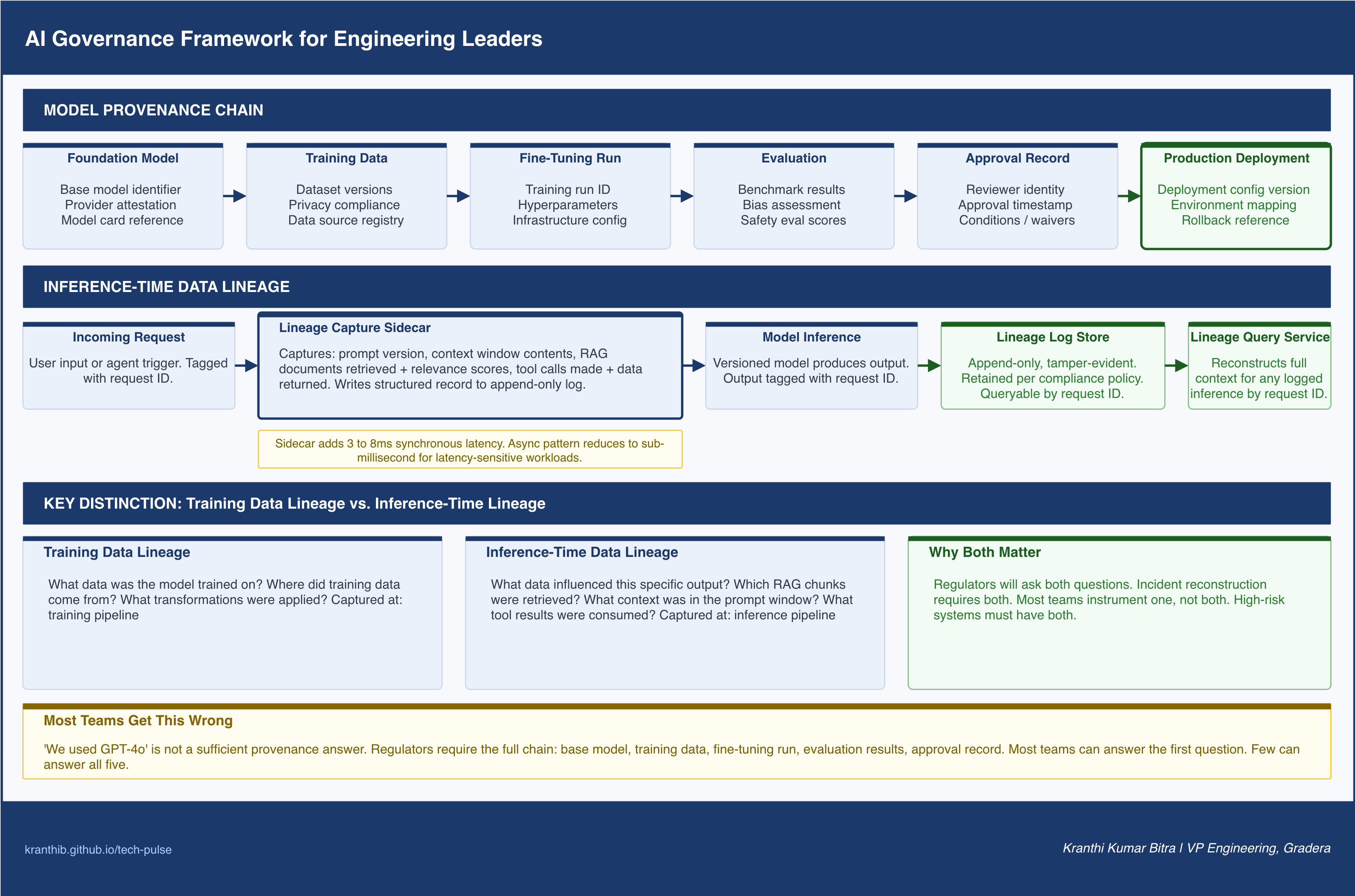
Model provenance answers the question: “Where did this model come from?” The complete provenance chain for a production AI model includes the base model or foundation model, any fine-tuning datasets and the transformations applied to them, the training infrastructure and the specific training run, the evaluation datasets and benchmark results, the human review and approval record, and the deployment configuration.
Most teams track some of this. Few track all of it. The gap matters because regulators increasingly want the full chain. “We used GPT-4o” is not a sufficient answer when an audit asks what data was used to train the model and what guardrails were applied. For fine-tuned models, the provenance obligation is even more extensive.
Data lineage for inference is architecturally distinct from training data lineage. At inference time, the model’s output is influenced by the inputs in the prompt window — which may include retrieved documents, conversation history, tool results, and injected context. Capturing what influenced a specific inference requires instrumenting the inference pipeline, not the training pipeline.
The implementation pattern I have found most reliable involves a sidecar service on the inference path that captures a structured record of the prompt context before the request is sent to the model. This record is written to an append-only log, tagged with a request identifier, and retained according to the applicable data retention policy. Downstream, a lineage query service allows reconstruction of the full context for any logged inference, given the request identifier.
This pattern adds latency — typically three to eight milliseconds on the capture path — but it is acceptable for the governance benefit in high-risk applications. For latency-sensitive paths, an asynchronous capture pattern can reduce the synchronous overhead to sub-millisecond while retaining the same governance properties.
Agent Identity and Access Control: The Zero-Trust Architecture
The access control problem for agentic systems is one of the most interesting architecture problems in enterprise AI right now. Traditional approaches break in ways that are subtle before they are catastrophic.
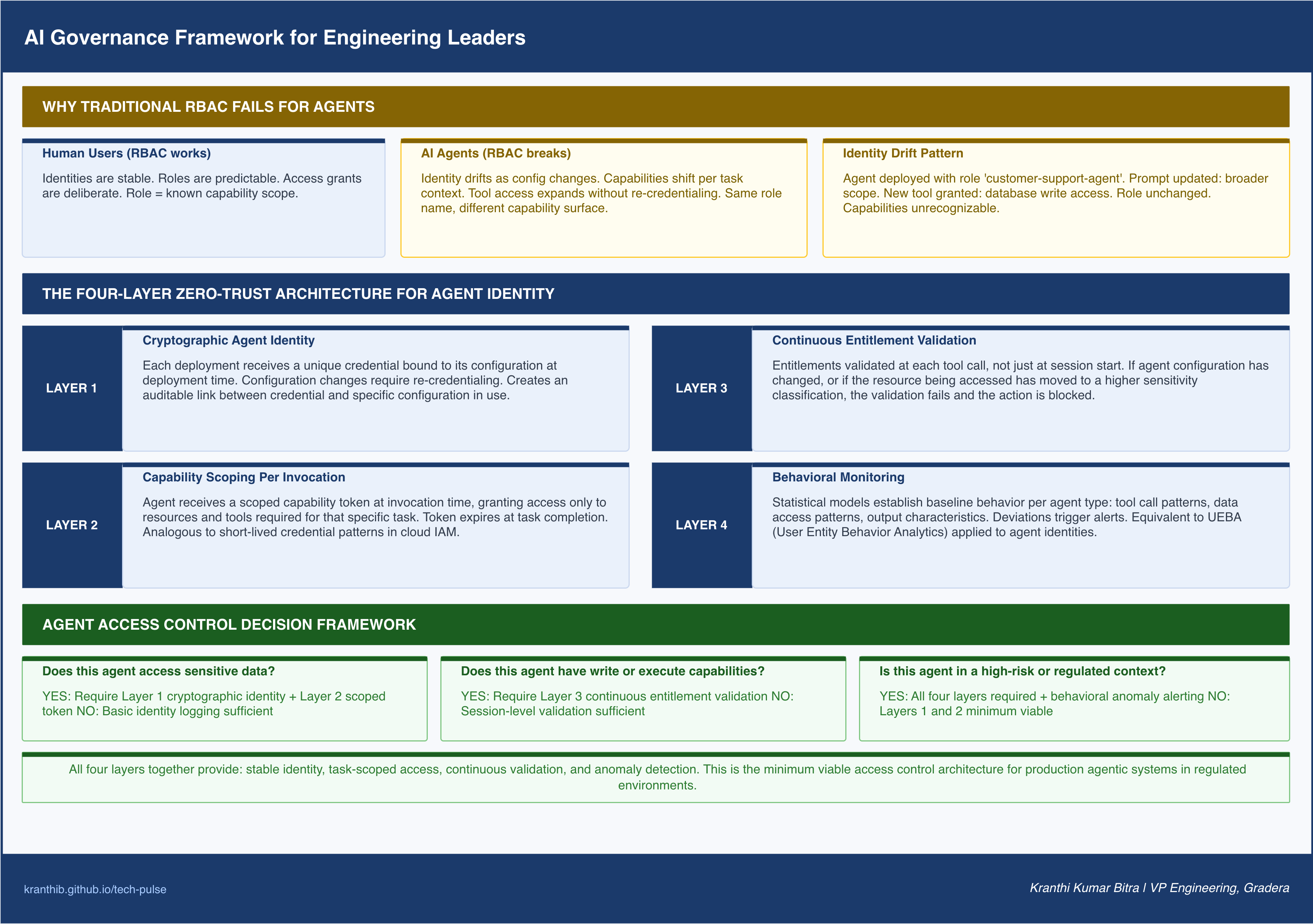
The core failure mode of applying traditional RBAC to agents is what I call identity drift. An agent’s effective capabilities at any point in time are determined by its tool access, its system prompt, its memory contents, and the context of the task it is currently executing. Two instances of the “same” agent — defined by the same deployment configuration — can have dramatically different effective capabilities depending on what task they were invoked for.
If your access control model grants permissions to “the customer support agent” as a static role, you have no mechanism to detect when that agent’s prompt was modified to give it broader scope, or when it was granted access to a new tool that expands its effective privileges. The role is the same. The capabilities are not.
The architecture I recommend for agent identity management has four layers.
The first layer is cryptographic agent identity. Each agent deployment receives a unique credential that is bound to its configuration at deployment time. Configuration changes require re-credentialing. This creates an auditable link between the credential and the specific configuration in use.
The second layer is capability scoping per invocation. When an agent is invoked for a specific task, it receives a scoped capability token that grants access only to the resources and tools required for that task. The token expires at task completion. This is analogous to short-lived credential patterns in cloud IAM, applied to agent tool access.
The third layer is continuous entitlement validation. Rather than assuming a granted capability remains valid for the duration of a task, the system validates entitlements at each tool call. If the agent’s configuration has changed, or if the resource being accessed has moved to a higher sensitivity classification, the validation fails and the action is blocked.
The fourth layer is behavioral monitoring. Statistical models establish baseline behavior for each agent type — typical tool call patterns, typical data access patterns, typical output characteristics. Deviations from the baseline trigger alerts. This is the AI equivalent of user entity behavior analytics, applied to agent identities.
Compliance-as-Code: Governance in the CI/CD Pipeline
Compliance-as-code is the practice of expressing governance controls as executable checks that run automatically in the CI/CD pipeline. Instead of a human reviewer checking whether a model change meets governance requirements, a set of automated checks enforces those requirements before the change can be deployed.
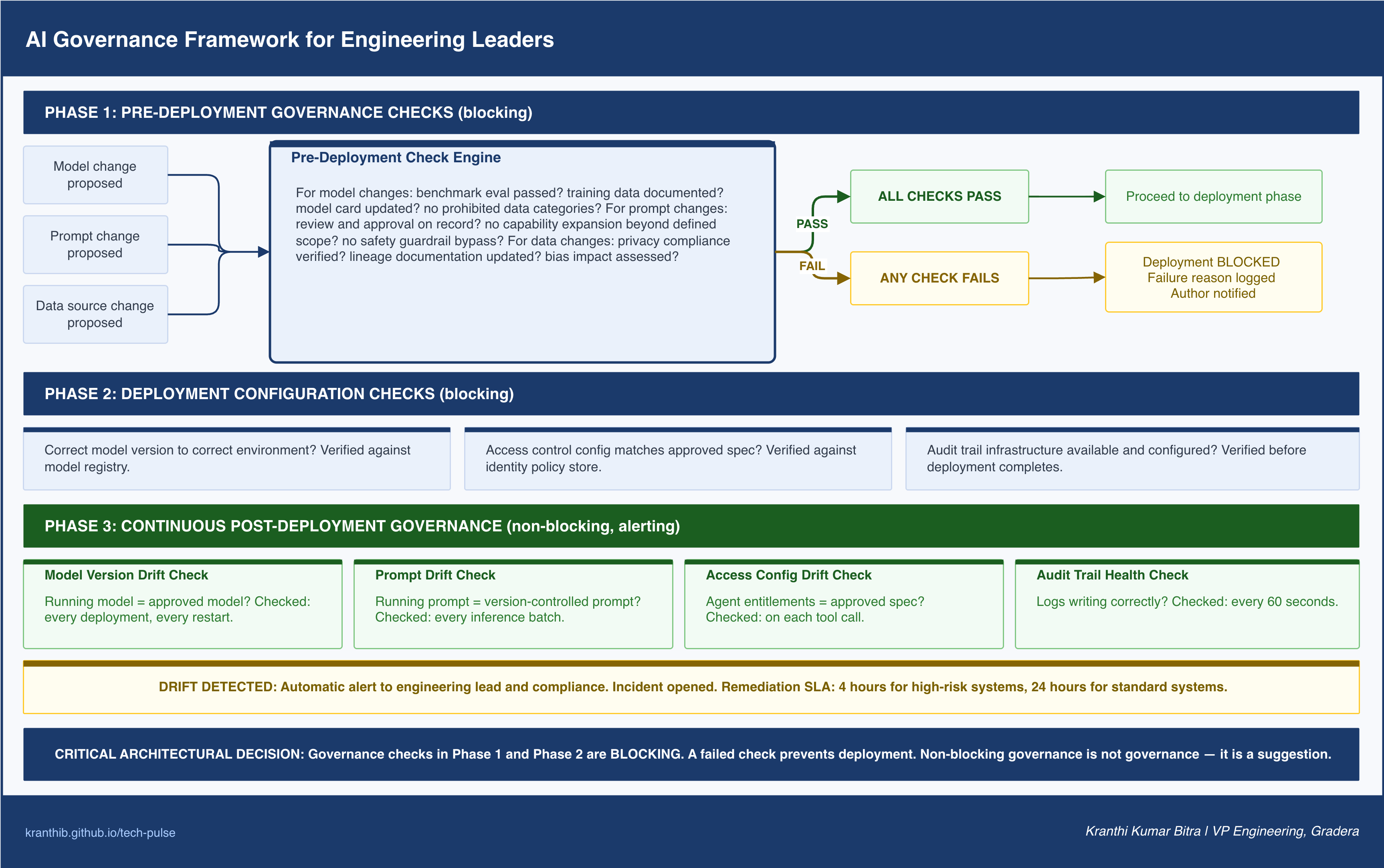
The implementation consists of three categories of checks.
Pre-deployment checks validate that a proposed change meets governance requirements before it reaches production. For model changes, these checks verify that the model has passed required evaluation benchmarks, that its training data lineage is documented, that a model card has been updated to reflect the change, and that no prohibited data categories were used in training or fine-tuning. For prompt changes, the checks verify that the new prompt has been reviewed and approved, that it does not introduce capability expansions beyond the agent’s defined scope, and that it does not bypass safety guardrails present in the previous version.
Deployment checks validate the deployment configuration itself. They verify that the correct model version is being deployed to the correct environment, that the access control configuration matches the approved specification, that logging and audit trail infrastructure is available and correctly configured for the deployment, and that the deployment is tagged with the correct metadata for governance tracking.
Post-deployment checks run continuously in production. They verify that the running system matches the deployed specification — that the model version in production is the model version that was approved, that the prompt in production matches the version-controlled prompt, that the access control configuration has not drifted from the approved configuration, and that the audit trail is being written correctly.
The tooling for compliance-as-code draws from existing infrastructure. Policy-as-code frameworks provide the evaluation engine. CI/CD pipeline extensions provide the integration points. Drift detection tools provide the continuous verification layer. The governance team defines the policies in code; the engineering team integrates those policies into the pipeline; the automated system enforces them on every deployment.
The critical architectural decision is that governance checks are blocking — a failed check prevents deployment, not merely alerts on it. Non-blocking governance is not governance. It is a suggestion.
What Most Teams Get Wrong
Governance implemented as a pre-deployment gate addresses approximately 10 percent of the actual risk surface.
The remaining 90 percent is in continuous change. A model version changes. A prompt is updated. A new data source is connected. An agent is granted access to a new tool. A third-party AI vendor updates their model without notifying you. A retrieval corpus is refreshed with new documents that introduce bias the original corpus did not contain.
None of these events pass through a pre-deployment gate. All of them change the effective behavior of a system that already passed its governance review.
Static governance gates create a false sense of security that is more dangerous than no governance at all. A team that has passed its governance review feels compliant. The system running in production may be substantially different from the system that was reviewed. When an incident occurs, the governance documentation describes a different system.
Effective AI governance is continuous. Every change — to the model, to the prompt, to the data, to the access configuration, to the third-party dependencies — is a governance event. Each one must be detected, evaluated, logged, and either approved or blocked automatically. The governance layer must be as dynamic as the system it governs.
This is architecturally demanding. It requires instrumentation across every point where the system can change. It requires a policy engine that can evaluate those changes against governance requirements in real time. It requires alerting infrastructure that can surface governance violations at the speed of deployment. But it is the only approach that provides genuine protection — not documentation of protection.
Third-Party AI Vendor Governance
A dimension of AI governance that most teams underweight is the governance of systems they do not own.
When your application calls an external model API, you do not control the model version being served. The provider may update the model without publishing a changelog. The update may change the model’s behavior on inputs relevant to your application. Your governance documentation may now describe a system that is using a different model than the one documented.
The governance obligations do not stop at your system boundary. If your application uses a third-party AI component in a high-risk context, you are responsible for the governance of that component’s behavior in your application, even if you cannot govern the component’s development.
The practical implication is that third-party AI vendor governance requires four capabilities. First, model version pinning — the ability to specify which version of a third-party model your application uses, and to prevent automatic upgrades without your review. This is available from some providers and absent from others; the presence or absence of this capability should be a procurement criterion for high-risk applications.
Second, behavioral monitoring at the API boundary. Even if you cannot inspect the model, you can monitor its outputs. A behavioral monitoring layer on the API boundary detects when the model’s outputs have changed in ways that are significant for your governance requirements — different bias patterns, different refusal rates, different output structure.
Third, vendor-side transparency documentation. Major AI providers increasingly publish model cards, training data statements, and evaluation results for their models. Your governance framework should include a process for reviewing this documentation when vendors publish updates and assessing the implications for your application.
Fourth, contractual governance provisions. For high-risk applications, vendor contracts should include specific provisions about model versioning, change notification timelines, and incident response obligations. This is an emerging area of AI procurement, and the quality of vendor compliance varies significantly.
The Governance Maturity Model
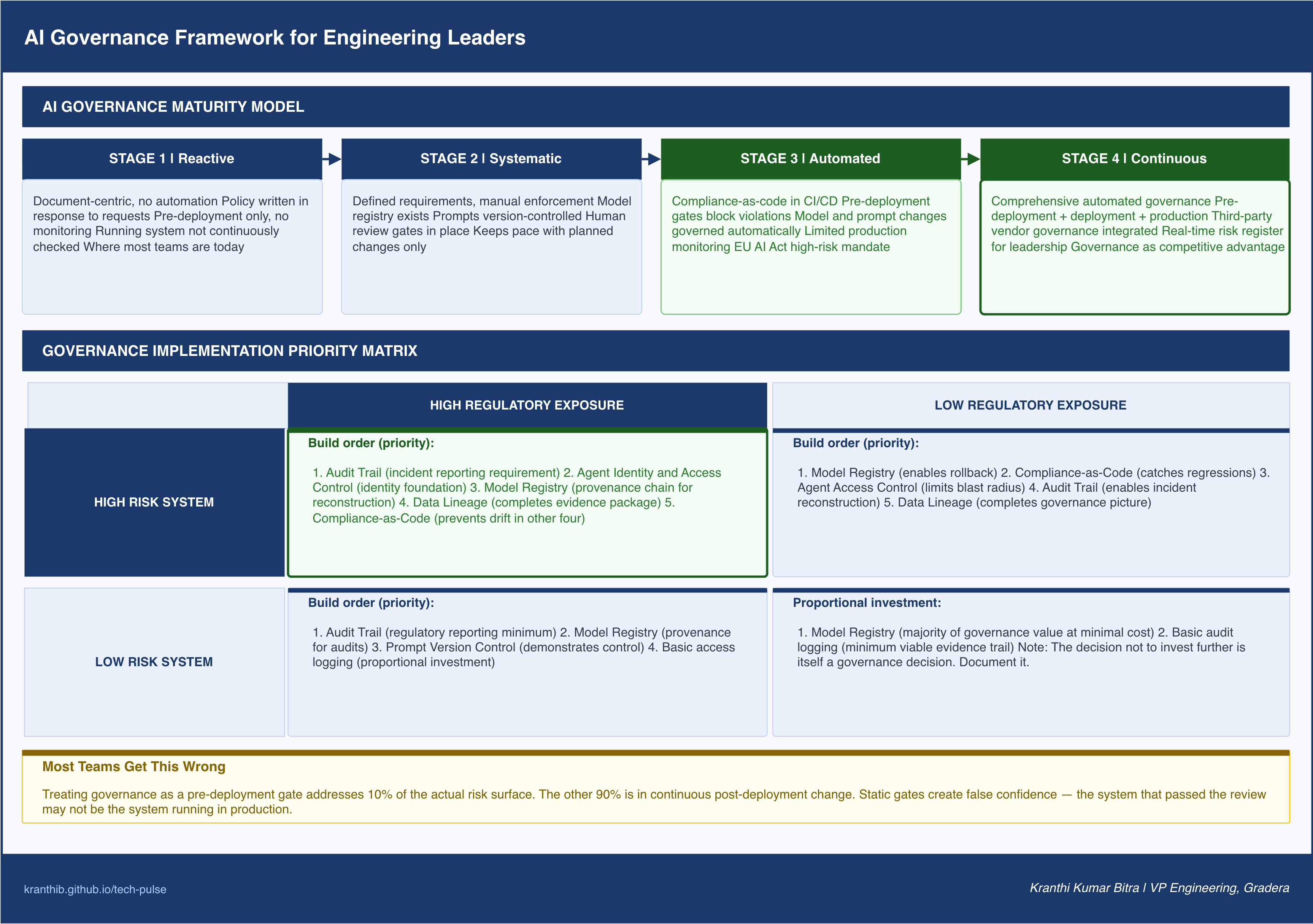
Based on what I observe across engineering organizations in 2026, AI governance tends to progress through four stages. The stages are not strictly sequential — organizations can invest ahead of their natural progression — but they reflect the typical accumulation of capability and cultural shift.
At Stage 1, governance is reactive and document-centric. Teams produce model cards, risk assessments, and policy documents in response to requests from compliance or legal. There is no automated enforcement. Governance is a pre-deployment activity. The running system is not continuously monitored for governance compliance.
At Stage 2, governance is systematic but manual. Teams have defined governance requirements clearly and apply them consistently. There is a model registry. Prompts are version-controlled. But the enforcement relies on human review processes, not automated checks. Governance keeps pace with planned changes but not with unplanned drift.
At Stage 3, governance is automated for the planned change surface. Compliance-as-code checks run in CI/CD. Pre-deployment governance gates block non-compliant deployments. Model and prompt changes are governed automatically. But continuous monitoring in production is still limited. Third-party governance is not yet systematic.
At Stage 4, governance is continuous and comprehensive. Automated checks cover pre-deployment, deployment, and production. Behavioral monitoring detects drift and anomalies continuously. Third-party vendor governance is integrated into the monitoring layer. Governance events feed a central risk register that provides real-time visibility to engineering leadership, compliance, and the board.
Most engineering organizations in 2026 are at Stage 1 or Stage 2. The EU AI Act’s high-risk system requirements effectively mandate Stage 3 for covered systems. Stage 4 is where governance becomes a competitive advantage — the engineering organization that has built it can ship AI features faster because governance is not a bottleneck, it is a continuous running rail.
The Governance Implementation Priority Matrix
The order in which governance artifacts are built matters. Not all governance investments produce equal risk reduction per unit of engineering effort, and not all AI systems carry equal governance obligation.
The implementation priority framework I use evaluates each AI workload on two dimensions: the risk level of the system (assessed by potential impact if the system fails, the sensitivity of the data it processes, and the reversibility of the decisions it influences) and the regulatory exposure (assessed by jurisdiction, sector, and whether the EU AI Act’s high-risk classification criteria are met).
For high-risk, high-regulatory-exposure systems, the build order is: audit trail first (because it is required for incident reporting), then agent identity and access control (because it provides the identity foundation the audit trail depends on), then model registry (because it provides the provenance chain for incident reconstruction), then data lineage (because it completes the evidence package), then compliance-as-code (because it prevents the others from drifting).
For high-risk, low-regulatory-exposure systems — systems with significant internal risk but not yet subject to formal compliance requirements — the build order prioritizes engineering utility: model registry first (because it enables rollback), then compliance-as-code (because it catches regressions), then agent access control, then audit trail, then data lineage.
For low-risk systems in either regulatory category, governance investment should be proportional and focused on the highest-return artifacts: model registry and basic audit logging provide the majority of the governance value at a fraction of the full build cost.
The decision not to invest in governance is itself a governance decision. For low-risk, low-exposure systems, that decision may be appropriate. For high-risk systems, it is a liability.
What Is Coming Next
The governance landscape will not stabilize at the current EU AI Act requirements. Several developments are already visible on the horizon.
Agent accountability standards are emerging. The question of who is responsible when an AI agent causes harm — the operator, the developer, or the provider — is actively being worked through by regulators in multiple jurisdictions. Engineering teams that have built comprehensive audit trails will be in a fundamentally better position to demonstrate what their system did and why, regardless of how liability frameworks ultimately resolve.
Non-human identity governance is becoming a priority. As the volume of agents in production grows, the management of agent identities — provisioning, rotation, revocation, entitlement review — is developing into its own sub-discipline. The teams building this capability now will not be scrambling to retrofit it when regulators require it.
Cross-organizational agent governance is emerging. When agents from different organizations interact, the governance obligations do not stop at the organizational boundary. Standards for how governance attestations are passed between agent systems are in early development. Engineering leaders who understand the problem now will be better positioned to engage with the standards process.
The direction is clear: governance requirements will increase, not decrease. The engineering organizations that build governance as a first-class engineering discipline now will have a structural advantage — both in their ability to operate at scale and in their ability to demonstrate compliance to increasingly demanding regulators.
Where to Start This Week
If your team is currently at Stage 1 or Stage 2, the highest-leverage move is not to attempt a comprehensive governance build. It is to pick the single artifact that closes the largest gap between your current state and the requirements of your highest-risk production AI system.
For most teams, that artifact is the audit trail. It is the foundation that everything else builds on, it is the first thing a regulator will ask for, and it is the artifact most commonly absent in engineering-built AI systems. A well-structured audit trail — capturing agent identity, model version, prompt version, inputs, tool calls, and outputs for every consequential decision — can be added to an existing inference pipeline in days, not months.
From there, the build sequence follows the risk surface. Model registry second. Prompt version control third. Agent access control fourth. Data lineage fifth. Compliance-as-code last — not because it is least important, but because it requires the other artifacts to exist before it can enforce them.
The August deadline is real. The enforcement gap is real. And the engineering team is the only function in the organization with the tools and the access to close it.
Governance that lives in a policy document protects no one. Governance that lives in the CI/CD pipeline protects everyone.