
Human-in-the-Loop Design for Agentic Systems: Engineering the Handoff, Not Just the Checkpoint
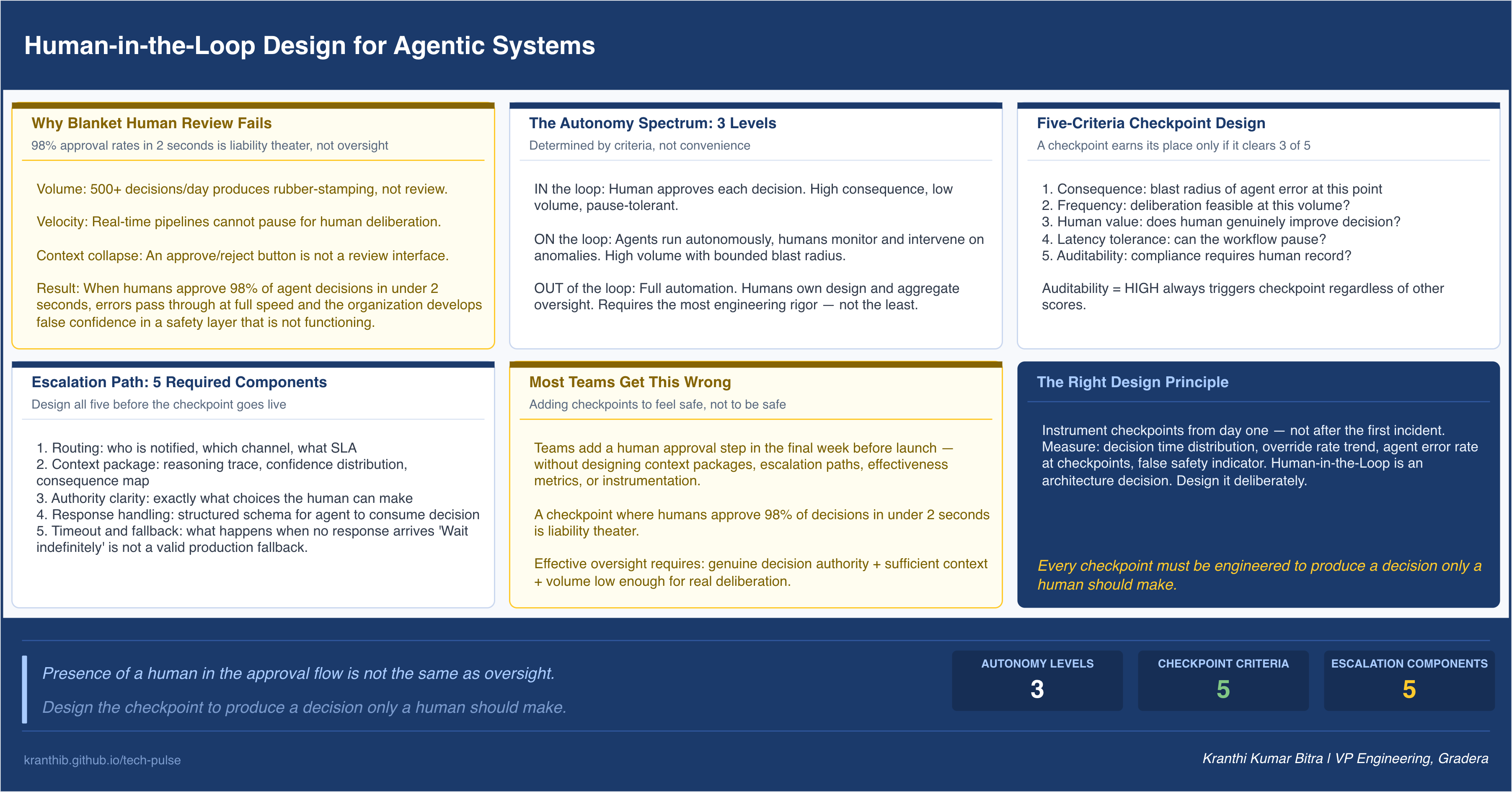
The Comforting Fiction That Is Costing You
There is a phrase that shows up in almost every AI system design review: “we have a human in the loop.” It is said with the confidence of someone who believes the problem is solved. In most cases, it is not solved. It has been deferred.
A fraud detection model that evaluates a million transactions per hour cannot wait for a human reviewer. A document processing agent that generates five hundred contract summaries a day cannot pause for manual approval on each one. A customer support agent handling three thousand conversations simultaneously cannot route every uncertain case to a queue and expect sub-minute resolution. At the velocity and volume where agentic systems operate in 2026, the traditional model of human review does not slow things down. It creates an illusion of control that evaporates the moment the queue backs up.
The real discipline is not whether humans are in the loop. It is designing exactly where, when, and how the handoff happens — and engineering that handoff with the same rigor applied to any other production system component.
I have seen this failure across multiple engineering contexts. Teams add a human approval step in the final week before launch, positioned as a safety measure, without designing what information the human sees, what authority they have, what happens when they are unavailable, or how their decision feeds back into agent behavior. The checkpoint exists on the architecture diagram. It does not exist as a functional, well-designed system component.
This post is a framework for fixing that.
Why Blanket Human Review Fails at Scale
The traditional case for human-in-the-loop assumes three conditions: that humans review a manageable volume of decisions, that they have sufficient context to make meaningful judgments, and that their review time is short enough not to block the workflow. At the scale that agentic systems operate, all three conditions break simultaneously.
Volume breaks the attention model. A human reviewing twenty decisions per day exercises genuine judgment. A human reviewing five hundred decisions per day pattern-matches. A human reviewing five thousand decisions per day rubber-stamps. The volume at which cognitive overload produces automatic approval is lower than most teams expect — and most agentic systems exceed that volume within the first week of production.
Velocity breaks the latency model. Many agentic workflows have an implicit assumption: that a human can review and respond faster than the system needs to proceed. In asynchronous, batch-oriented workflows this is sometimes true. In real-time pipelines — financial transactions, live customer interactions, time-sensitive document processing — the human review window is often measured in seconds. Designing a checkpoint that requires ten minutes of human deliberation into a system that produces an output every two seconds is not oversight. It is a bottleneck that will be bypassed the moment it causes a production incident.
Context collapse breaks the quality model. Even when a human has time to review, the question is whether they have the information required to make a meaningful decision. Most agentic systems surface a minimal context package: the input, the agent output, and an approve/reject button. Without understanding what reasoning path the agent took, what alternative outputs were considered, what the confidence distribution looked like, and what the downstream consequences of each choice are, the human is not reviewing a decision. They are reviewing a label. That is not oversight — it is accountability theater.
The rubber-stamp problem compounds all three. When humans approve ninety-eight percent of agent decisions within two seconds, two things happen. First, the one percent of genuine errors that require intervention are processed at the same two-second pace as the obvious approvals, meaning errors get through. Second, the organization develops false confidence in a safety layer that is not functioning. The presence of a human in the approval flow becomes evidence of safety rather than a mechanism for it.
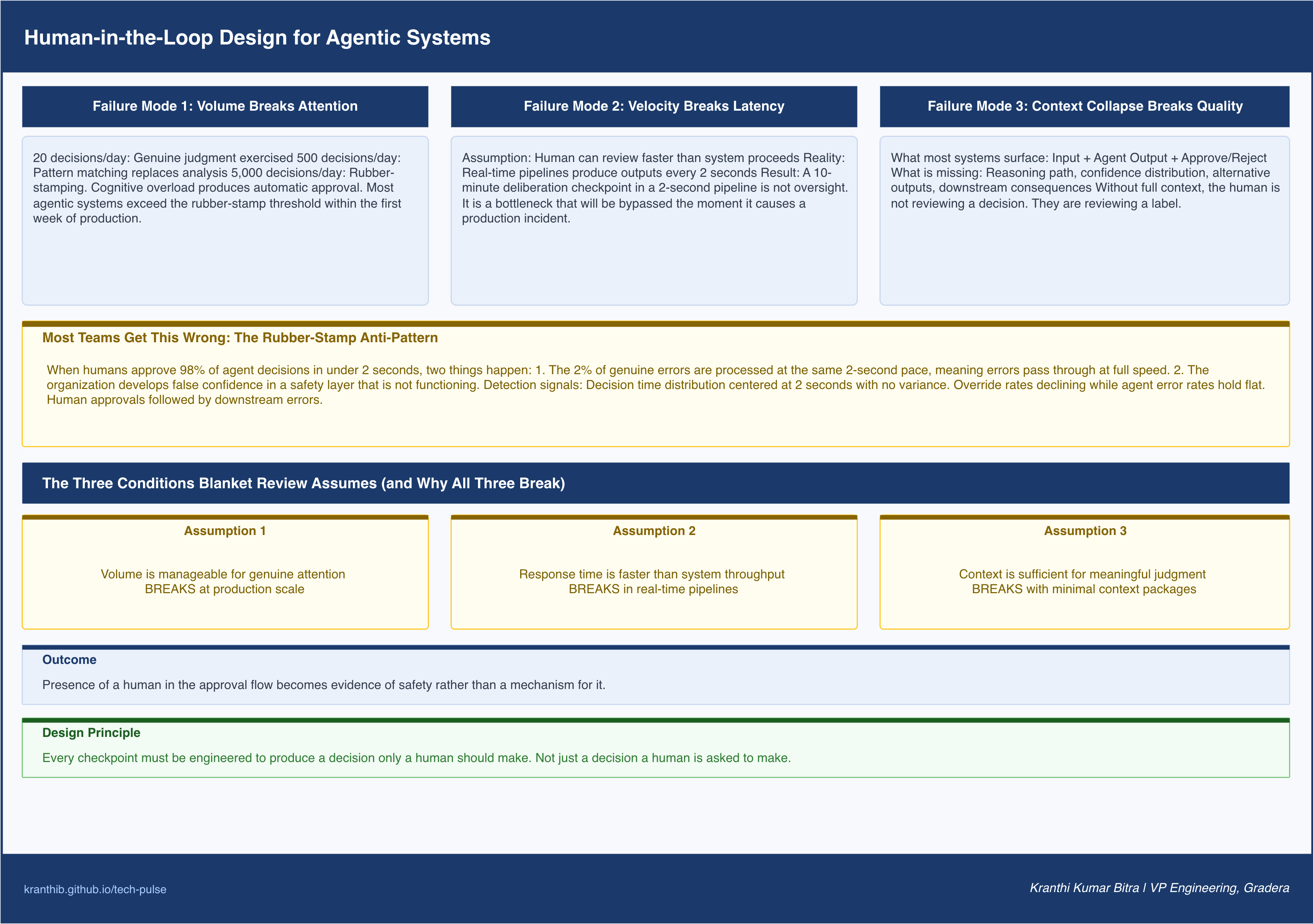
The Autonomy Spectrum: Three Levels, Not a Dial
The framing of “more human involvement equals more safety” is wrong. It treats autonomy as a single dimension when it is actually a set of design decisions about authority, context, and timing. The useful frame is not a dial from zero to one hundred. It is a spectrum with three architecturally distinct positions, each with different engineering requirements.
Level 1: Human in the Loop
At this level, humans are active participants in each decision cycle. The agent proposes an action or a conclusion, and a human explicitly approves or modifies it before the agent proceeds. The human has blocking authority — the workflow pauses until they act.
This level is appropriate when:
- The consequence of an incorrect agent decision is significant and difficult to reverse
- The volume of decisions is low enough for genuine human attention
- The latency tolerance of the workflow allows for human response time
- The domain carries a regulatory or fiduciary requirement for documented human approval
The engineering requirement at this level is not just a checkpoint — it is a complete context package that enables real deliberation, a timeout and fallback path for when the human is unavailable, and an audit record that captures the human decision alongside the agent action.
Level 2: Human on the Loop
At this level, agents operate autonomously within defined parameters, and humans monitor the system rather than approving individual decisions. Alerts and escalations surface to humans when the agent encounters a condition outside its confidence boundaries, when outputs deviate from expected patterns, or when downstream signals indicate something may have gone wrong.
The human’s role shifts from approver to supervisor. They do not block individual decisions, but they have the authority and the tooling to intervene, override, or halt the agent when patterns warrant it.
This level is appropriate when:
- Volume or velocity makes per-decision review impractical
- The blast radius of individual agent errors is bounded and recoverable
- The system has reliable confidence scoring and anomaly detection
- The team has designed clear intervention protocols and tested them
The engineering requirement at this level is a monitoring layer with meaningful signal-to-noise ratio. An alert system that fires continuously trains humans to ignore it. The design challenge is escalating the right cases at the right time with enough context to enable action.
Level 3: Human Out of the Loop
At this level, agents operate fully autonomously. Humans design the system, set the parameters, review aggregate performance, and make decisions about agent configuration and policy. They do not participate in individual decision cycles.
This level is appropriate when:
- Decision volume makes any human involvement impractical
- The task is well-defined, reversible, and low-consequence per decision
- The agent has demonstrated reliability within its operating envelope
- Aggregate performance review is sufficient for quality assurance
The engineering requirement at this level is the most demanding: comprehensive observability, automatic rollback capabilities, performance guardrails, and a path to human escalation when the system encounters conditions outside its designed operating range. Removing the human from individual decisions does not remove the human from the system — it moves them upstream to the design and downstream to the oversight of aggregate behavior.
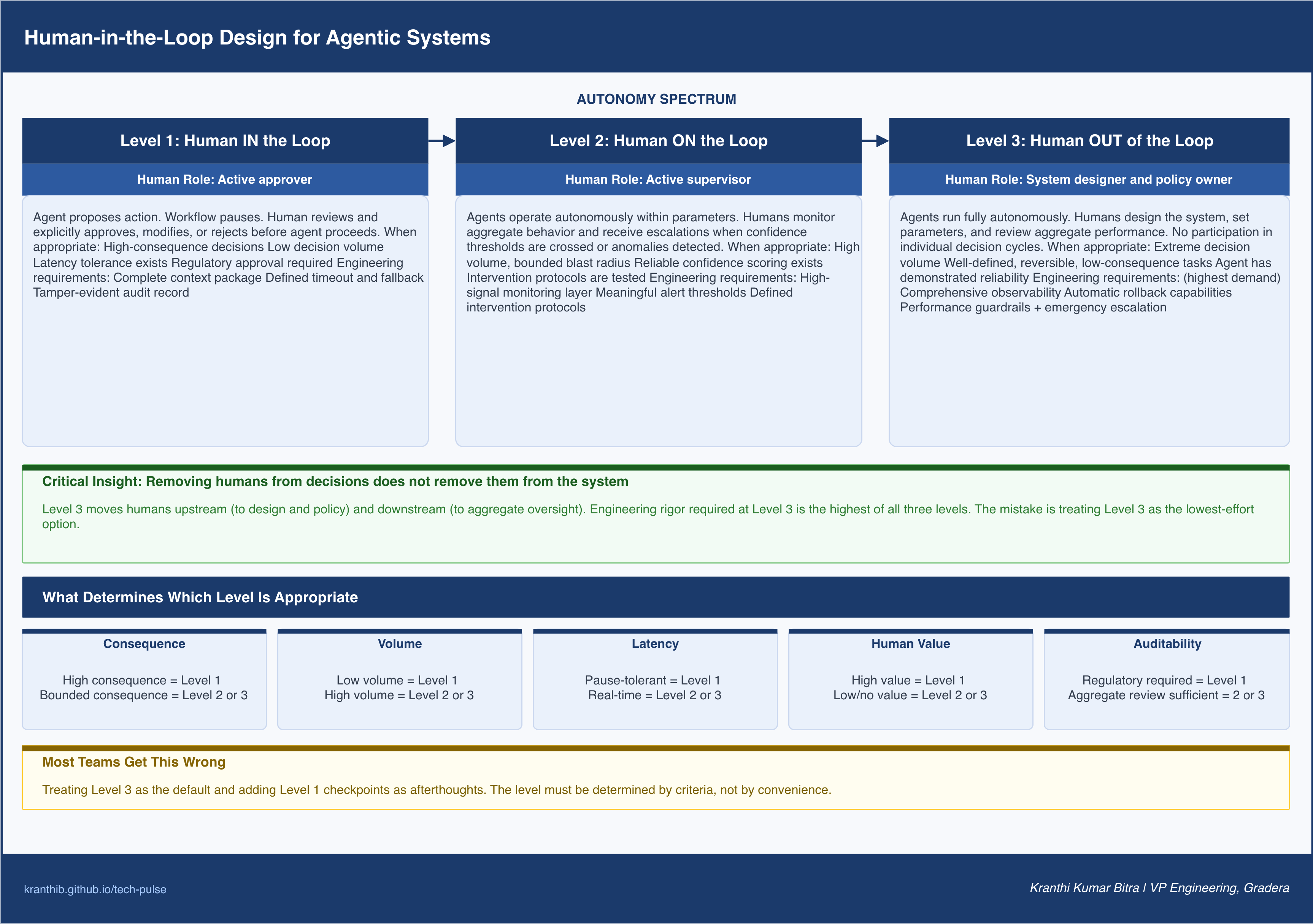
Checkpoint Design: The Five-Criteria Framework
The most common mistake in human checkpoint design is positioning checkpoints based on intuition or organizational comfort rather than engineering criteria. A checkpoint that exists because “it felt like the right place to add a review” will either be bypassed under pressure or will generate the rubber-stamp pattern within weeks.
Effective checkpoint design requires evaluating five criteria for each potential intervention point. Every checkpoint should clear a threshold on at least three of these to earn its place in the workflow.
Criterion 1: Consequence
What is the blast radius of an agent error at this point in the workflow? A consequence assessment should cover both the immediate impact — what goes wrong in this system — and the downstream impact — what systems, customers, or processes are affected. A decision that triggers a downstream chain of irreversible actions has a much larger blast radius than one that produces a single, correctable output.
High-consequence checkpoints are where human involvement must be genuine and structurally guaranteed. Low-consequence decisions are candidates for full automation with retrospective monitoring.
Criterion 2: Frequency
How often does this decision occur? Frequency directly determines whether genuine human deliberation is feasible. A checkpoint that fires fifty times per day is a different engineering problem from one that fires fifty thousand times per day. High-frequency checkpoints require either automation, sampling strategies, or the human-on-the-loop model. Designing a human-in-the-loop checkpoint for a high-frequency decision without volume controls is designing a bottleneck.
Criterion 3: Human Value
Can a human genuinely improve the decision at this point, or is the agent performing at or above human accuracy? This is the most uncomfortable question in checkpoint design because the answer is often “no” — especially for pattern-matching tasks in large-volume, well-defined domains. Human review at a point where humans cannot add signal is not oversight. It adds latency, creates false confidence, and produces the rubber-stamp pattern.
Honest assessment of human value requires empirical data: compare human decision accuracy to agent decision accuracy on historical cases, measure inter-rater reliability among human reviewers, and evaluate whether human overrides of agent decisions produce better or worse outcomes than agent decisions held firm.
Criterion 4: Latency Tolerance
Can the workflow pause for human input without degrading the value it delivers? Some workflows have hard latency constraints — a real-time fraud alert that is useful only if delivered in under five hundred milliseconds cannot accommodate a human review step. Others have soft constraints — a document review pipeline where outputs are consumed the following morning can afford a review window of several hours. Checkpoint design must work within the actual latency envelope of the workflow, not the theoretical one.
Criterion 5: Auditability
Is a documented human decision required for compliance, legal, or fiduciary purposes — regardless of whether the human’s involvement adds analytical value? In regulated domains, the answer is sometimes yes. A lending decision, a medical recommendation, a legal document generation — these may require human sign-off not because humans make better decisions than agents in every case, but because regulation, liability, and institutional accountability structures require a human in the decision chain.
Where auditability is the primary driver of a checkpoint, the design imperative is different: focus on ensuring the human decision record is complete, accurate, and tamper-evident — and ensure that the human reviewing it has enough context to make a decision that would survive a regulatory audit.
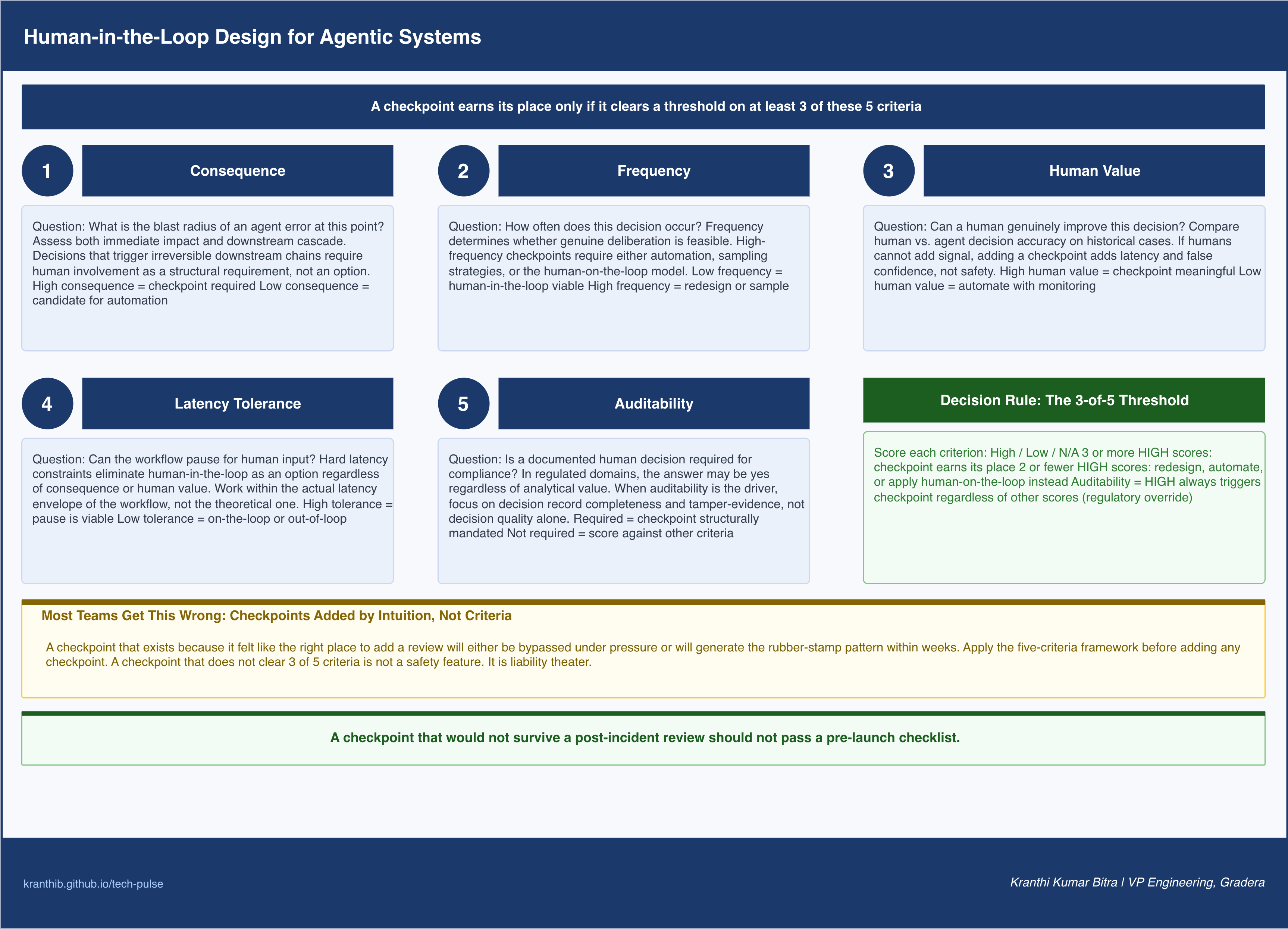
Escalation Path Architecture
Designing a checkpoint is the first part of the problem. Designing what happens when an agent cannot proceed — either because it hits a confidence threshold, encounters an ambiguous condition, or reaches a point requiring human authority — is the second and more complex part.
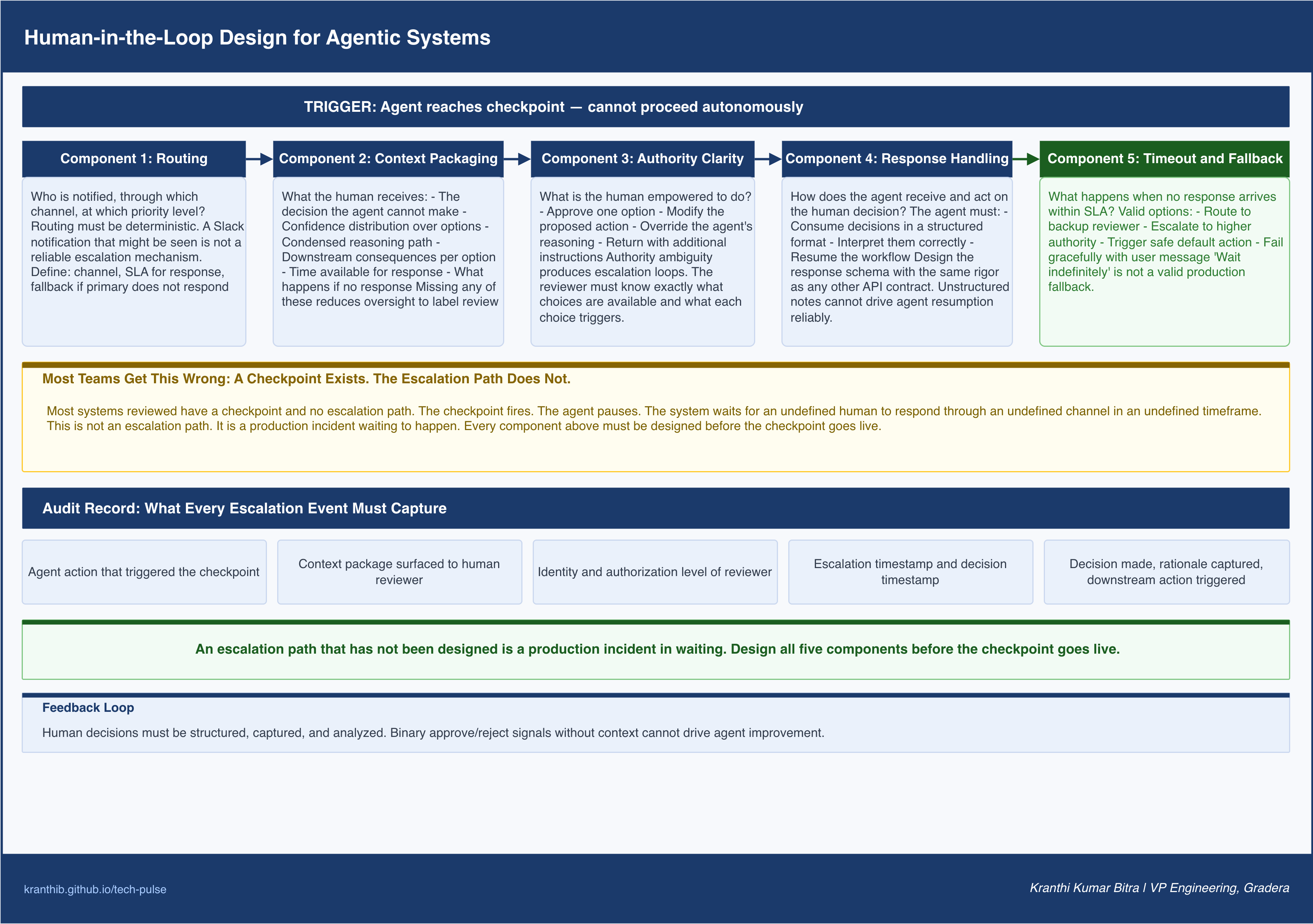
Most systems I have reviewed have a checkpoint and no escalation path. The checkpoint fires. The agent pauses. And then the system waits for an undefined human to respond through an undefined channel in an undefined timeframe. This is not an escalation path. It is a production incident waiting to happen.
A well-designed escalation path has five components.
Routing. When an agent cannot proceed, who is notified, through which channel, at which priority level? Escalation routing should be deterministic, not best-effort. A Slack notification that might be seen is not a reliable escalation mechanism for a time-sensitive decision. Define the channel, the notification mechanism, the SLA for response, and the fallback when the primary responder does not respond within the SLA.
Context packaging. What information does the human receive when the escalation arrives? The minimum useful context package includes: the decision the agent cannot make, the confidence distribution over available options, the agent’s reasoning path (condensed), the downstream consequences of each option, the time available for response, and what happens if the human does not respond in time. Most systems surface the first item and nothing else.
Authority clarity. What is the human empowered to do when they receive the escalation? Approve one option? Modify the agent’s proposed action? Override the agent’s reasoning entirely? Return the case to the agent with additional instructions? Authority ambiguity at escalation time produces delays and escalation loops. The human reviewer should know exactly what choices are available and what each choice triggers.
Response handling. How does the agent receive and act on the human decision? The escalation handoff is a two-way interface: agent to human, and human back to agent. The agent must be able to consume human decisions in a structured format, interpret them correctly, and resume the workflow — not just receive a text note and start over. Design the response schema as carefully as any other API contract.
Timeout and fallback. What happens when the human does not respond within the SLA? Options include: holding the workflow (acceptable only for low-throughput, high-stakes decisions), routing to a backup reviewer, escalating to a higher authority, triggering a safe default action, or gracefully failing with an appropriate user-facing message. Every escalation path needs a fallback. “Wait indefinitely” is not a valid option in production.
The Rubber-Stamp Anti-Pattern
The rubber-stamp anti-pattern is the most dangerous failure mode in human-in-the-loop design because it looks like safety while delivering none of it. It deserves its own section because it is both common and systematically underdetected.
The pattern emerges when the volume of human review decisions exceeds the capacity for genuine deliberation. As volume increases, humans develop heuristics — they begin approving based on surface features rather than full analysis. The threshold for override rises because overrides require cognitive effort and, in many organizations, create friction with the team that built the agent. Review time shortens. Approval rates climb toward the nineties and beyond.
At this point, the human checkpoint is a formality. Errors pass through at the same rate as correct decisions. The system behaves as if humans were not present — except that the organization believes they are.
How to detect it:
Measure the distribution of human decision times at each checkpoint. A bimodal distribution — most decisions in under two seconds, with a long tail of deliberated cases — is healthy. A distribution centered at two seconds with almost no variance indicates rubber-stamping.
Measure override rates over time. A declining override rate can mean the agent is improving. It can also mean humans are developing learned deference. Distinguishing between the two requires examining override rates against agent error rates — if errors are flat but overrides are declining, the latter is more likely.
Run blind audits: take a sample of decisions the agent made without human review and compare them to the decisions made with human review on similar cases. If outcomes are statistically identical, the human review is not adding value.
How to fix it:
Raise the checkpoint threshold. Move the checkpoint from every decision to decisions above a consequence or uncertainty threshold. This reduces volume to a level where genuine deliberation is feasible.
Redesign the context package. If humans are making surface-level judgments, they may not have the information needed to make deeper ones. Adding confidence distributions, alternative options, and downstream consequence information increases the cognitive engagement required.
Introduce structured review requirements. Require humans to record a brief rationale for their decision — not for every approval, but for a random sample. The knowledge that any decision might require articulation raises the standard for all of them.
Rotate reviewer assignments. Long-running review assignments build learned deference to specific agent behaviors. Rotating reviewers resets baseline skepticism.
The Context Package Problem
The gap between what humans receive when reviewing an agent decision and what they need to make a meaningful one is the hidden cost of most human-in-the-loop implementations. Closing this gap is one of the highest-leverage investments an engineering team can make.
A minimal context package gives the human the agent output and asks for an approval. A functional context package gives the human what they need to actually deliberate.
For most checkpoint types, a functional context package includes:
The decision summary. What is the agent asking the human to approve? Stated plainly, not in system terminology.
The agent’s reasoning trace. Not the raw chain-of-thought log — a structured summary of the key decision points the agent traversed and how it weighted competing considerations. One hundred words maximum.
The confidence distribution. If the agent considered multiple options, what was the probability mass on each? Seeing that the agent assigned sixty percent confidence to option A and thirty-eight percent to option B changes how a human approaches the review compared to seeing only that option A was selected.
The consequence map. What downstream actions follow from this decision? What is reversible and what is not? How quickly does the downstream cascade begin?
The available actions. Approve, reject, modify, escalate, request more information. List them explicitly with their consequences. Do not assume the reviewer knows what each choice triggers.
The decision deadline. When does this decision time out? What happens after the deadline?
Packaging this context effectively requires engineering investment. The agent must be instrumented to produce structured reasoning traces. The review interface must present information in a format that enables rapid but genuine assessment. The consequence map must be computed dynamically based on the current system state at the time of escalation.
This is non-trivial engineering. It is also the engineering that determines whether your human checkpoint is oversight or theater.
High-Stakes Domain Considerations
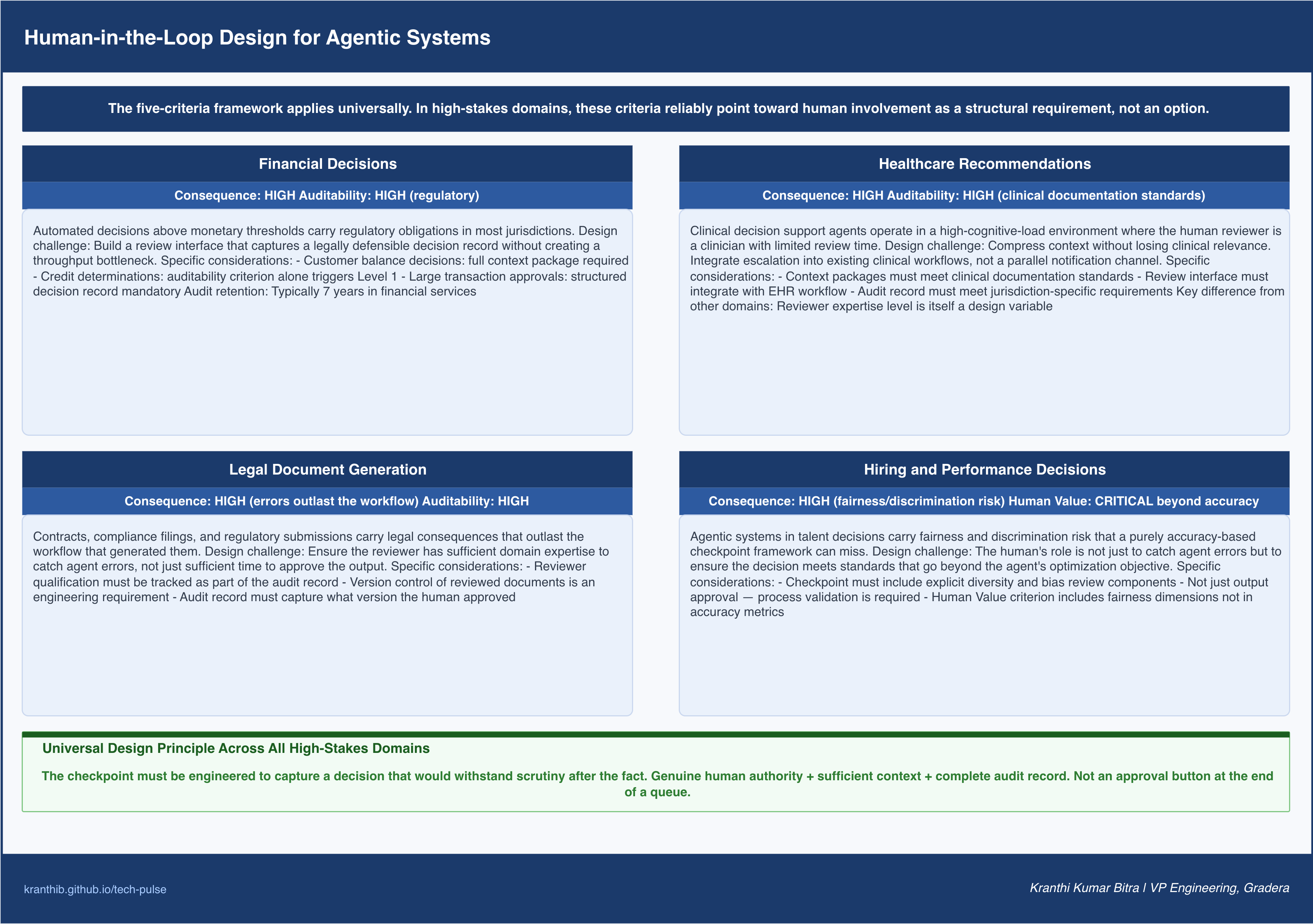
The checkpoint design framework applies universally, but several domains carry structural requirements that raise the baseline independently of how the five criteria score.
Financial decisions. Automated decisions with monetary consequences above defined thresholds carry regulatory obligations in most jurisdictions. Beyond compliance, the consequence and auditability criteria reliably point toward human involvement for decisions that affect customer balances, credit determinations, or large transaction approvals. The design challenge in financial systems is not whether to include humans but how to design the review interface to capture a legally defensible decision record without creating a decision throughput bottleneck.
Healthcare recommendations. Clinical decision support systems operating in the agentic layer face a distinct design challenge: the human in the loop is typically a clinician with a high cognitive load and limited review time. Context packaging in healthcare must be compressed without losing clinical relevance. The escalation path must integrate with existing clinical workflows — not create a parallel notification channel the clinician must monitor separately. And the audit record must meet the standards of the clinical documentation environment.
Legal document generation. Agents generating contracts, compliance filings, or regulatory submissions are producing documents where errors carry legal consequences that outlast the workflow. The auditability criterion alone pushes these toward human-in-the-loop design. The design challenge is ensuring the reviewer has sufficient domain expertise to catch agent errors — not just sufficient time to approve the output.
Hiring and performance decisions. Agentic systems participating in talent decisions carry fairness and discrimination risk that a purely accuracy-based checkpoint framework can miss. In these domains, the human’s role is not just to catch agent errors but to ensure the decision meets standards that go beyond the agent’s optimization objective. Checkpoint design here must include explicit diversity and bias review components — not just output approval.
In all high-stakes domains, the design principle is the same: the checkpoint must be engineered to capture a decision that would withstand scrutiny after the fact. That requires genuine human authority, sufficient context, and a complete audit record — not an approval button at the end of a queue.
Feedback Loop Design
The last component of human-in-the-loop architecture that most teams neglect is the feedback loop: how human decisions return to the system and influence future agent behavior.
This matters because the relationship between human reviewers and agents is not static. If human overrides of agent decisions are not captured and analyzed, the agent never learns from them. If they are captured but not used carefully, they can introduce training instability — particularly if the override pattern reflects reviewer bias rather than genuine errors.
There are three feedback loop designs, each appropriate for different contexts.
Immediate parameter adjustment. Human overrides are logged and used to adjust agent confidence thresholds, routing rules, or filtering criteria in near-real-time. This is appropriate for systems where the agent is operating on a well-defined, measurable task and human overrides are high-signal corrections. The risk is that noisy human decisions — or reviewers who systematically disagree with the agent for reasons unrelated to accuracy — introduce drift.
Batched fine-tuning input. Human override decisions are accumulated over a defined period, reviewed for quality and bias, and used as training signal for a periodic model update. This is appropriate for foundation model-adjacent systems where individual decisions are too noisy to use directly but aggregate patterns carry genuine signal. The latency is higher — the agent does not benefit from today’s overrides until the next training cycle — but the quality of the signal is more controlled.
Policy and threshold recalibration. Human override patterns are analyzed not to change the model but to recalibrate where checkpoints fire and what the agent is permitted to do autonomously. If humans are consistently overriding agent decisions in a specific subdomain, the right response may not be fine-tuning — it may be narrowing the agent’s autonomous operating envelope in that subdomain. This is the least technically complex feedback loop and often the most immediately actionable.
The critical design requirement across all three approaches: human decisions must be captured in a structured format that makes them analyzable. Unstructured reviewer notes or binary approve/reject signals without context cannot be turned into useful feedback signal. Design the decision record format from the beginning.
What Most Teams Get Wrong
Adding human checkpoints to feel safe rather than to be safe.
This is the architectural error that underlies most human-in-the-loop failures. The presence of a checkpoint — any checkpoint, positioned anywhere, designed however — feels like a safety measure. It satisfies the compliance question (“do you have human oversight?”), the leadership question (“are humans reviewing agent decisions?”), and the engineering retrospective question (“why did no one catch this?”).
But a checkpoint where humans approve ninety-eight percent of agent decisions in under two seconds is not oversight. It is liability theater.
Effective human involvement requires three things that most checkpoints do not have: genuine decision authority, sufficient context to exercise that authority, and a volume low enough to allow real deliberation. Remove any one of the three and the checkpoint becomes decoration.
The engineering team’s job is to design checkpoints that would survive a post-incident review — not just one that passes a pre-launch checklist. That means applying the five-criteria framework before adding any checkpoint, designing the context package before building the review interface, and measuring checkpoint effectiveness after launch with the same rigor applied to any other system component.
If the checkpoint is not generating meaningful human decisions, it is not a safety feature. It is a risk that has been given a safety label.
Audit Trail Requirements
Every human decision in an agentic workflow is an event that should be recorded with the same care as any other system event. This is not primarily a compliance consideration — it is an engineering requirement for system correctness.
An audit trail for human-in-the-loop decisions should capture:
- The agent action or decision that triggered the checkpoint
- The context package surfaced to the human reviewer
- The identity of the human reviewer and their authorization level
- The timestamp of the escalation and the timestamp of the human decision
- The decision made and any modifier or rationale captured
- The downstream action triggered by the human decision
- Whether the human’s decision was subsequently reviewed, overridden, or used as training signal
This record serves multiple purposes. In regulated domains, it is the evidence of oversight. In performance reviews, it is the signal for identifying checkpoint effectiveness and rubber-stamp patterns. In incident post-mortems, it is the audit trail for understanding what the human saw and decided at each point in the workflow chain.
The audit trail must be tamper-evident, queryable, and retained according to the regulatory requirements of the domain. In financial services, this is typically seven years. In healthcare, it varies by jurisdiction. In general enterprise applications, the minimum is the duration of any associated contract or liability period.
Design the audit schema before designing the review interface. It is significantly harder to add comprehensive logging to an existing checkpoint than to build it in from the start.
Applying the Framework: A Decision Guide
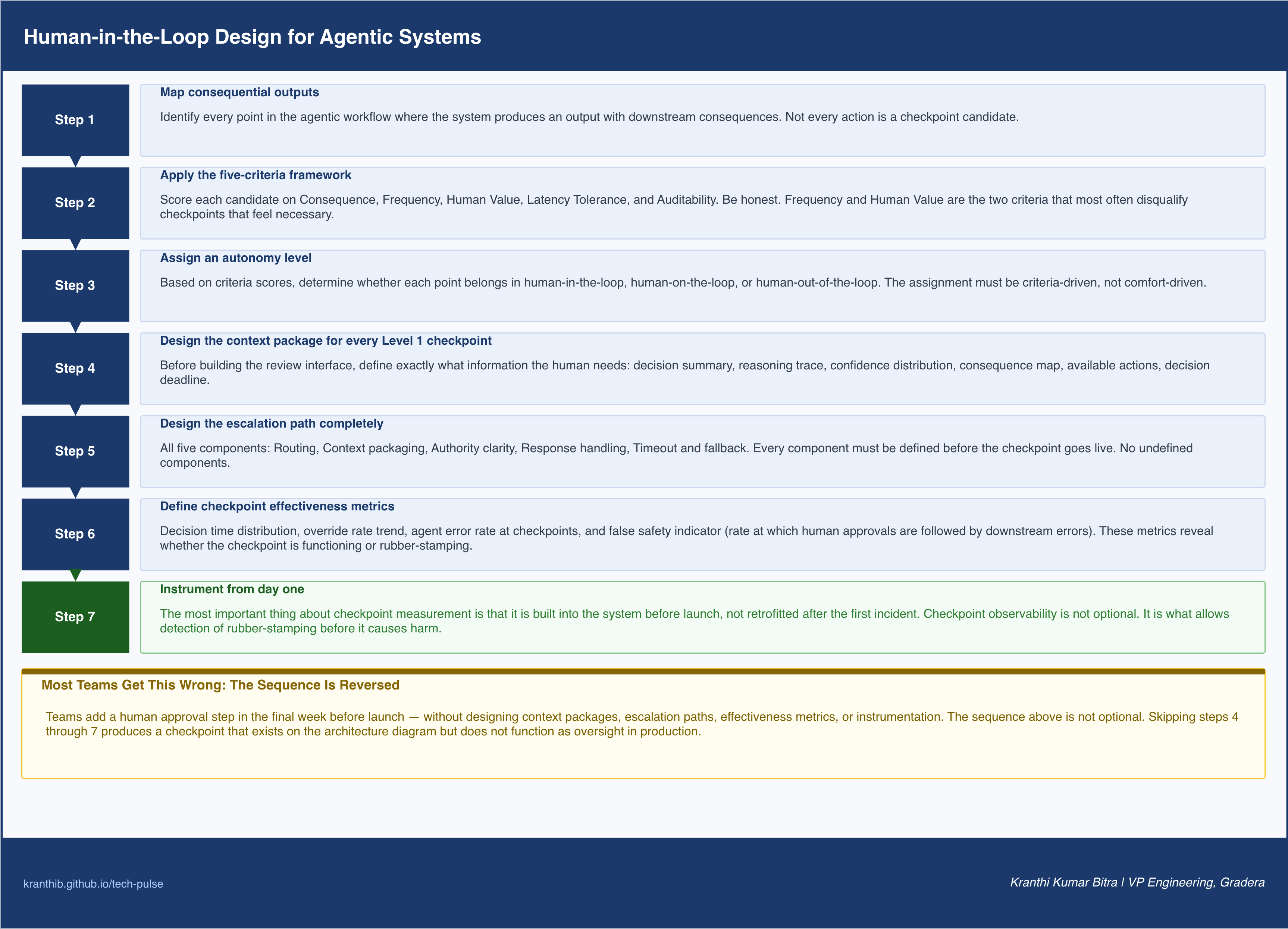
For engineering teams designing or auditing human-in-the-loop components, the following sequence produces better checkpoint designs than intuition:
Step 1: Map every point in the agentic workflow where the system produces an output that has downstream consequences. Not every agent action is a checkpoint candidate — only those where the downstream consequence of an error is significant enough to warrant human attention.
Step 2: Apply the five-criteria framework to each candidate. Score consequence, frequency, human value, latency tolerance, and auditability. Be honest about the frequency and human value scores — these are the two that most commonly disqualify a checkpoint that feels necessary.
Step 3: Assign an autonomy level to each checkpoint. Based on the criteria scores, determine whether each point belongs in the human-in-the-loop, human-on-the-loop, or human-out-of-the-loop category.
Step 4: Design the context package for every human-in-the-loop checkpoint. Before building the review interface, define exactly what information the human needs and how it will be structured and surfaced.
Step 5: Design the escalation path completely. Routing, context packaging, authority clarity, response handling, timeout, and fallback. Every component.
Step 6: Define the metrics for checkpoint effectiveness. Decision time distribution, override rate trend, agent error rate at checkpoints, and false safety indicator — the rate at which human approvals are followed by downstream errors.
Step 7: Instrument from day one. The most important thing about checkpoint measurement is that it is built into the system before launch, not retrofitted after the first incident.
Where This Is Heading
The trajectory of human-in-the-loop design in 2026 and beyond is not toward more human involvement or less. It is toward more deliberate involvement.
As agents become more capable, the set of tasks where humans add genuine decision value will narrow. But the set of tasks where human authority is structurally required — for regulatory, fiduciary, or accountability reasons — will not narrow at the same rate. The gap between what agents can do autonomously and what they are permitted to do autonomously will widen as capability increases.
This means the engineering challenge of human-in-the-loop design will not diminish with more powerful agents. It will become more complex. The checkpoints that remain will be the hardest ones — the highest-consequence, most ambiguous, most context-dependent decisions. Engineering the handoff for those decisions will require better context packaging, better escalation tooling, better feedback loop design, and better measurement of human decision quality than anything most teams have built today.
The teams that build that infrastructure now — before the capability gap forces the issue — will be in a structurally better position. The teams that treat human-in-the-loop as a checkbox will find themselves redesigning their oversight architecture under pressure, after an incident, with a compliance team watching.
The best human-agent collaboration in 2026 is not the one with the most checkpoints. It is the one where every checkpoint was designed to produce a decision only a human should make.