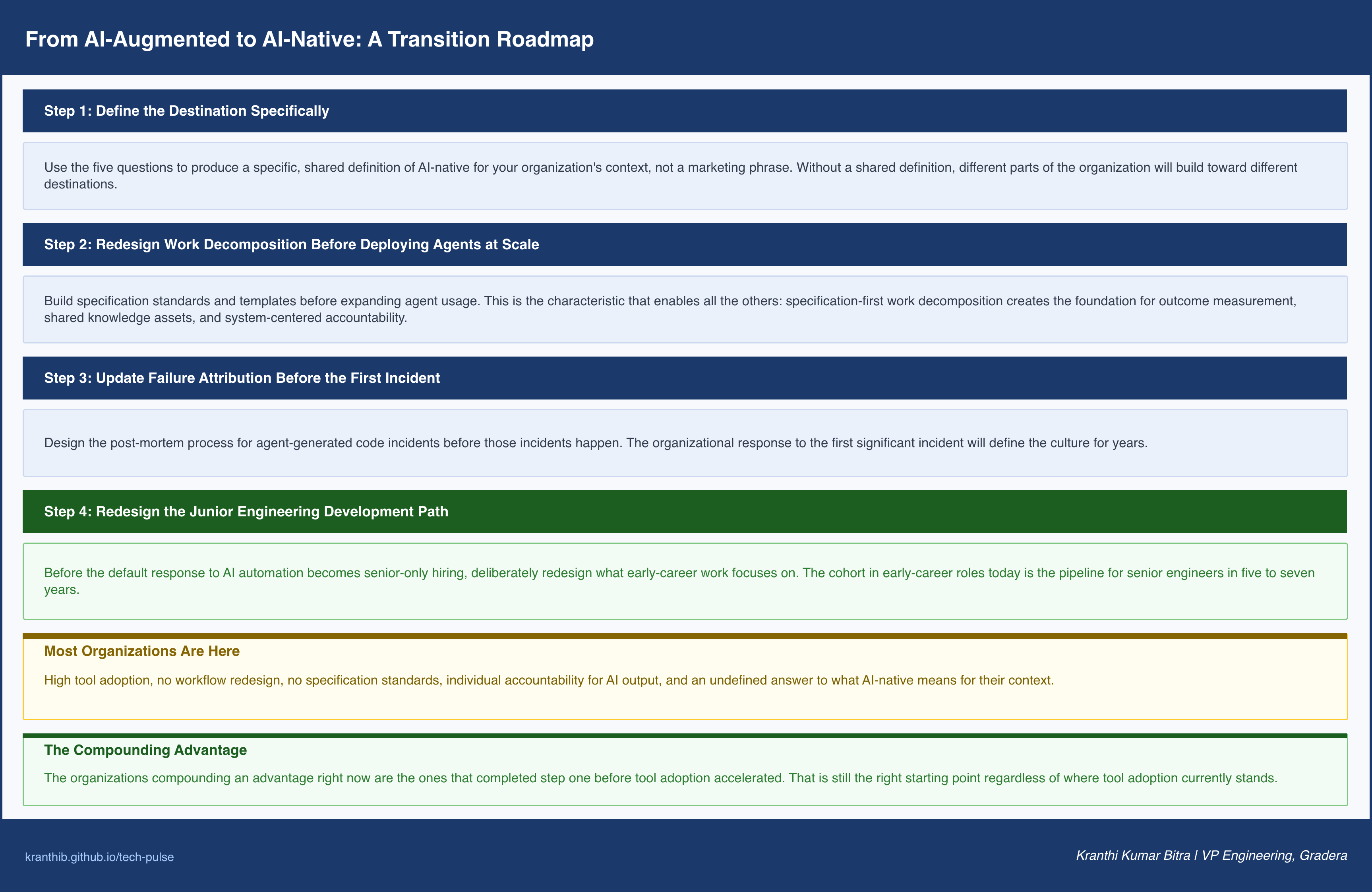
AI-Native Engineering Culture: The Five Characteristics That Actually Distinguish It
When a research firm surveyed more than two hundred engineering leaders and asked each to define “AI-native engineering” in their own words, they received a different answer from every single person. Some described a complete organizational redesign. Others described autocomplete with better tooling. That gap is not a communication problem. It is a governance problem: engineering organizations are being asked to build toward a destination that nobody has defined precisely enough to navigate toward or measure progress against. This post attempts to be specific about what the destination actually looks like.
The Difference Between AI-Augmented and AI-Native
The most clarifying distinction in this entire conversation is one that most organizations are not making deliberately: the difference between an AI-augmented engineering culture and an AI-native one.
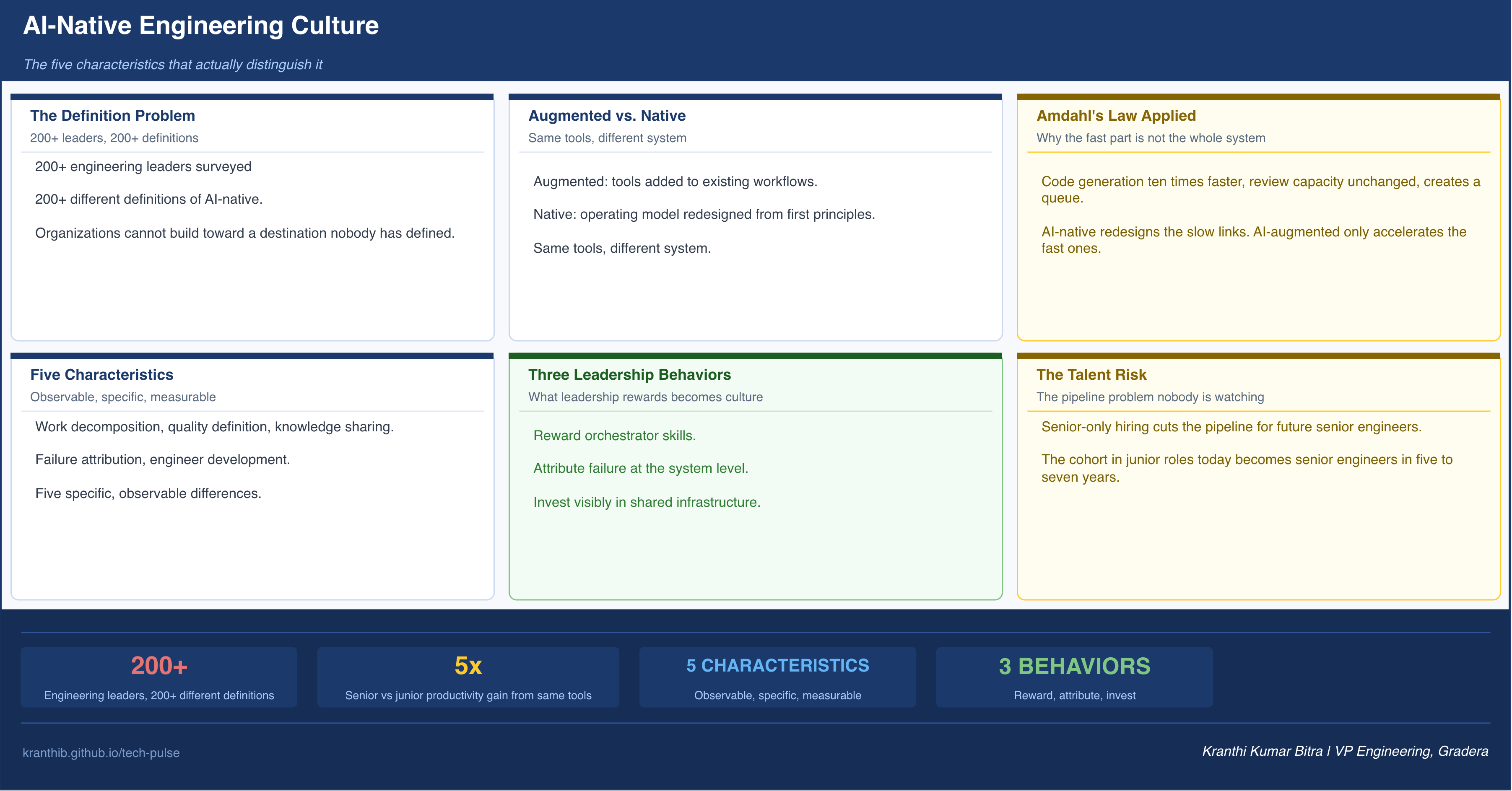
An AI-augmented engineering culture has added AI tools to existing workflows. Developers use code completion tools when writing. PR reviewers use AI summaries to orient themselves before reading. Incident responders use AI to correlate alerts faster. The workflows are fundamentally the same workflows the organization had before. Individual steps within those workflows are faster or easier because an AI tool is available. But the bottlenecks, the points where work slows down or accumulates, are the same bottlenecks that existed before the tools arrived, because nobody redesigned the system around the tools. Nobody asked which bottlenecks would emerge as a consequence of making code generation faster, or which assumptions about team structure, review processes, and knowledge transfer were baked into the old workflow design.
An AI-native engineering culture has redesigned its operating model around AI capabilities from first principles. It has asked not just “where can AI help us do what we already do” but “if AI handles execution at scale, what does the organization need to change about how it defines work, validates output, shares knowledge, attributes failure, and develops people?” The tools are the same tools. The cultural change is in the operating model that surrounds them.
The data on the gap between these two approaches is now substantial enough that it should inform how engineering leaders think about what they are actually building. One study of more than ten thousand developers across over a thousand teams found that high-AI-adoption teams completed significantly more tasks and merged dramatically more pull requests than low-adoption teams, but PR review time increased nearly as dramatically in the other direction, creating a critical bottleneck at the human approval stage. The system moved only as fast as its slowest link, which in this case turned out to be the review process that nobody redesigned when code generation got faster. Another analysis found that senior engineers realize nearly five times the productivity gains of junior engineers from the same AI tools, because the tools amplify existing depth of judgment rather than substituting for judgment that does not yet exist.
Both of these findings are exactly what you would expect if AI tools were being deployed into an AI-augmented culture: the individual steps that the tools touch get faster, but the system around those steps stays the same, and the differential impact across engineers reflects the fact that the tools require judgment to use well, which means their value is bounded by the existing distribution of judgment in the team.
The Amdahl’s Law framing is useful here because it makes the structural problem precise. In distributed computing, Amdahl’s Law describes why parallelizing part of a process produces diminishing returns as the unparallelized portion becomes the binding constraint. The same principle applies to engineering workflows: if AI tools accelerate code generation by a factor of ten while review, deployment, and production monitoring capacity remain constant, the organization does not become ten times more productive. It becomes constrained by the stages that code generation feeds, and the pressure on those stages is now ten times higher. An AI-native culture addresses this by redesigning the downstream processes alongside the upstream ones, so that the full workflow moves faster rather than the fast part of the workflow moving faster and creating a larger queue for the slow part.
An AI-native culture addresses both findings directly: it redesigns the slow links rather than just accelerating the fast ones, and it deliberately rebuilds the development pathway for engineers at all levels around the judgment skills that the new environment requires, rather than assuming that junior engineers will develop those skills the same way senior engineers did.
The Five Characteristics
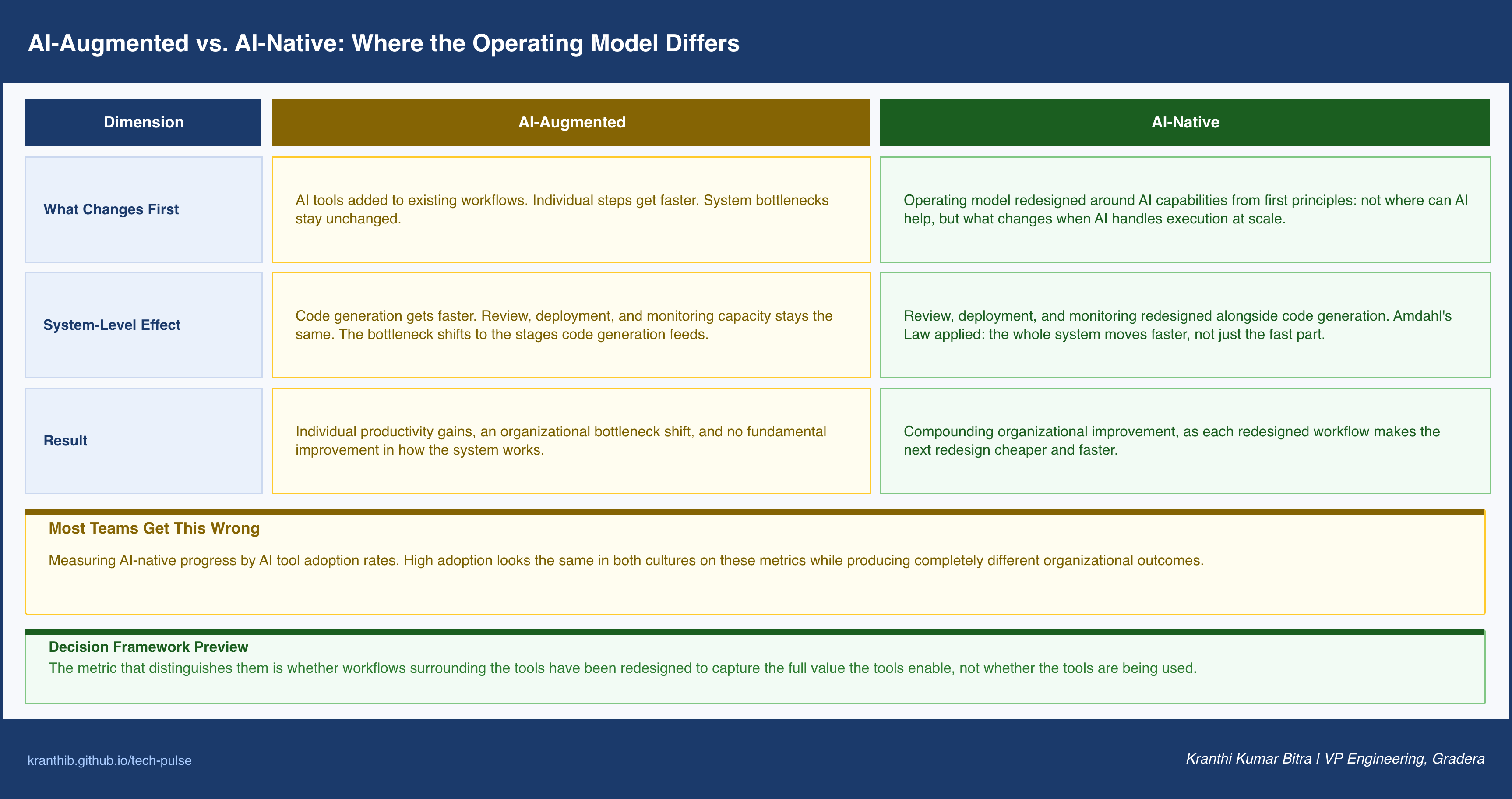
What distinguishes an AI-native engineering culture from an AI-augmented one is not the tools the organization uses. It is five specific, observable characteristics of how the organization works. Each characteristic has an AI-augmented version and an AI-native version, and the gap between them is the actual gap the organization needs to close.
Characteristic One: How Work Is Decomposed
In an AI-augmented culture, work is decomposed the same way it always was: product managers write requirements, engineers break those requirements into implementation tasks, and the granularity of task decomposition is calibrated to what a human developer working continuously on one thing for a few days can reasonably complete. AI tools help with the implementation, but the task design assumes a human author.
In an AI-native culture, work is decomposed differently from the start. Tasks are designed to be agent-delegable: they have explicit acceptance criteria that make the expected output verifiable, defined scope boundaries that prevent unintended changes to adjacent systems, and clear guidance on what the agent should do when it encounters something the specification does not cover. This design discipline is not just about enabling autonomous coding agents today. It is about building the organizational habit of specifying work precisely enough that its quality can be evaluated against the specification rather than against the author’s intent. That habit is valuable with or without agents, and it is the prerequisite for any meaningful expansion of autonomous execution.
The organizational tell for this characteristic is in how PRs get reviewed. In an AI-augmented culture, a PR review evaluates whether the author’s implementation seems reasonable given what the reviewer knows about the system. In an AI-native culture, a PR review evaluates whether the implementation satisfies the specification, because the specification was written first and is part of the PR.
Characteristic Two: How Quality Is Defined
In an AI-augmented culture, quality is still primarily defined by process metrics: code review pass rates, test coverage percentages, deployment frequency, and mean time to recovery. These metrics were designed to measure the quality of a system where human judgment was the production input, and they measure process fidelity reasonably well for that purpose.
In an AI-native culture, quality is defined by outcome metrics: does the software behave correctly for users, does it handle edge cases that were not explicitly specified, does it degrade gracefully when upstream dependencies fail. The shift is from measuring whether the right steps were followed to measuring whether the right outcomes were achieved. This matters because AI-generated code can satisfy every process metric while failing on outcome quality in ways that the process metrics are not designed to detect. Passing a code review, achieving ninety percent test coverage, and being deployed within a standard deployment window does not guarantee that the software handles the failure modes the reviewer did not think to test for.
The organizational investment required for outcome-based quality definition is significant: evaluation frameworks that test for behaviors that were not explicitly specified, production monitoring that catches quality degradation before users report it, and a culture of treating quality issues discovered in production as systems design problems rather than as individual failures.
Characteristic Three: How Knowledge Is Shared
In an AI-augmented culture, knowledge is shared the same way it has always been shared in engineering organizations: through documentation, through code review comments, through informal mentorship, and through the slow accretion of shared context that comes from working in the same codebase over time. This knowledge-sharing model works reasonably well when the rate at which knowledge needs to be transferred is bounded by human throughput. When AI tools dramatically accelerate the rate at which the codebase evolves, the traditional knowledge-sharing model becomes a bottleneck, because the documentation does not keep pace with the change rate, and the informal mentorship model was calibrated for a time when senior engineers could review and discuss every significant change.
In an AI-native culture, the knowledge assets are different in kind, not just in format. Prompt libraries are treated as shared engineering assets with the same rigor applied to library code: they are versioned, reviewed, improved over time, and accessible to every engineer who needs them rather than living in individual developers’ local files. Agent configurations, the specifications and constraints that govern how autonomous agents are deployed on specific task categories, are documented and shared as engineering infrastructure rather than tribal knowledge. Evaluation datasets, the collections of test cases and expected outputs that define what correct behavior looks like for a given system, are maintained as first-class engineering artifacts that get updated when the system’s expected behavior changes.
The organizational tell for this characteristic is whether the accumulated learning from AI usage is compounding or resetting. In an AI-augmented culture, each engineer’s learning about how to use AI tools effectively stays mostly with that engineer. In an AI-native culture, that learning gets captured in shared assets that make the whole organization more effective over time.
Characteristic Four: How Failure Is Attributed
In an AI-augmented culture, failure attribution follows the familiar pattern: when a bug reaches production, someone is accountable for the code that contained it. The accountability model assumes human authorship of every significant decision, and it assigns responsibility accordingly. This model produces a well-documented side effect: it incentivizes defensive behavior around AI tool usage. Engineers who know that they will be accountable for any errors in AI-assisted code they shipped are incentivized to either avoid using AI tools for anything consequential or to add so much manual verification that the productivity benefit of the tool is largely offset by the defensive overhead.
In an AI-native culture, failure attribution is system-centered rather than individual-centered. When a problem reaches production, the investigation asks where in the system design the failure originated: was the specification unclear, was the review process inadequate, was the monitoring insufficient to detect the failure mode, was the rollback capability not in place. This does not eliminate individual accountability, but it locates accountability at the level of system design decisions rather than at the level of individual code authorship, which is the appropriate level when the code may have been written by an agent following a specification rather than by an individual engineer expressing their own judgment.
The organizational benefit of this shift is that it enables honest post-mortems. An organization where engineers fear that admitting an AI tool contributed to a failure will be held against them will produce post-mortems that obscure the actual failure mechanism. An organization where system design is the unit of accountability will produce post-mortems that surface the real root causes and generate system improvements.
Characteristic Five: How Engineers Develop
In an AI-augmented culture, the traditional engineering career path remains essentially intact: junior engineers develop skills by writing a lot of code, getting feedback on that code through review, and gradually accumulating the pattern recognition and judgment that makes them effective at more complex problems. AI tools make individual steps in this process faster or easier, but the development path is the same.
In an AI-native culture, this traditional development path faces a structural challenge that most organizations are not addressing: if AI tools handle most of the code generation that junior engineers used to do as developmental work, the learning pathway for developing the judgment skills that make senior engineers effective needs to be deliberately redesigned rather than assumed to happen organically. The organizations that are navigating this most successfully are not eliminating junior engineering roles; they are redesigning what those roles focus on, shifting the developmental work from “write more code” to “verify more agent output, develop specification skills, build evaluation expertise, and develop the architectural judgment that makes all of these more effective.”
The alternative, which a growing number of organizations are choosing, is to shift toward senior-only engineering teams and stop developing junior engineers at all. This produces a short-term efficiency gain and a long-term talent crisis: the pipeline for future senior engineers drains because nobody is building the foundational judgment skills in the cohort that would become those senior engineers in five to seven years.
A Worked Example: Tracing the Five Characteristics Through One Sprint
The five characteristics above are easier to agree with in the abstract than to recognize in a specific engineering context. Tracing them through a single sprint scenario makes the difference between AI-augmented and AI-native behavior concrete enough to use as an organizational diagnostic.
Consider two engineering teams working on the same type of backend service, with the same AI coding tools available, running what looks like the same kind of sprint. The external behavior looks identical: both teams have a backlog of tickets, both use autonomous coding agents for some of the work, and both ship code at the end of the sprint. The cultural difference is in how each of the five characteristics manifests.
In the AI-augmented team, tickets are written as they always have been, with requirements described at the product level and implementation left to the engineer’s judgment. The agent-delegated tickets get assigned to agents, which produce code that the responsible engineer reviews before approving. The sprint review measures how many tickets were closed, which is higher than it was before the tools arrived. When a production issue appears two sprints later, the post-mortem identifies which PR introduced it and focuses on whether the review process was adequate.
In the AI-native team, tickets that will be delegated to agents are written with explicit acceptance criteria, scope boundaries, and guidance on edge cases. The review process for agent-generated PRs includes an automated semantic validation step that checks specification adherence before human review. The sprint review measures not just tickets closed but outcome metrics: did the shipped code handle the edge cases the specification defined, are there monitoring alerts in place for the failure modes the implementation could encounter. When a production issue appears, the post-mortem examines the specification quality, the review process, and the monitoring coverage, not primarily which human approved the PR.
The productivity difference between these teams in any given sprint may be modest. The compounding difference over several sprints is not: the AI-native team’s specifications are getting better because they are being written with the discipline that agent delegation requires, its shared specification templates are improving as the team captures what works, and its evaluation framework is expanding as the team discovers failure modes and adds them to the test suite. The AI-augmented team’s throughput is higher than it was, but the quality of its specifications is not improving because nobody is evaluating specifications as a distinct skill, and its evaluation framework is not expanding because outcome quality is not being measured directly.
This is the compounding dynamic that distinguishes AI-native cultures over time from AI-augmented ones, and it does not show up in the adoption metrics that most organizations are tracking.
Leadership Behaviors That Build vs. Kill the Culture
The five characteristics above describe what an AI-native engineering culture looks like. What determines whether an organization gets there is leadership behavior, not organizational structure or policy documents.
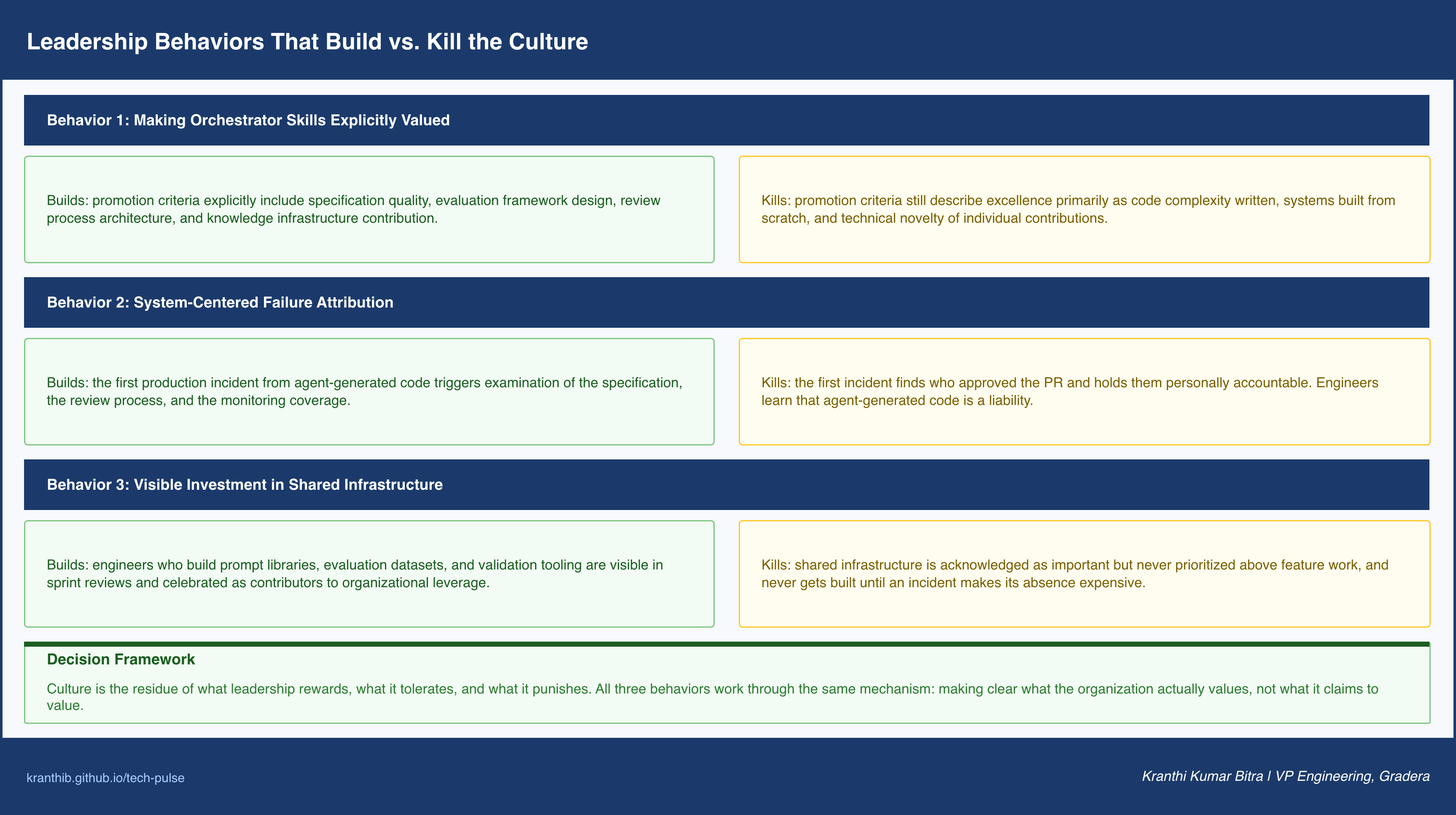
The most important leadership behavior is making the orchestrator skills explicitly valued and visible in the organization’s assessment and reward frameworks. If the promotion criteria still describe engineering excellence primarily in terms of the complexity of the code written, the novelty of the technical solutions designed, and the number of systems built from scratch, engineers will rationally optimize for those things and treat AI tools as a productivity supplement rather than as an opportunity to shift toward higher-leverage orchestration work. If the promotion criteria explicitly include the quality of specifications written, the rigor of evaluation frameworks designed, the effectiveness of review processes built, and the organizational systems for knowledge capture contributed, engineers will develop those skills.
This leadership behavior is harder to implement than it sounds because it requires organizations to develop new assessment signals for skills that were previously not assessed directly. A senior engineer who spends a quarter building a specification library that enables ten other engineers to delegate work to autonomous agents more effectively has produced significant organizational leverage, but that leverage is invisible to traditional engineering performance metrics that count output artifacts. Making this contribution visible requires developing new ways of attributing organizational impact, and that is legitimately difficult work that most engineering performance frameworks have not been designed to do.
The second most important behavior is treating failure attribution correctly when something goes wrong. The first time a significant production incident is traced back to an agent-generated change that passed review, the organization’s response to that incident will teach every engineer more about what AI-native culture actually means than any amount of strategy documents will. If the response is to find who approved the PR and hold them personally accountable, the engineers will learn that agent-generated code is a liability rather than an asset and will adjust their behavior accordingly. If the response is to examine the specification for the task, the review process that let the gap through, and the monitoring that failed to catch the problem before it affected users, the engineers will learn that the organization is serious about system-centered accountability.
The third behavior is visible investment in the infrastructure that makes AI-native culture possible: the shared prompt libraries, the evaluation datasets, the specification templates, the semantic validation tooling in the CI pipeline. These investments are not glamorous, and they do not produce immediately visible outcomes. They are the organizational equivalents of test infrastructure and internal developer platforms: invisible when working well, extremely expensive to retrofit when absent. Leaders who make them visible, celebrate the engineers who build them, and track their adoption as a measure of organizational progress are signaling what AI-native culture actually requires.
What Most Teams Get Wrong
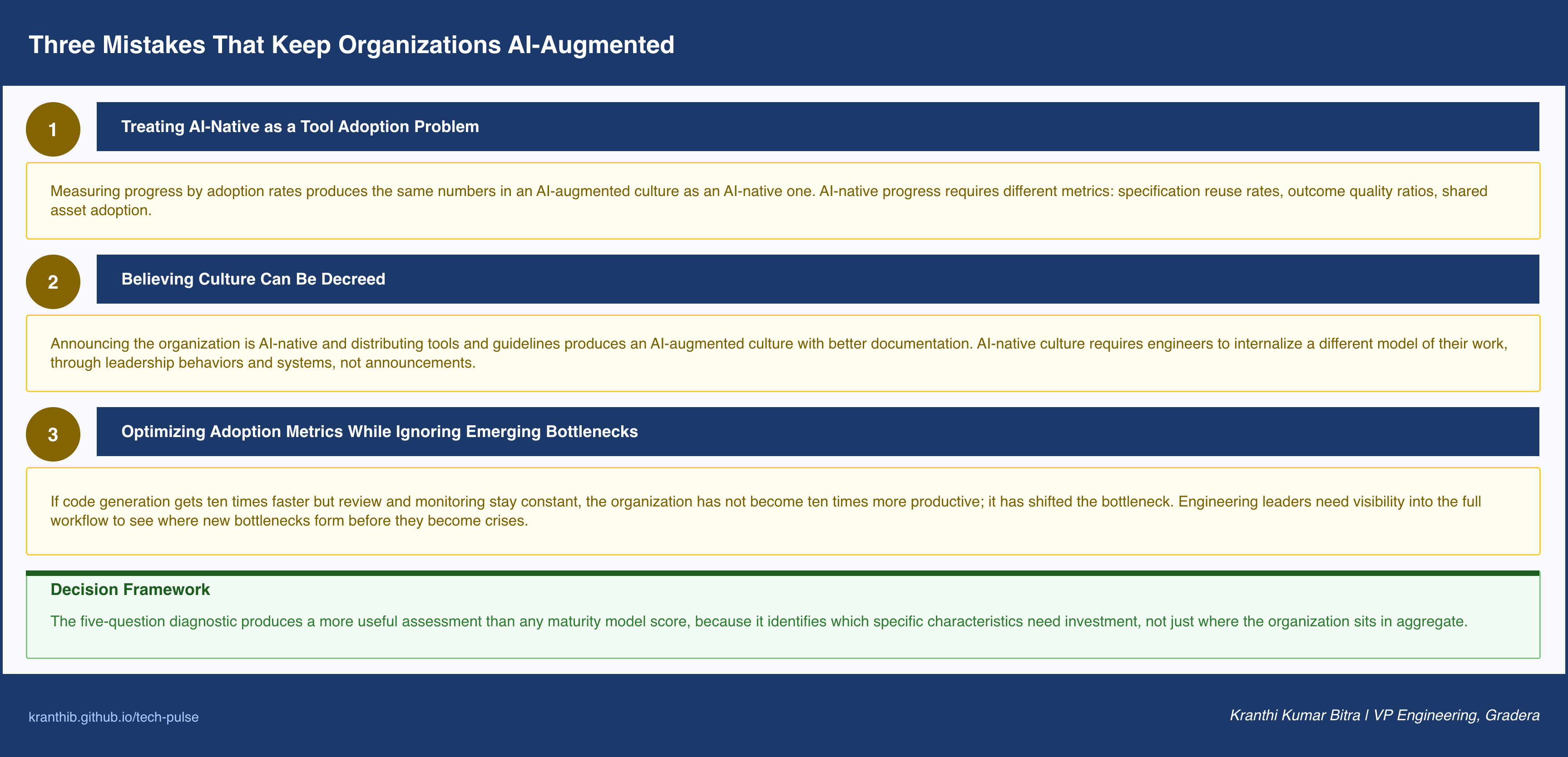
The most common mistake is treating AI-native culture as a tool adoption problem. An organization that measures AI-native progress by AI tool adoption rates, percentage of engineers using code completion tools, number of AI-assisted PRs per week, ratio of AI-generated to human-written code, has defined the destination incorrectly. High adoption rates in an AI-augmented culture look the same as high adoption rates in an AI-native culture on these metrics, while producing completely different organizational outcomes. The metric that distinguishes them is not adoption; it is whether the workflows surrounding the tools have been redesigned to capture the full value the tools enable.
A more useful set of metrics tracks the downstream quality indicators that AI-native practices are designed to improve: the share of PRs that arrive at human review already validated against their specifications, the change in production incident rate as a function of agent-generated versus human-generated code, the depth and reuse rate of the shared specification and evaluation libraries, and the time to useful contribution for engineers in their first year, as a proxy for whether the development pathway is being deliberately designed. None of these metrics appear on a standard engineering dashboard, and that absence is itself a useful organizational signal about how far the AI-native transition has progressed.
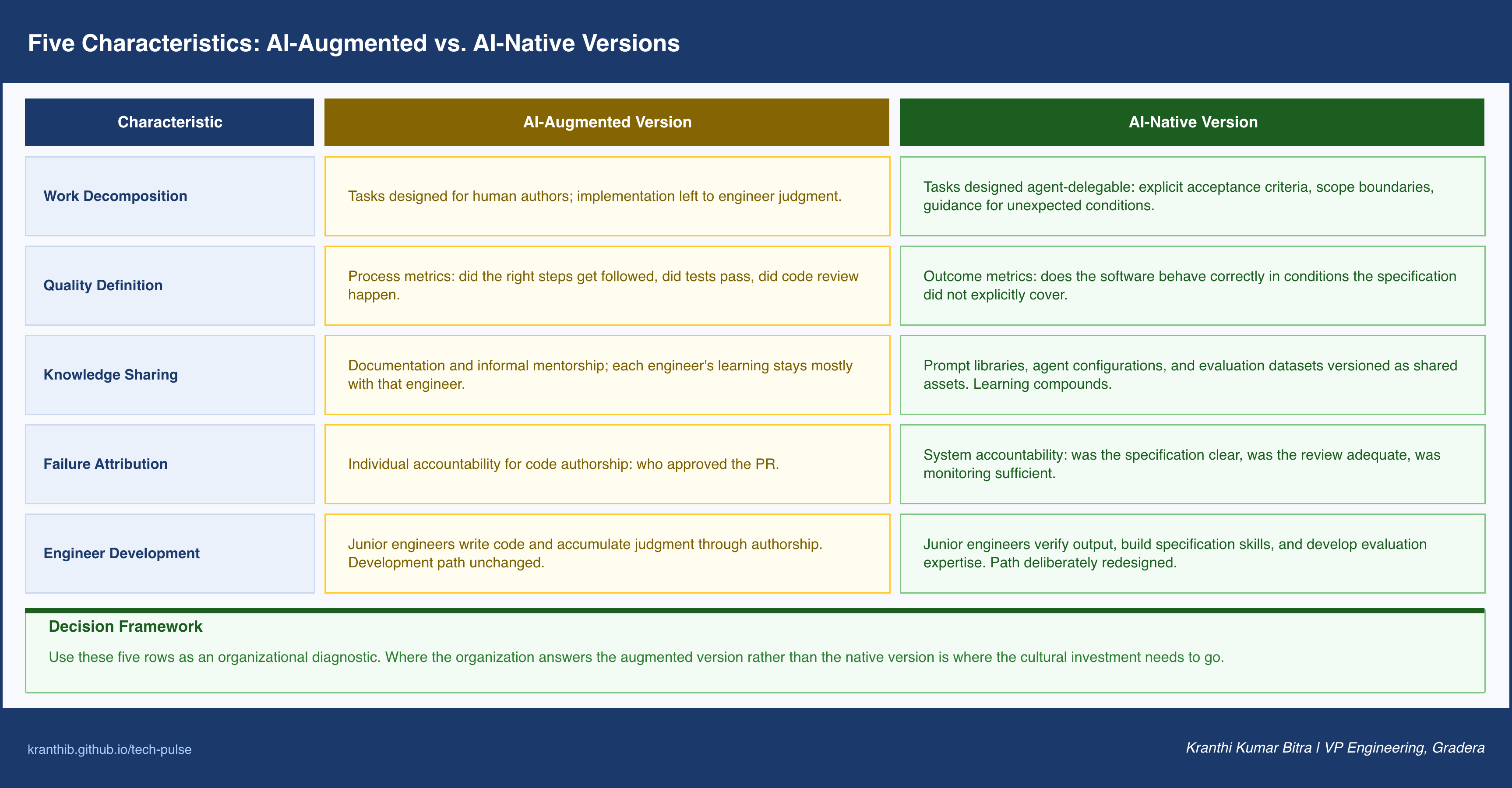
The second most common mistake is believing that AI-native culture can be decreed from the top. An engineering leader who announces that the organization is now AI-native and distributes tools and guidelines will produce an AI-augmented culture with better tools and more documentation. AI-native culture requires engineers at every level to genuinely internalize a different model of what their work is: from authorship to orchestration, from process compliance to outcome accountability, from individual knowledge to shared engineering assets. That internalization happens through leadership behaviors and organizational systems, not through announcements.
The third mistake is the most consequential: optimizing the AI adoption metrics while ignoring the emerging bottlenecks. If code generation gets ten times faster but review, deployment, and monitoring capacity stays constant, the organization has not become ten times more productive. It has produced a system where the bottleneck has moved from code generation to the stages that code generation feeds, and the pressure on those stages is now ten times higher. An AI-native culture redesigns those downstream processes alongside the upstream ones, which requires engineering leaders to have enough visibility into the full workflow to see where the new bottlenecks are forming before they become crises.
A Five-Question Culture Diagnostic
For engineering leaders trying to assess where their organization actually sits on the AI-native spectrum, rather than where they believe it sits, five questions produce an honest answer.
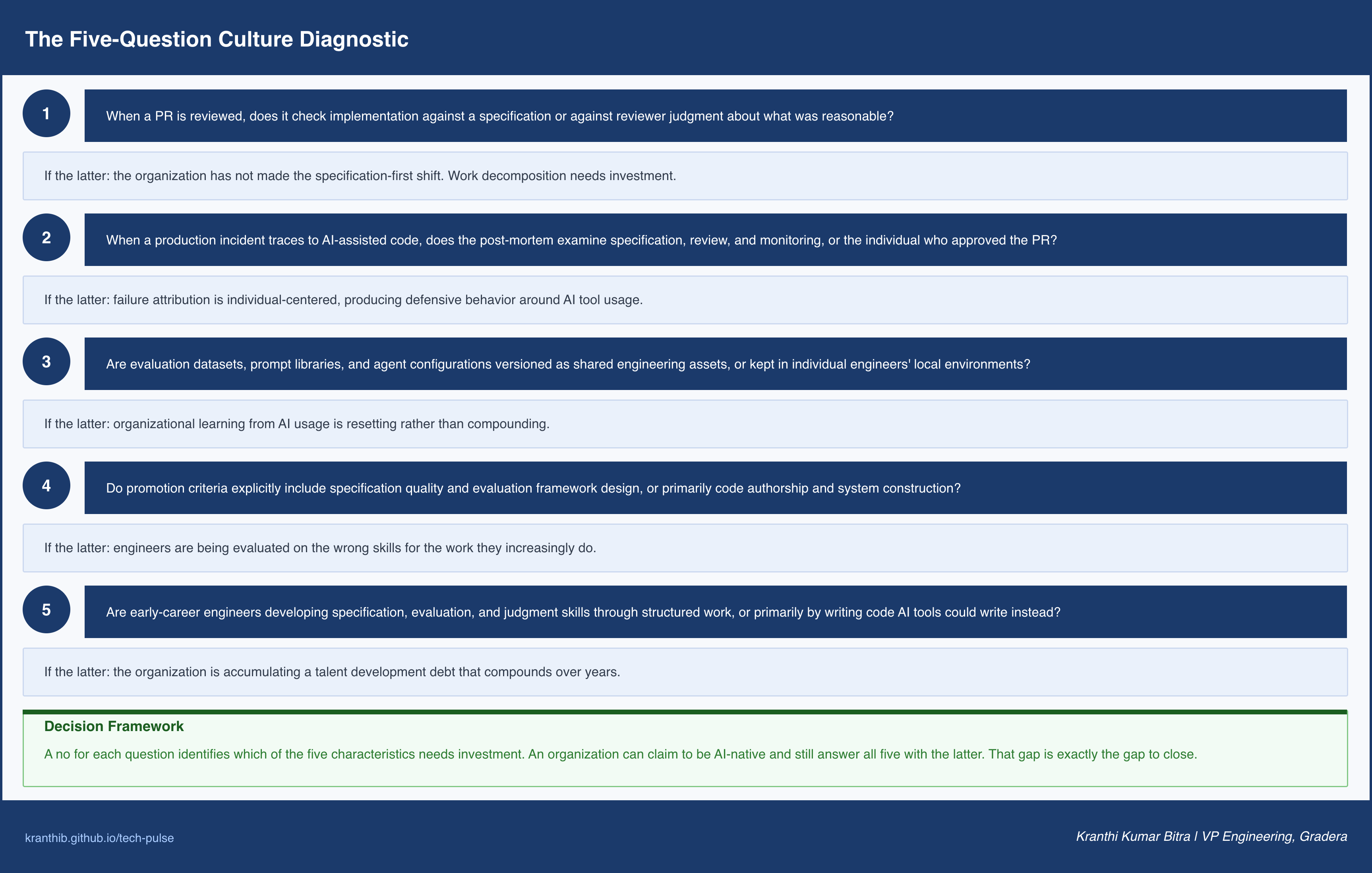
Question one: When the organization reviews a PR, does the review check implementation against a specification, or does it check implementation against the reviewer’s judgment about what was reasonable? If the answer is the latter, the organization has not yet made the shift to specification-first work decomposition that AI-native culture requires.
Question two: When a production incident is traced back to AI-assisted code, does the post-mortem examine the specification, the review process, and the monitoring, or does it examine the individual who approved the PR? If the answer is the latter, the failure attribution model is still individual-centered, and engineers are operating under the disincentive structure that produces defensive behavior around AI tool usage.
Question three: Are the organization’s evaluation datasets, prompt libraries, and agent configurations versioned and shared as engineering infrastructure, or do they live primarily in individual engineers’ local environments and personal practices? If the answer is the latter, the knowledge-sharing model has not yet shifted to capture the organizational learning from AI usage.
Question four: Do the criteria for promotion and performance assessment include explicitly the skills that orchestrator work requires, specification writing, evaluation framework design, review process architecture, or do they describe engineering excellence primarily in terms of code authorship and system construction? If the answer is the latter, engineers are being evaluated on the wrong skills for the work the organization is increasingly asking them to do.
Question five: Are junior and mid-level engineers developing specification, evaluation, and judgment skills through structured work in those areas, or are they still primarily developing by writing code that AI tools could write instead? If the answer is the latter, the organization is accumulating a talent development debt that will compound over the next several years.
An honest answer to these five questions is more useful than any benchmark comparison or maturity model score, because it identifies specifically which characteristics need investment rather than producing an aggregate number that tells the organization it is somewhere in the middle without specifying where the work is. The questions are also designed to produce answers that are independent of how the organization describes itself: an organization can claim to be AI-native and still answer most of these questions with “the latter,” and the gap between the claim and the answer is exactly the gap that needs to be closed.
Where This Is Heading
The gap between AI-augmented and AI-native engineering cultures is widening rather than narrowing, because the organizations that have made the AI-native shift are compounding the advantage of that shift while the ones that have not are compressing their teams’ time with AI tool adoption programs that do not produce the organizational improvement they expect.
The data pattern emerging across the research in this area is consistent: AI tools produce large productivity gains for skilled engineers with deep foundational knowledge, and modest or even negative productivity effects for engineers who lack that foundation, because the tools amplify existing judgment rather than substituting for missing judgment. Organizations that deploy AI tools broadly without redesigning how they develop that foundational judgment are widening the internal productivity gap rather than democratizing productivity. The AI-native shift is the organizational design response to this finding: instead of deploying tools and hoping the judgment develops, design the culture so that developing judgment is the explicit purpose of early engineering work, and the tools amplify that judgment once it exists.
The talent implications of this trajectory deserve attention from engineering leaders who are planning more than a quarter ahead. The senior engineers in any organization five to seven years from now are the junior and mid-level engineers today. If those engineers spend the next several years primarily accepting AI suggestions rather than building the system design, failure analysis, and architectural judgment that makes senior engineers valuable, the organization will have a different kind of senior engineer pipeline than it would have developed otherwise. Not worse engineers, necessarily, but engineers with different strengths and different gaps, and understanding that now is more useful than discovering it when those engineers are in positions where the gap matters.
A dimension of this challenge worth naming explicitly is the difference between the experience of learning through authorship and the experience of learning through verification and direction. The traditional engineering development path built foundational judgment through a specific mechanism: writing code, having it reviewed and critiqued, writing better code, encountering failures in production and debugging them, and gradually accumulating the pattern recognition that comes from personal experience with the consequences of specific choices. Verification and direction work develops judgment through a different mechanism: evaluating output against specifications, identifying the gaps between what was produced and what was needed, designing better specifications to prevent the same gaps, and accumulating the pattern recognition that comes from personal experience with what makes specifications fail. Both mechanisms develop genuine engineering judgment, but they develop different facets of it, and organizations that are redesigning the early engineering role need to be deliberate about which facets they are building and which they might be neglecting.
The organizations that are most deliberately building AI-native culture today share a characteristic that is easy to overlook because it sounds simple: they have a specific, shared definition of what AI-native means for their context. Not a marketing phrase or a high-level aspiration, but a set of concrete, observable practices that the organization is working toward, and a way of measuring whether it is getting there. That specificity is both the prerequisite for the cultural shift and, given the research finding that hundreds of engineering leaders produced hundreds of different definitions of AI-native, the thing most organizations are still missing.