
Autonomous Software Engineering: When the Agent Opens the PR
The distinction that matters now is not between developers who use AI and developers who do not. It is between engineering organizations that have figured out how to govern autonomous coding agents contributing to production codebases and organizations that have not. The first group is shipping faster than at any point in software history. The second group is about to discover that capability without governance is just a faster way to accumulate the kind of technical debt that takes years to unwind.
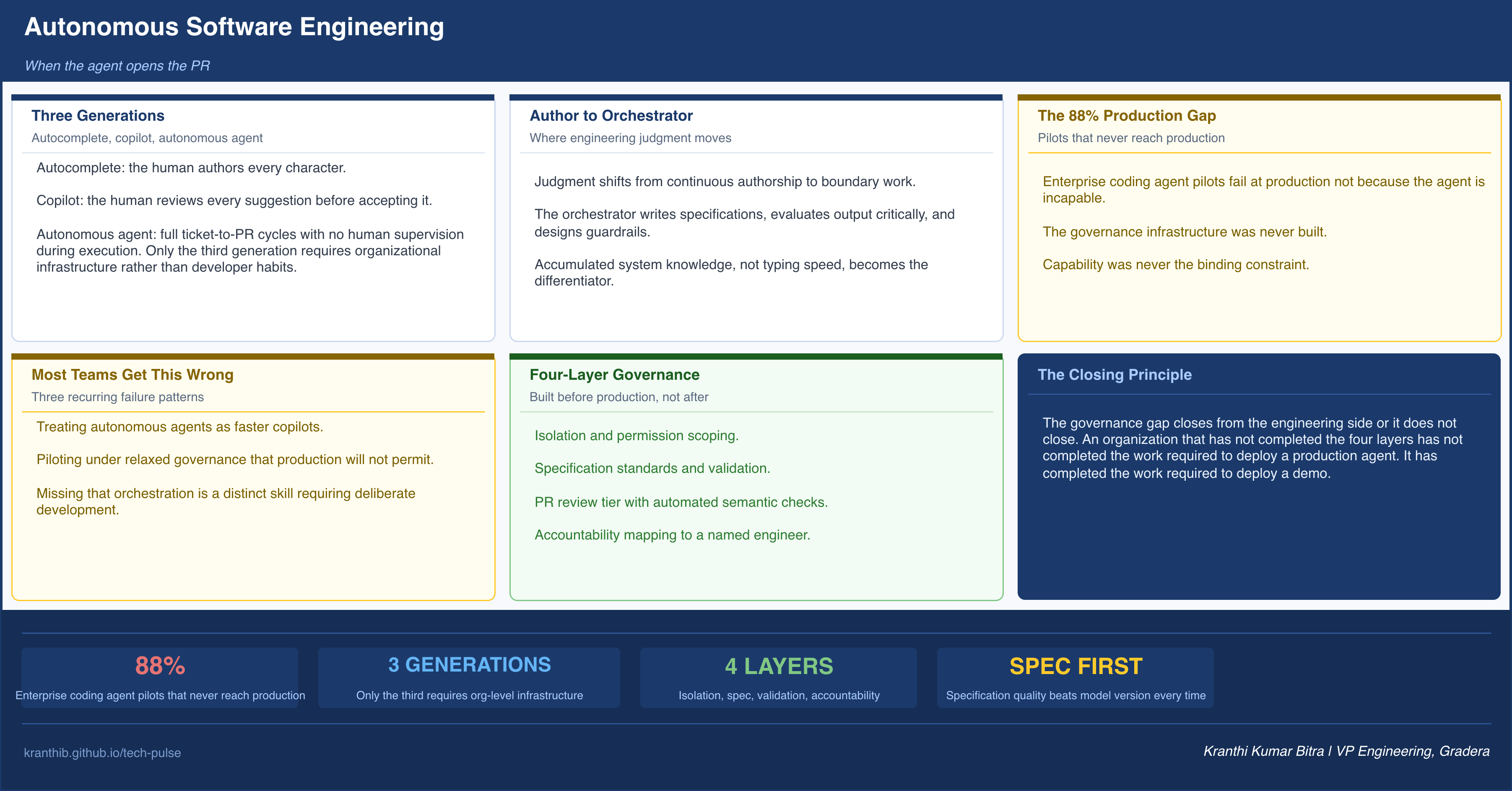
Three Generations of AI Assistance in Software Development
The history of AI assistance in software development is short enough to trace in three distinct generations, and understanding the progression clarifies why the current generation requires a fundamentally different organizational response than the previous two.
The first generation was autocomplete at the character and line level: a model that had seen enough code to predict what the next few tokens were likely to be, surfaced through an IDE plugin that made suggestions as the developer typed. The developer remained the author of every line. The AI was a statistical suggestion engine with no understanding of the broader codebase, the task being worked on, or the consequences of any particular suggestion. Governance was minimal because the human was the bottleneck: every character that landed in the codebase had passed through a human’s deliberate choice.
The second generation was function and block completion: models that could receive a typed comment describing the intent of a function and produce a plausible implementation, or that could observe the pattern of code in surrounding context and suggest the next logical block. The developer was still making the architectural decisions, writing the surrounding scaffolding, and reviewing every suggestion before accepting it. But the unit of AI contribution had grown from characters to functions, and the governance question had shifted: was the function the AI suggested actually correct, not just syntactically valid, and did the developer have enough context and time to verify that before moving on.
The third generation is the one that changes the organizational question. Autonomous coding agents now accept task descriptions at the level of tickets, bug reports, or feature specifications. They explore the repository, form a plan, write code across multiple files, run the test suite, iterate on failures, and open pull requests, end to end, with minimal human direction between task assignment and PR submission. The agent is not assisting a developer who is actively writing code. It is functioning as a developer who has been assigned a task and will work to completion.
This third generation is running in production today at engineering organizations whose code quality and productivity standards are generally trusted. The governance question has changed shape again: when a pull request was authored by an agent that nobody supervised during execution, how does the engineering organization ensure that the code is correct, secure, safe to merge, and consistent with the architectural decisions the team made? The answer is not “the same way we review human PRs,” because the volume, velocity, and nature of agent-generated code creates review dynamics that standard human review processes were not designed for.
It is worth being precise about what “minimal human direction” means in practice, because it is often misunderstood in ways that either overstate or understate the actual level of automation. A well-deployed autonomous coding agent today is not a system where an engineering manager assigns a feature and the agent ships it to production without any human involvement. It is a system where an engineer writes a specification, the agent executes it in a sandboxed environment, and the resulting PR goes through both automated validation and human review before merging. The human involvement is different in character from traditional pair programming or code authorship, but it is not absent. The judgment that matters has moved from the act of writing code to the acts of specifying work, reviewing output, and designing the guardrails that make both trustworthy.
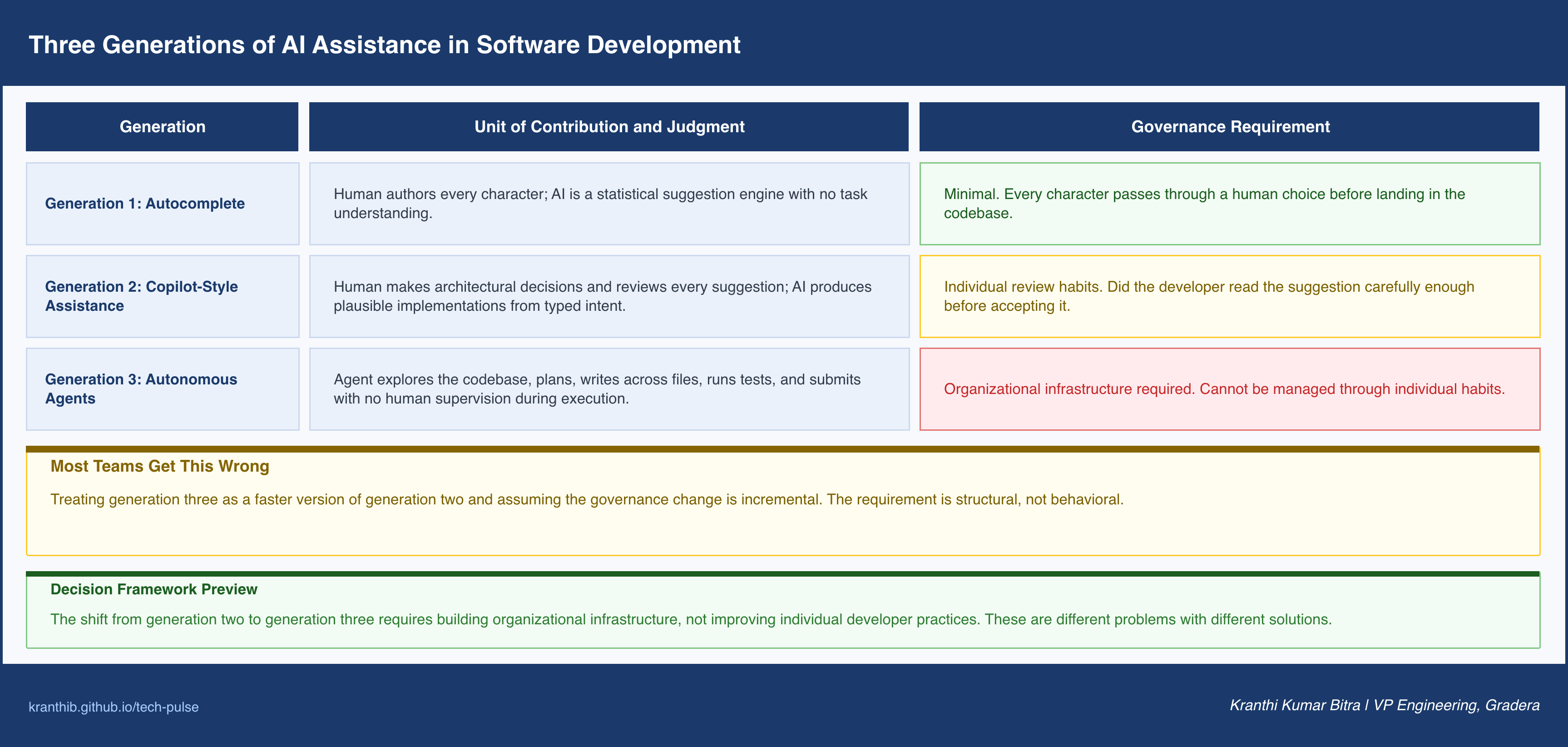
The Shift from Author to Orchestrator
The change in role that autonomous coding agents introduce is not primarily about productivity metrics, though the productivity impact is real. It is about where engineering judgment is applied.
In the first and second generations of AI assistance, engineering judgment was applied continuously throughout the act of writing code. The developer made decisions about naming, structure, error handling, and edge cases at the granularity of individual lines and functions, with the AI offering suggestions that the developer could accept, modify, or reject in real time. Engineering expertise was exercised as authorship.
In the third generation, engineering judgment is applied at the boundaries of agent tasks rather than throughout their execution. The engineer defines the task clearly enough for the agent to execute it without clarification, selects which tasks are appropriate for agent delegation, reviews the agent’s output after execution, and integrates the agent’s contribution into the broader system. Engineering expertise is exercised as direction and review rather than authorship.
This is a meaningful shift that some engineers find liberating and others find disorienting. The engineers who adapt most successfully tend to be the ones who recognize that the skills most valuable in an orchestrator role are different from the skills most valuable in an author role. An author needs to be fluent in the implementation details of the language and framework being used. An orchestrator needs to be fluent in specifying requirements precisely, evaluating output quality critically, identifying the gap between what an agent produced and what the system actually needed, and designing the guardrails and review processes that keep the aggregate output of many agents coherent over time.
One articulation of this shift describes the unit of programming moving from a function to a plain-language instruction, with the engineer’s role moving from direct author to orchestrator and reviewer of what the system produces. This framing is useful because it highlights that orchestration is a skill in its own right, not simply a reduced version of the authorship skill. A developer who is excellent at writing code is not automatically excellent at writing the task specifications that produce good agent output, or at reviewing agent-generated code with the critical eye that the absence of moment-to-moment human judgment during execution requires.
The organizations that are navigating this transition well are investing in developing the orchestrator skill alongside the agent tooling, rather than assuming that engineers who are proficient with AI assistance will naturally become proficient at autonomous agent direction. These are related but distinct capabilities, and the gap between them is where a significant share of the pilot-to-production failures in autonomous coding are currently originating.
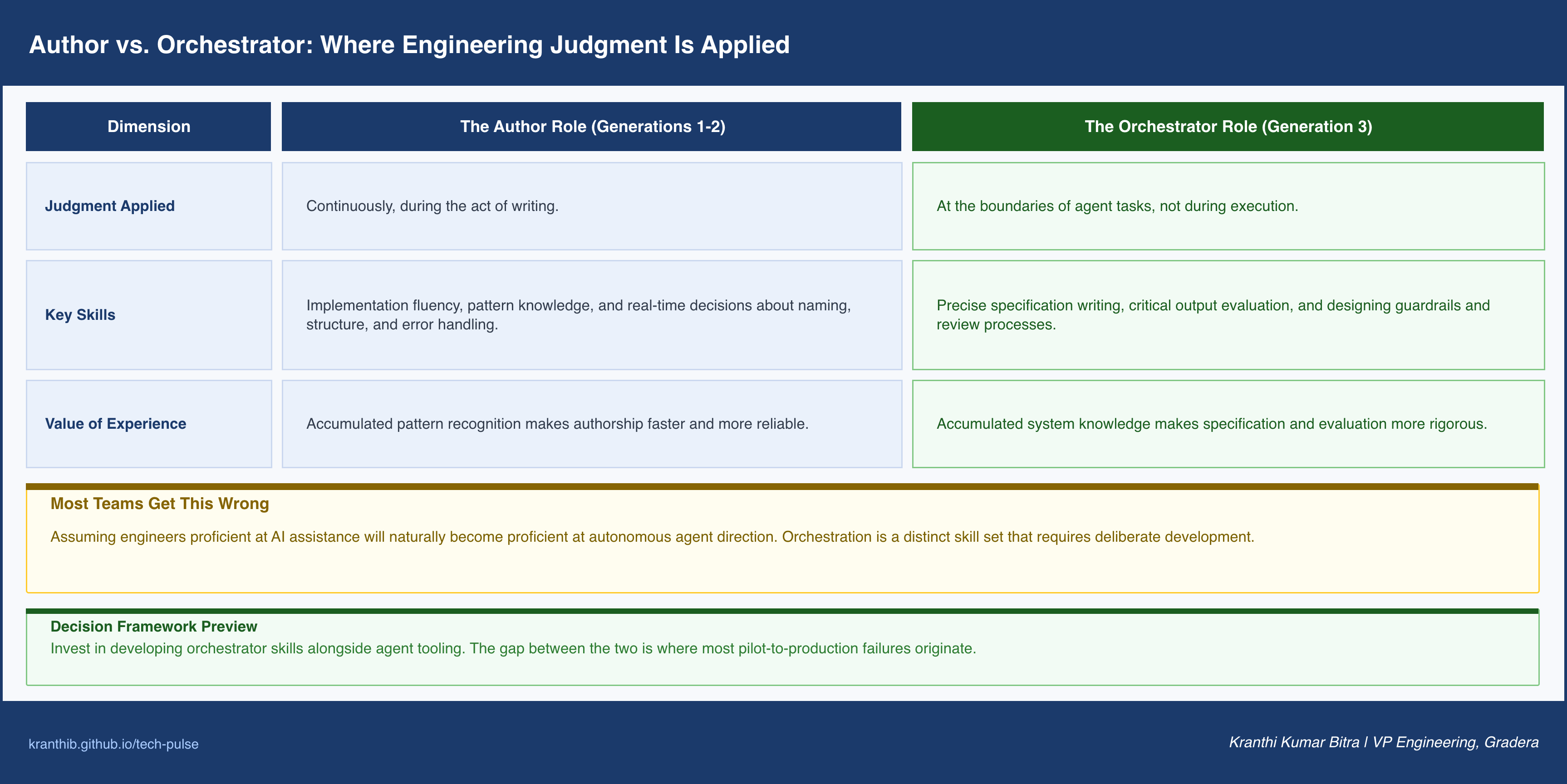
The Production Gap: Why 88% of Enterprise Agent Pilots Do Not Reach Production
The parallel to the agentic reliability gap discussed in the previous post in this series is striking but instructive. The same pattern that causes general agentic AI projects to fail at the pilot-to-production transition applies with particular force to autonomous coding agents: the capability exists, the pilot demonstrates it, and something in the surrounding organizational infrastructure prevents the capability from reaching production.
For autonomous coding agents specifically, the blocker is rarely the agent itself. By the time organizations are piloting a modern autonomous coding agent, the agent can produce code that passes tests, follows the patterns it sees in the repository, and addresses the requirements it was given. The blocker is the deployment infrastructure, governance controls, compliance requirements, and security constraints that enterprise organizations have built around their software delivery pipelines, none of which were designed with an agent contributor in mind.
Enterprise software delivery pipelines have security controls that assume the code author is a human with an authenticated identity, responsible for the changes they introduce, and subject to the employment relationship that governs behavior. An agent has none of these properties by default. It does not have an authenticated identity that can be traced to a responsible individual. It is not subject to the norms and consequences that govern human contributor behavior. And its output, while potentially indistinguishable from human-authored code in terms of syntax and test passage, may reflect quality tradeoffs or failure modes that are systematically different from what human authors would produce.
The isolation question is the most operationally immediate. An autonomous coding agent that executes in the same environment as production code, with access to credentials, configuration files, and live systems, is a security risk independent of any malicious intent. The agent may read sensitive values it encounters in the codebase to complete a task that seems to require them. It may make changes that are syntactically correct but operationally dangerous. It may introduce dependencies or modify configuration in ways that are technically within its task scope but practically outside the bounds the organization intended. The isolation infrastructure, sandboxed execution environments with carefully scoped permissions, is the control that addresses this risk, and it requires deliberate engineering investment to build correctly.
The governance question is equally fundamental. When an agent opens a PR, the standard review process asks who reviewed the code before it was submitted and what tests it passed. For human contributors, those questions have answers grounded in accountability: the author reviewed it, the test suite ran. For agent contributors, those questions need different answers: which guardrail checks ran before the PR was opened, what the agent’s task specification was and how it was validated, and who is accountable for the agent’s output at the organizational level. Building the infrastructure to answer these questions is the governance work that most pilot-stage deployments have not yet completed.
The Review Problem at Agent-Generated Scale
The most direct operational challenge autonomous coding agents introduce is a change in the economics and dynamics of code review. Human code review works reasonably well at human throughput: a developer opens a few PRs per day, and reviewers have time to understand the context, evaluate the decisions, and provide meaningful feedback. Agent contributors can open PRs at a rate that human review capacity cannot match if the organization treats agent PRs the same way it treats human PRs.
The naive response to this challenge is to reduce the review burden by skipping steps. Automated test passage becomes a proxy for correctness, and review time per PR shrinks to whatever is necessary to keep the queue moving. This approach is tempting because it maintains the illusion of a normal review process while accommodating higher volume. It is dangerous because it systematically reduces the depth of human judgment applied to each change at exactly the moment when the nature of agent-generated code makes deep review more valuable, not less.
The problem is not that agent-generated code is necessarily worse than human-generated code. In many cases it is not. The problem is that agents fail in systematically different ways than humans do. A human developer who misunderstands a requirement will produce code that reflects that misunderstanding, and a reviewer who knows the requirement will usually detect the discrepancy in review. An agent that misunderstands a requirement will produce code that correctly implements the misunderstood version, passes all tests against that misunderstood version, and will look to a reviewer who is not reading carefully like a reasonable implementation of the actual requirement. The agent’s failure mode is confident correctness on the wrong specification, which is harder to detect than human errors that tend to be more obviously inconsistent with the surrounding code.
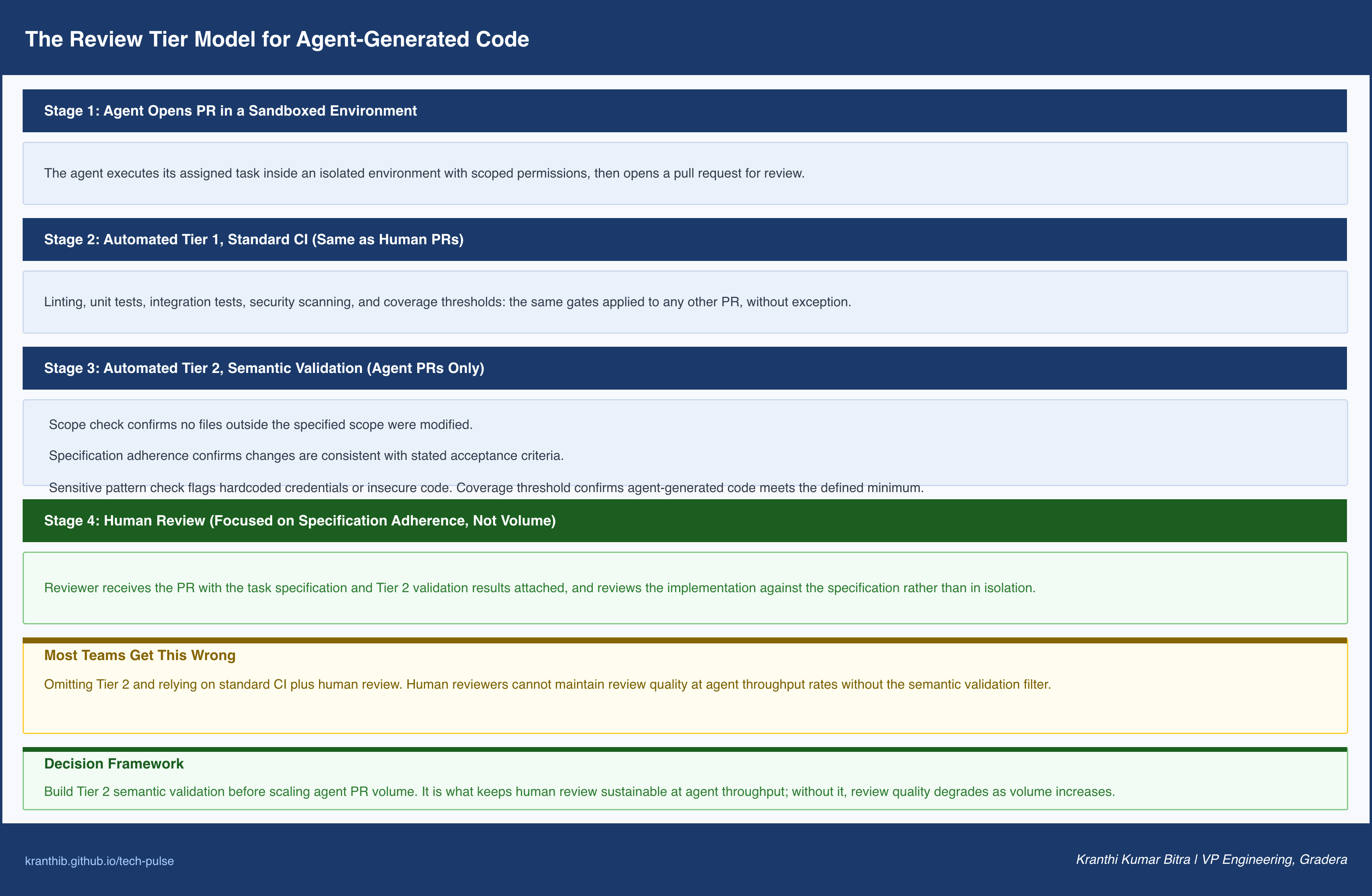
The effective response to this challenge is not to reduce review standards but to change the review process. This means several things in practice. It means writing task specifications at the level of precision that makes the agent’s interpretation verifiable rather than assumed. It means running automated semantic validation on PR contents before they reach human review, checking not just that tests pass but that the changes match the stated specification. It means flagging the PRs that touch higher-risk areas of the codebase for deeper human attention, rather than treating all agent PRs as equivalent. And it means treating the agent’s task specification as part of the PR rather than as ephemeral context that disappears when the task is assigned, so that reviewers can evaluate whether the agent did what was asked rather than whether the code seems reasonable in isolation.
The organizations handling this well have essentially built a second tier of automated review for agent-generated code, sitting between the agent’s PR submission and human review, that checks properties the standard test suite does not. This tier is not a replacement for human review; it is the filter that ensures human review is focused on the questions that require human judgment rather than being diluted by volume.
A useful reframe for reviewers of agent-generated code is to evaluate PRs as implementations of a specification rather than as expressions of an author’s intent. Human-generated code carries implicit intent that experienced reviewers learn to read through the choices the author made: this pattern was chosen for performance reasons, this abstraction was introduced for future extensibility, this edge case was handled this way because of a past incident. Agent-generated code carries no such implicit intent. It implements the specification it was given, and the reviewer’s job is to verify that the specification was correct and completely implemented, not to decode reasoning about tradeoffs the agent did not deliberate over.
A Worked Example: What Agent Governance Looks Like Inside a Sprint
Abstractions about governance frameworks are easier to agree with than to implement. Walking through a concrete sprint scenario makes the governance requirements tangible in a way that a checklist does not.
Consider an engineering team that has deployed an autonomous coding agent as a contributor to their backend services codebase. The sprint includes fifteen tickets, of which the team has decided eight are appropriate for agent delegation: well-defined bug fixes, straightforward feature additions with clear acceptance criteria, and test coverage improvements for existing functionality. The remaining seven require architectural judgment or involve systems with complex interdependencies that the team has not yet developed specification patterns for.
The first governance activity is specification writing. The engineer responsible for each delegated ticket writes a task specification rather than simply assigning the ticket to the agent. The specification defines the files in scope, the acceptance criteria the PR must satisfy, the constraints the agent must respect, and what the agent should do if it encounters something unexpected. This takes approximately twenty minutes per ticket for well-defined work, compared to the agent’s execution time of roughly forty to ninety minutes per ticket. The upfront investment in specification quality is the primary determinant of output quality.
The agent executes the eight tasks in parallel, opening eight PRs over the course of a morning. Each PR passes through the automated semantic validation tier before reaching human review. The validation checks that the changed files are within the specified scope, that no sensitive patterns are present, that test coverage on changed code meets the team’s threshold, and that the changes are consistent with the acceptance criteria stated in the specification. Three of the eight PRs pass all checks cleanly. Four pass most checks but trigger a flag on the coverage threshold, indicating that the agent’s implementation introduced code paths not covered by the tests it wrote. One PR fails the scope check because the agent, while implementing a bug fix, identified a related issue in an adjacent file and made a change to address it, a sensible decision in isolation but one that crossed the specified scope boundary.
The human review session is now structured differently than it would be for eight human-authored PRs. For the three clean PRs, the reviewer’s job is to verify that the implementation matches the specification and that no edge cases were missed, a focused task that takes fifteen to twenty minutes per PR. For the four coverage-flagged PRs, the reviewer must determine whether the uncovered code paths represent a genuine gap the agent should have addressed or whether the agent’s coverage is acceptable given the nature of the changes. For the scope-violated PR, the reviewer evaluates both the original bug fix and the adjacent change, deciding whether to approve both, revert the adjacent change, or create a separate ticket for the adjacent issue.
The total review time for eight agent-generated PRs is approximately three hours, compared to an estimated five to six hours if all eight had been written by human developers who also required review. But the more significant difference is in where the review time is spent: on specification adherence and edge case coverage rather than on basic syntax and pattern following, which the agent handles reliably. The review is more focused and, for the issues that matter, more thorough.
The scope violation, which might seem like a governance failure, is actually a governance system working as designed. The agent identified something outside its assigned scope and addressed it, which is precisely the kind of behavior the scope check is designed to catch. The decision about whether that additional change is desirable is now a deliberate human choice rather than something that slips through unnoticed.
What Most Teams Get Wrong
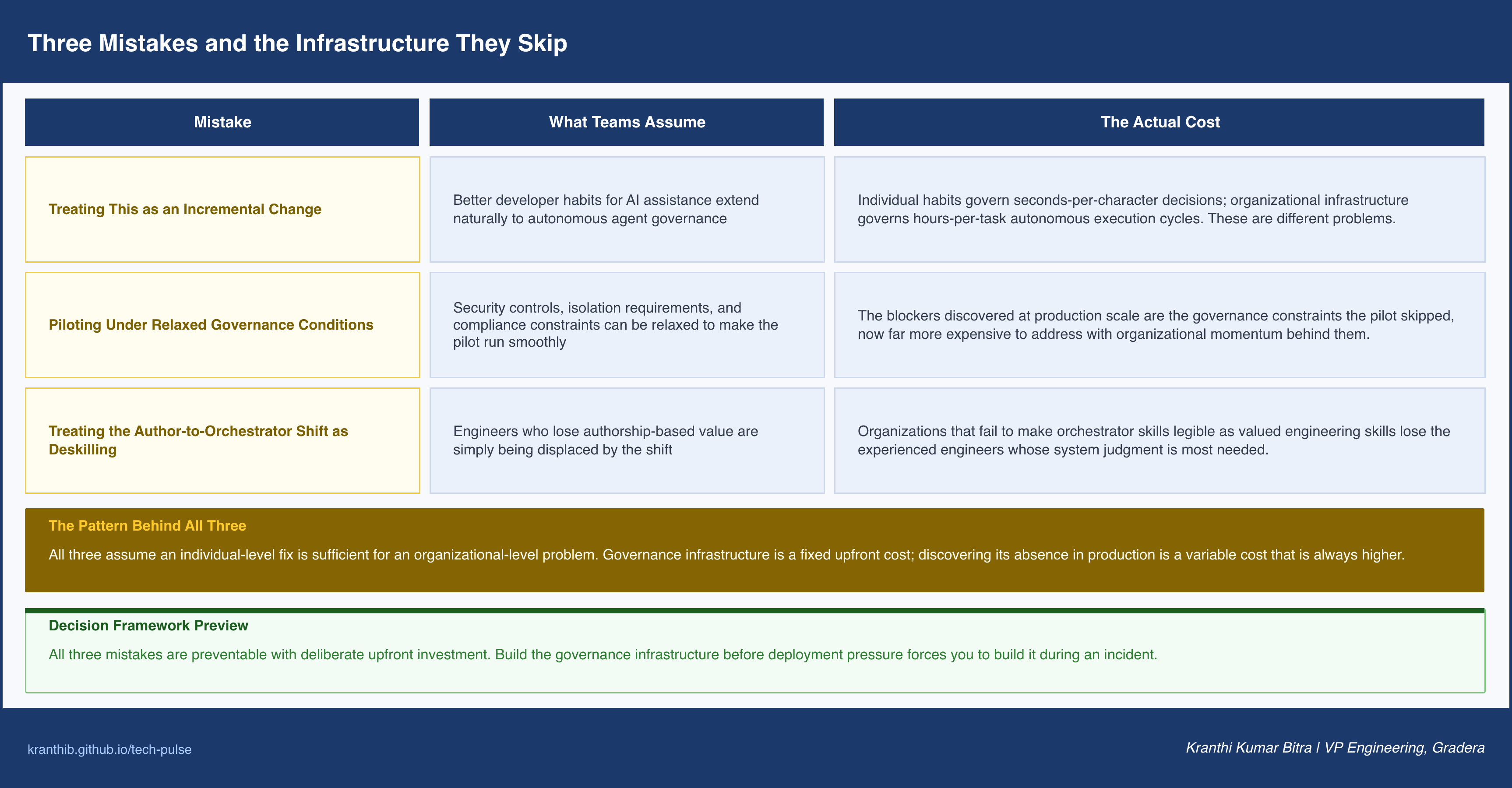
The most common mistake is treating autonomous coding agents as a faster version of existing AI code assistance and therefore assuming that the governance and process changes required are incremental rather than structural.
A developer using a code completion tool needs to be more careful about accepting suggestions without reading them. A developer who is a reviewer of agent-generated PRs needs a fundamentally different review strategy than they use for human-generated PRs. Scaling code completion tooling requires making sure developers have good habits around suggestion review. Scaling autonomous coding agents requires building organizational infrastructure, isolation environments, governance frameworks, specification standards, and review tier automation, that did not exist and cannot be improvised through better individual habits.
The second most common mistake is piloting autonomous agents in a context that does not represent the governance constraints of the actual production environment. A pilot that runs agents with broad repository access, against a codebase without the security controls that production code requires, in an environment where the organization is comfortable accepting any output that passes tests, will produce a success story that does not translate. The blockers that prevent pilot-to-production transition are almost always the governance and security controls that were relaxed to make the pilot work smoothly, and discovering those blockers after the pilot has generated organizational momentum toward deployment is significantly more expensive than identifying them upfront.
The third mistake, specific to the engineering culture dimension of this change, is treating the author-to-orchestrator shift as a deskilling event rather than a reskilling one. Engineers who see autonomous coding agents as a threat to the value of their authorship skills are responding to a real displacement in one dimension of engineering work. The organizations that navigate this transition well are the ones that make the orchestrator skills, precise specification writing, critical output evaluation, guardrail and permission system design, and systematic failure detection, legible as engineering skills worth developing and rewarding, rather than leaving engineers to discover on their own that the skills they need have changed.
A Governance Framework for Agent Contributors
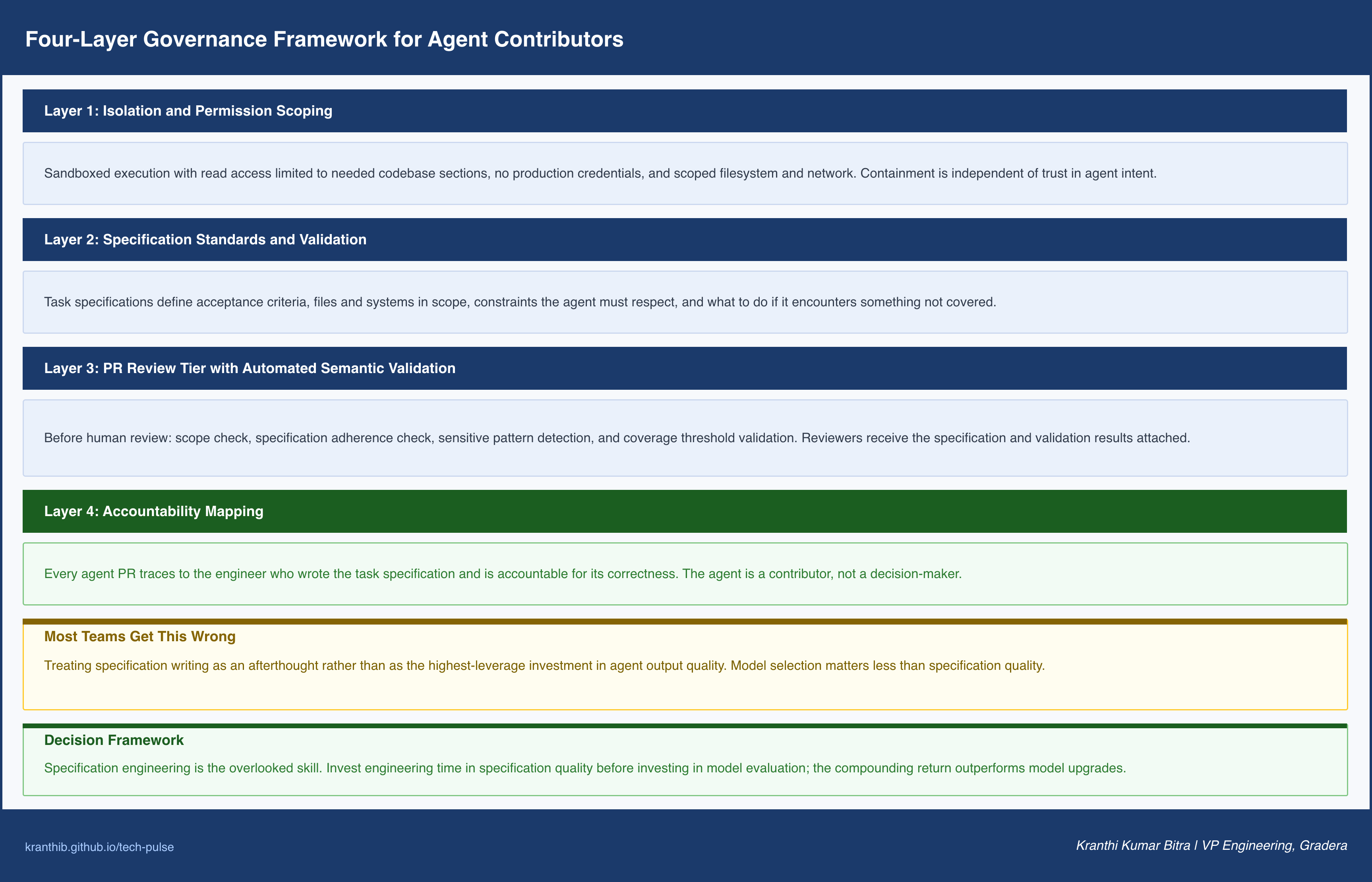
The engineering organizations that are furthest along in deploying autonomous coding agents at scale share a consistent structural approach to governance that can be described as four layers, each of which addresses a different failure mode.
Isolation and permission scoping. Every agent execution runs in a sandboxed environment with explicitly scoped permissions: read access to the parts of the codebase it needs, no access to production credentials, no access to live systems, and a filesystem and network environment that prevents the agent from reaching outside its authorized scope. The isolation is not a trust statement about the agent’s intentions; it is a containment statement about the blast radius of any agent mistake or misbehavior. An agent that cannot reach production credentials cannot leak them. An agent that cannot modify files outside its task scope cannot introduce changes to systems it was not assigned to touch.
The isolation question has a natural parallel in the broader agentic security conversation. Just as identity and permission scoping matter for agents that execute business processes, they matter for agents that contribute code. An agent writing code in a sandboxed environment with no access to production systems is in the same security posture as a contractor working with a clean laptop provided by the client: the blast radius of any mistake is bounded by the environment rather than requiring trust in the contractor’s judgment about what not to touch.
Specification standards and validation. Agent task specifications are written at a level of precision that makes the expected output verifiable before execution begins. A standard task specification includes the acceptance criteria for a successful completion, the files and systems in scope, the constraints the agent must respect, and an explicit statement of what the agent should do if it encounters a situation the specification does not cover. Organizations that have invested in specification standards find that the rigor required to write a good agent task specification is also the rigor required to define work clearly enough that any contributor, human or agent, can execute it successfully.
A useful test for specification quality is whether the specification is specific enough that two different engineers, reading it independently, would agree on what constitutes a successful completion. Specifications that fail this test will produce agent output that varies unpredictably depending on how the agent resolves the ambiguity, and the resulting review conversations are not about code quality but about what was actually required. Resolving this ambiguity in the specification rather than in the review is always cheaper.
PR review tier with automated semantic validation. Agent-generated PRs pass through an additional automated review tier before reaching human reviewers. This tier checks that the changes in the PR are consistent with the task specification, that no files outside the specified scope were modified, that no sensitive patterns such as hardcoded credentials or insecure coding practices are present, and that the test coverage on the changed code meets the threshold the organization has defined for agent-generated changes. PRs that pass this tier reach human reviewers flagged with the task specification and the tier’s validation results, so reviewers can evaluate the implementation against the specification rather than in isolation.
Accountability mapping. Every agent-generated PR is traceable to the human who assigned the task and is accountable for the specification’s correctness. The agent is a contributor, not a decision-maker, and the accountability for what the agent was asked to do lives with the engineer who defined the task. This accountability mapping is what makes the organizational and legal questions around agent-generated code tractable: the author of the specification is the responsible party, and the review process verifies that the agent’s implementation matches the specification the responsible party approved.
Where This Is Heading
The trajectory here is toward engineering organizations that look less like traditional software teams and more like hybrid teams where human engineers and autonomous agents are working on different parts of the same codebase simultaneously, with humans setting direction, defining specifications, and reviewing output while agents handle the execution of well-defined tasks.
The economics of this trajectory are compelling enough that the direction of travel is not in serious question. The question is which organizations will navigate the transition in a way that produces durable quality improvements alongside the productivity gains, and which will discover that the short-term speed of autonomous agent deployment outpaced the governance infrastructure needed to sustain it. The organizations that figure this out early will have an engineering velocity advantage that compounds over time, because each iteration of agent governance infrastructure makes the next expansion of agent scope cheaper and faster to implement safely. The organizations that deploy first and govern later will have a technical debt overhang that has to be paid down before they can expand scope further, which is the same dynamic that has historically separated the organizations that survived rapid growth from those that did not.
A consistent finding from the organizations furthest along is that the bottleneck is not the agent capability but the quality of the specification. Agents that receive precise, well-defined task specifications consistently outperform agents that receive loose, ambiguous ones, and the gap in output quality between these two conditions is larger than the gap between different agent models receiving the same specification. The implication is that investing engineering time in specification quality produces more improvement in agent output than investing the same time in model evaluation and selection. Specification engineering is the overlooked skill in the autonomous coding agent conversation, and the organizations that recognize it as a core engineering discipline will have a durable advantage over those that treat it as a prompt-writing afterthought.
There is a useful parallel here to the shift from manual testing to test-driven development in an earlier generation of software engineering practice. Test-driven development required engineers to invest time upfront in specifying the expected behavior of code before writing the implementation, which slowed initial development velocity but produced more reliable, better-defined code over the medium term. Specification-driven agent task definition requires a similar upfront investment in defining expected behavior before delegating implementation to an agent, and produces the same medium-term benefit: better-defined work that is easier to evaluate, verify, and maintain. The organizations that built test discipline into their engineering culture early had a durable quality advantage. The ones that build specification discipline now will have the same kind of advantage in the autonomous agent era.
The longer-term implication for engineering careers is worth naming directly. The engineers whose value is primarily in their speed at writing code face the most exposure from this transition. The engineers whose value is in their judgment about what to build, how to evaluate whether it was built correctly, and how to design systems that remain maintainable as they evolve, face the least exposure, because those are precisely the skills the orchestrator role requires more of, not less. The transition does not make experienced engineers less valuable. It changes the work in which their experience is most directly applied, and the organizations that communicate this change clearly will retain the engineers whose judgment is most needed rather than losing them to uncertainty about what their role is becoming.